Hole 18 at Cog Hill Golf & CC (Dubsdread)
- Par
- 4
- Yardage
- 494 yds
- Stroke index
- 8
- Hazards
- 4 bunkers · Water
Aerial source not provided
Green size: 39 yds deep × 19 yds wide
Scorecard yardage is for Championship tees. The aerial shows its labeled reference position; distance rings measure to the green.
Championship tees · Par 4 · 494 yards
The plan for No. 18
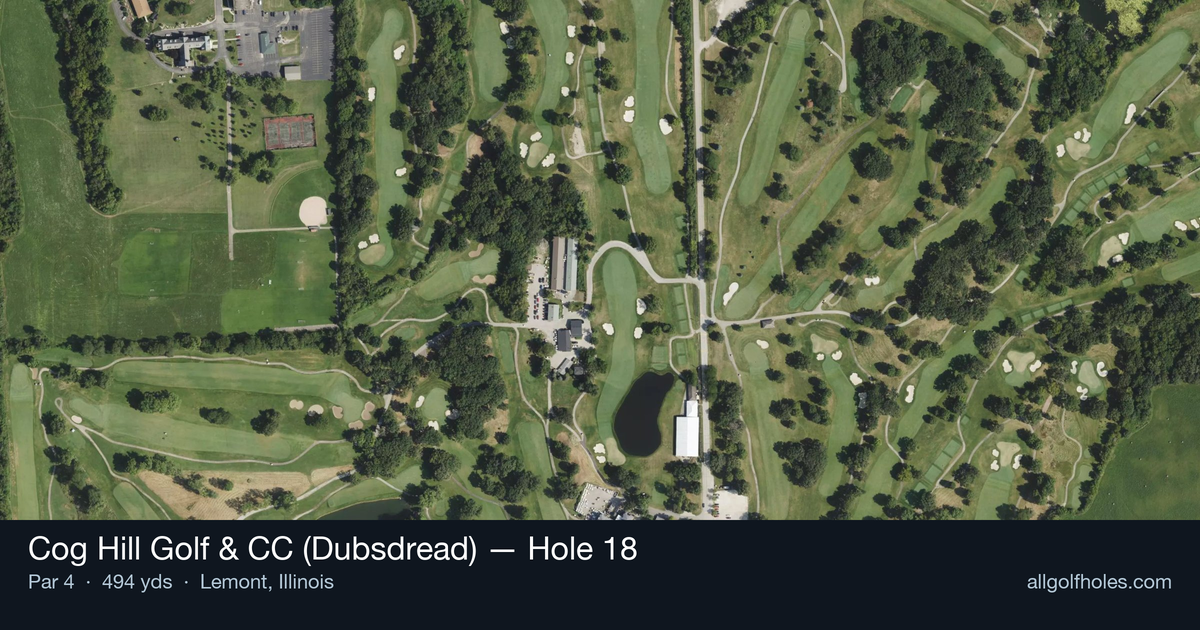
The 18th hole at Cog Hill Golf & CC (Dubsdread) stands as the course's signature finishing challenge and statistically the most difficult hole for PGA Tour professionals. This demanding 494-yard par 4 epitomizes why Dubsdread earned its fearsome reputation as one of America's toughest public courses. The straight layout may appear deceptively simple, but the combination of championship length and a small, unforgiving green complex creates a stern test of precision and nerve. Players must navigate the pressure-packed closing hole knowing that even tour professionals consistently struggle to make par here. The compact green demands pinpoint accuracy on the approach shot, leaving little margin for error. This iconic finishing hole perfectly captures the relentless challenge that made Dubsdread a beloved PGA Tour venue and Joe Jemsek's crowning achievement in public golf.
Off the tee
Your tee shot strategy centers on maximizing distance while maintaining accuracy down the center line. With 494 yards to cover, most players will need every yard they can safely manage off the tee. Target the center of the fairway, as the straight layout rewards aggressive but controlled driving. Consider using your driver unless conditions strongly favor a more conservative approach. The key is finding the optimal balance between distance and position - you'll need to be well inside the 200-yard mark for your approach to have any realistic chance at the small green.
Approach & recovery
The approach shot to this small green demands precision over power. Depending on your tee shot distance, you'll likely face a mid-iron to long-iron into a compact target. The small green size leaves little margin for error, making club selection and target line crucial. Aim for the center of the green regardless of pin position - the risk of missing this small target far outweighs any advantage gained from attacking specific pin locations. Focus on a smooth, controlled swing that prioritizes accuracy over distance, as even tour professionals struggle to hit this green in regulation consistently.
On the green
Once on the putting surface, treat every birdie opportunity as a bonus. The small green typically features subtle breaks that can be deceptive under pressure. Read putts carefully and err on the side of leaving approach putts short rather than racing them past the hole. Par is an excellent score here, so don't let the pressure of the finishing hole lead to aggressive putting that could result in three-putts. ## RISK VS REWARD This hole offers limited risk/reward opportunities, instead demanding solid execution on two difficult shots. The primary reward comes from successfully navigating the length challenge - players who can reach the green in regulation give themselves legitimate birdie chances. However, the small target and championship-level difficulty mean that conservative play often yields better results than aggressive tactics. ## DIFFERENT SKILL LEVELS **High-Handicap Players:** Focus on advancing the ball as far as possible with your tee shot, then play a conservative approach that prioritizes getting on or near the green rather than attacking pins. Consider laying up to your most comfortable wedge distance if the approach shot exceeds your comfort zone with longer irons. **Low-Handicap Players:** This hole rewards your ability to execute under pressure. Use the full length of your driving capability, then trust your iron play to find the small green. The championship pedigree of this hole means that par is always a good score, so avoid unnecessary risks that could lead to bogey or worse. The 18th at Dubsdread stands as a fitting finale to this legendary course, demanding the complete range of golf skills while testing your mental fortitude when the round is on the line.
Watch for
- Water hazard influence the hole; use mapped edges for the selected tee.
- 4 mapped bunkers guard landing zones and/or the green.
- Tree-lined areas (16 mapped woodland zones) punish offline tee shots.
Hole 18 Green Complex
Mapped green boundary
Green size: 3,897 sq ft
How did Hole 18 play?
How did this hole play today?
Frequently asked questions
Yardage reference: Championship tees · 494 yards.
What's the best strategy off the tee?
↓
For this 494-yard par 4, most players will hit driver to set up a comfortable approach.
How difficult is hole 18?
↓
This hole is one of the tougher holes on the course for most golfers. Key challenges include: long par 4, water in play, heavily bunkered, small green.
How big is the green on hole 18?
↓
The green is small and requires precision. The green is deeper than wide, so club selection is crucial. Expect challenging pin positions with limited room for error.
What's a good score on hole 18?
↓
This hole is one of the tougher holes where par feels like birdie. A challenging par 4. Accept that bogey happens and avoid big numbers.