Hole 13 at Forest Dunes Golf Club
- Par
- 4
- Yardage
- 373 yds
- Stroke index
- 12
- Hazards
- 11 bunkers · Water
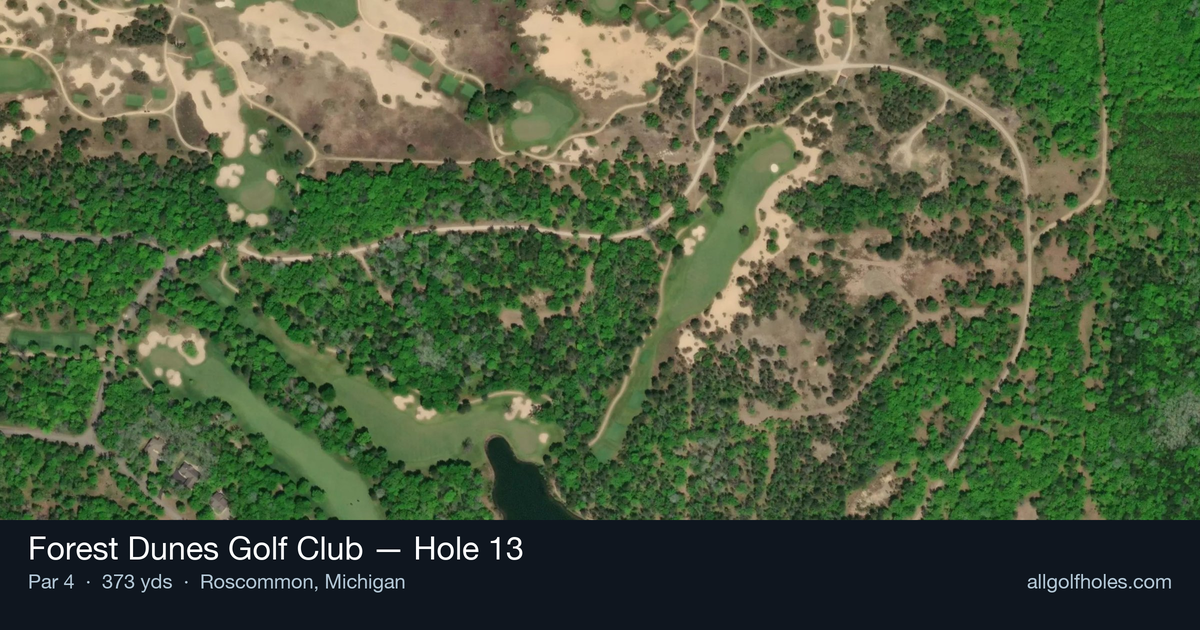
Aerial source not provided
Green size: 26 yds deep × 27 yds wide
Scorecard yardage is for Championship tees. The aerial shows its labeled reference position; distance rings measure to the green.
Championship tees · Par 4 · 373 yards
The plan for No. 13
Known as "Waterloo," Forest Dunes Golf Club hole 13 stands as one of the most celebrated par 4s in American golf, earning recognition as one of the best golf holes in the country. This 373-yard masterpiece showcases Robert Trent Jones' brilliant design philosophy, transitioning from the tree-lined "forest nine" into the open, windswept terrain of Michigan's pristine sand dunes. The straight layout may appear deceptively simple, but the compact green complex demands precise approach shots, particularly when Michigan winds swirl across the dunes. Strategic bunker placement and the hole's position within the dramatic landscape shift create a memorable test that rewards both power and finesse. Waterloo epitomizes why Forest Dunes remains a pilgrimage destination for serious golfers.
Off the tee
Your tee shot strategy should prioritize finding the optimal angle for your approach rather than maximum distance. A well-placed drive in the center of the fairway, even if it's not your longest club, sets up the best opportunity to attack the small green. The target line should favor the side that gives you the most comfortable approach angle based on pin position. Avoid the temptation to bomb driver if conditions or your accuracy suggest a more conservative club selection - the hole's length at 373 yards allows for a shorter tee shot while still leaving a manageable approach.
Approach & recovery
The approach shot to this small green is where "Waterloo" earns its fearsome reputation. Club selection becomes critical, as the compact green offers little margin for error in distance control. Focus on hitting the center of the green regardless of pin position, as the small target makes precision more important than aggressive pin-hunting. A mid-iron to long-iron approach, depending on your tee shot placement and conditions, should be struck with confidence and commitment. The key is avoiding short-sided positions that make up-and-down extremely difficult.
On the green
The small green at the 13th demands exceptional putting strategy and green-reading skills. Every putt becomes crucial given the difficulty of reaching this surface in regulation. Focus on lag putting to ensure two-putts, as the compact surface can create tricky slopes and breaks that aren't immediately apparent. When the pin is tucked in challenging positions, aim for the fat part of the green and accept longer putts rather than risk leaving yourself in impossible positions. ## RISK VS REWARD "Waterloo" presents a unique risk/reward scenario where the greatest danger lies in being overly aggressive. The hole's reputation suggests that conservative, strategic play yields better scores than attempting to overpower the design. The reward for precise execution is a legitimate birdie opportunity, but the risk of trying to force the issue can quickly lead to bogey or worse. Smart golfers recognize that par represents a victory on this celebrated hole. ## DIFFERENT SKILL LEVELS **High-handicap players** should embrace a conservative approach, potentially laying up to their most comfortable wedge distance and focusing on avoiding big numbers. Use whatever club gives you the most confidence off the tee, even if it means a longer approach shot. The priority is keeping the ball in play and giving yourself chances to make pars. **Low-handicap players** can be more aggressive with their tee shots to set up shorter approach shots, but must resist the urge to attack every pin position. The small green rewards precision over power, so even skilled players should respect the hole's design and play to the center of the green when pins are tucked in challenging spots. The 13th hole at Forest Dunes has earned its place among America's greatest golf holes through strategic complexity disguised as simplicity. Respect "Waterloo's" reputation, play within your abilities, and you'll understand why this Robert Trent Jones creation continues to challenge and inspire golfers of all skill levels.
Watch for
- Course conditioning and mapped hazards may affect line selection; confirm from the aerial.
Hole 13 Green Complex
Mapped green boundary
Green size: 3,928 sq ft
How did Hole 13 play?
How did this hole play today?
Frequently asked questions
Yardage reference: Championship tees · 373 yards.
What's the best strategy off the tee?
↓
For this 373-yard par 4, most players will hit 3-wood or driver to set up a comfortable approach.
How difficult is hole 13?
↓
This hole is one of the tougher holes on the course for most golfers. Key challenges include: water in play, heavily bunkered, small green.
What hazards should I watch out for on hole 13?
↓
Key hazards include: fairway bunkers at 2318549.7-2318691.5 yards; water at 2318650.6 yards. Plan your shots to avoid these trouble spots.
How big is the green on hole 13?
↓
The green is small and requires precision. Expect challenging pin positions with limited room for error.
Which side of the fairway is safer on hole 13?
↓
Aim for the left side of the fairway when possible. Missing right (water) brings more trouble into play.
What's a good score on hole 13?
↓
This hole is a medium-length test where par is a solid result. A straightforward par 4 where course management pays off.