Hole 14 at Forest Dunes Golf Club
- Par
- 4
- Yardage
- 464 yds
- Stroke index
- 2
- Hazards
- 5 bunkers · Water
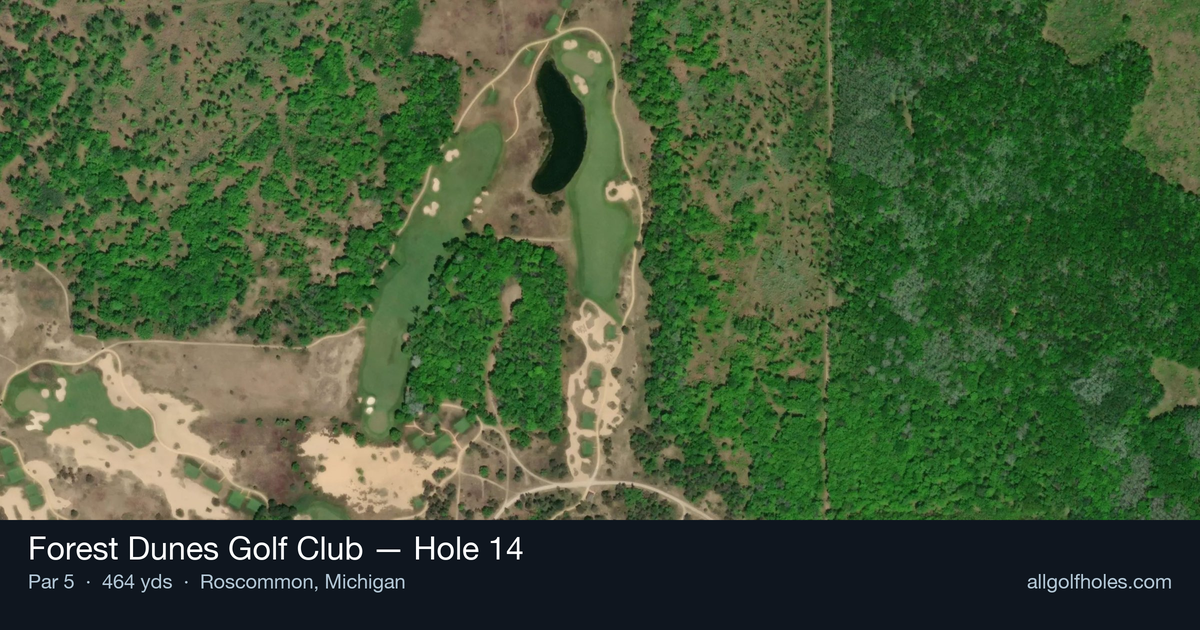
Aerial source not provided
Green size: 34 yds deep × 44 yds wide
Scorecard yardage is for Championship tees. The aerial shows its labeled reference position; distance rings measure to the green.
Championship tees · Par 4 · 464 yards
The plan for No. 14
Forest Dunes Golf Club hole 14 presents a deceptively challenging par 5 at 464 yards that demands precision over power. This straight hole features the signature Redan green complex, where the putting surface slopes dramatically from back to front, creating one of golf's most strategic approach shots. The tee shot plays to a generous fairway, but the real challenge emerges on the approach, where players must navigate to the back portion of the small, tilted green to avoid watching their ball roll off the front edge. The short grass left of the green adds another layer of difficulty, punishing slightly missed approaches. As the second-hardest hole on the course, this par 5 rewards course management and precise iron play over aggressive tactics.
Off the tee
Your tee shot strategy should focus on finding the optimal position for your second shot rather than simply bombing it as far as possible. With a straight layout, the fairway offers a clear target line down the middle. Driver is likely the right choice for most players, as you'll want maximum distance to set up a realistic chance at reaching in two or leave yourself a comfortable wedge for your third. The key is avoiding any trouble that might lurk in the rough areas, as even minor misses can complicate your approach to that small green. Aim for the center-right portion of the fairway to give yourself the best angle and lie for your crucial second shot.
Approach & recovery
This is where the hole's true character reveals itself. If you've hit a strong drive, you'll face the classic par-5 decision: go for it in two or lay up for a wedge. The small green size suggests that going for it requires exceptional accuracy - a slight miss could leave you in a difficult position around the green. For those laying up, position your second shot in the optimal wedge range, typically between 80-120 yards from the pin. This gives you the best chance to stick your approach shot close on that small target. The straight layout means you won't have to worry about doglegs affecting your angle, but club selection becomes critical given the green's size.
On the green
The small green at the 14th demands respect with your putter. Every approach shot needs to be precise, as there's little margin for error. Focus on getting your ball below the hole when possible, as uphill putts on a small green are generally more manageable than downhill sliders. Pay attention to any subtle breaks and remember that on smaller greens, even slight slopes can have a significant impact on ball roll. Take extra time reading your putts, especially from longer distances where the break will be more pronounced. ## RISK VS REWARD The 14th offers a compelling risk-reward scenario. Going for the green in two can yield eagle opportunities, but the small target makes this a high-risk proposition. The reward is significant - eagles and birdies are possible with aggressive play. However, the risk of missing that small green and facing a difficult up-and-down is equally real. The safer play of laying up typically leaves you with a scoring opportunity via a well-executed wedge shot, making birdie very achievable while minimizing the chance of a big number. ## DIFFERENT SKILL LEVELS **Low-Handicap Players:** Should seriously consider going for the green in two if they've hit a quality drive. Your ball-striking skills give you the best chance to hit and hold that small green. Focus on committing fully to your decision - half-hearted swings lead to poor contact and missed opportunities. **High-Handicap Players:** The smart play is almost always to lay up and give yourself a comfortable wedge shot. Your third shot accuracy with shorter clubs will be much better than trying to hit a long iron or fairway wood precisely onto a small target. Play for birdie with three well-executed shots rather than risking a big number by being overly aggressive. **Mid-Handicap Players:** Your decision should be based on lie, distance remaining, and current round momentum. If you're striking the ball well and have a good lie with reasonable distance to the green, consider going for it. Otherwise, the percentage play is laying up to your favorite wedge distance. Remember, this hole's #2 handicap ranking means even good golfers struggle here. Smart course management and accepting par when the hole doesn't give you clear birdie opportunities will serve you well in your overall score.
Watch for
- Course conditioning and mapped hazards may affect line selection; confirm from the aerial.
Hole 14 Green Complex
Mapped green boundary
Green size: 3,712 sq ft
How did Hole 14 play?
How did this hole play today?
Frequently asked questions
Yardage reference: Championship tees · 464 yards.
How difficult is hole 14?
↓
This hole is one of the tougher holes on the course for most golfers. Key challenges include: water in play, heavily bunkered, small green.
What hazards should I watch out for on hole 14?
↓
Key hazards include: water at 2319017.5 yards. Plan your shots to avoid these trouble spots.
How big is the green on hole 14?
↓
The green is small and requires precision. The green is wider than it is deep, rewarding shots that find the correct tier. Expect challenging pin positions with limited room for error.