Hole 11 at Forest Dunes Golf Club
- Par
- 3
- Yardage
- 192 yds
- Stroke index
- 18
- Hazards
- 1 bunker · Water
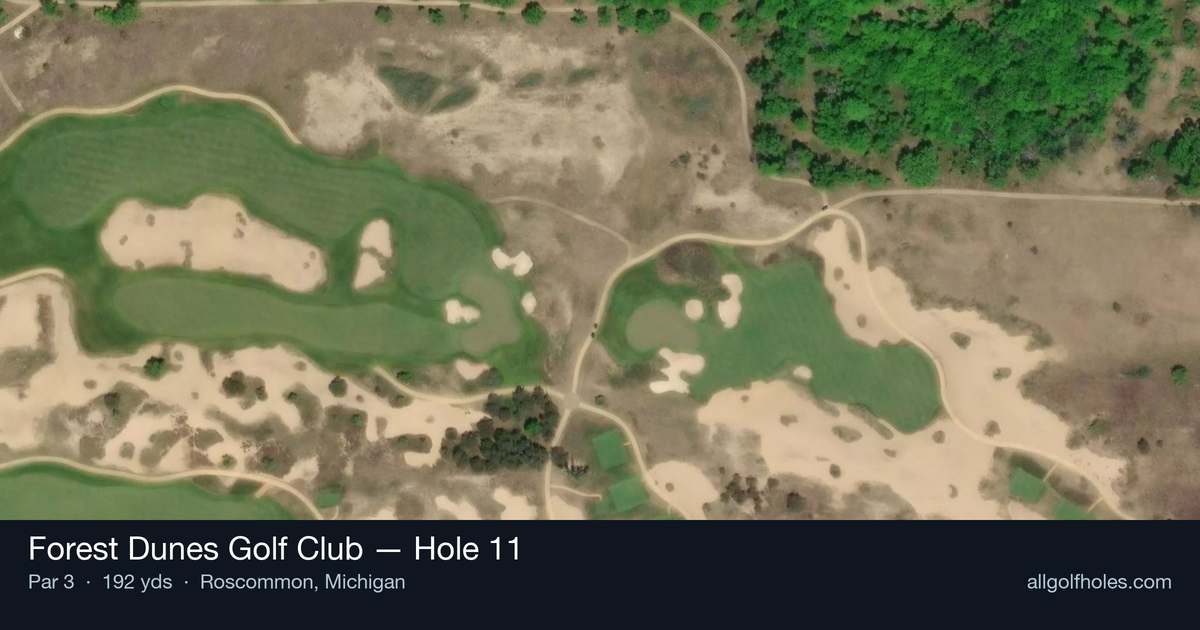
Aerial source not provided
Green size: 33 yds deep × 47 yds wide
Scorecard yardage is for Championship tees. The aerial shows its labeled reference position; distance rings measure to the green.
Championship tees · Par 3 · 192 yards
The plan for No. 11
The 11th hole at Forest Dunes Golf Club presents a deceptively straightforward par 3 that embodies the course's transition from the wooded front nine to the dramatic dune landscape. At 192 yards, this tee shot demands precision over power, with the small green requiring golfers to commit fully to their club selection. The hole's character reflects Tom Weiskopf's masterful design philosophy, where simplicity masks subtle complexity. Without major hazards to intimidate, the challenge lies in the green's compact target and the need for accurate distance control in Michigan's often-changing wind conditions. As the easiest handicap hole on the course, it offers a brief respite while still demanding respect, making it a perfect example of how strategic golf architecture can create memorable moments through understated elegance.
Off the tee
Club selection is paramount on this hole, with most players requiring anything from a mid-iron to hybrid depending on conditions and pin position. Take one extra club and swing smoothly rather than forcing a shorter iron - the small green demands precision, and an aggressive swing often leads to directional mistakes. Aim for the center of the green regardless of pin position, as the compact putting surface makes getting close from anywhere on the green more valuable than attacking tight pins. Pay special attention to wind direction, as the open back nine at Forest Dunes can create swirling conditions that significantly affect ball flight.
Approach & recovery
Since this is a par 3, your tee shot IS your approach shot. Focus on a smooth, controlled swing that prioritizes accuracy over distance. The small green size means even slight misses can leave challenging recovery shots, so resist the temptation to attack sucker pins. Choose a target line through the center of the green and commit to it fully. If the pin is tucked in a corner, still aim for the fat part of the green - two-putting from 30 feet is far preferable to chipping from off the green.
On the green
With a small green, most putts will be relatively short, but don't underestimate the subtleties. Forest Dunes' back nine putting surfaces can be influenced by the surrounding sand dunes, potentially creating more break than initially apparent. Take time to read the green from multiple angles, as the compact size can create optical illusions about slope direction. Focus on speed control above all else - getting your first putt to the hole gives you the best chance at birdie while ensuring a comfortable par putt if you miss. ## RISK VS REWARD This hole offers a clear risk/reward proposition: attack the pin for birdie chances or play conservatively for certain pars. The reward side involves aggressive pin-seeking, especially when the flag is accessible. However, the risk of missing the small green entirely often outweighs the potential gain of getting close to difficult pins. The smart play is conservative - aim for the green's center, take your birdie chances when they come naturally, and walk away with par when they don't. ## DIFFERENT SKILL LEVELS **High-handicap players** should treat this as a bogey hole with par as a bonus. Take plenty of club, aim for the biggest part of the green, and don't worry about pin positions. Focus on making solid contact and getting the ball airborne - even a shot that finds the green's edge puts you in position for par. **Low-handicap players** can be more aggressive with pin positions, especially when the flag is in the center or front portions of the green. Consider the wind carefully and don't hesitate to take one more club if conditions are firm. This is a hole where course management skills separate good scores from great ones - know when to attack and when to play safe based on your overall round momentum. The 11th hole exemplifies Forest Dunes' philosophy that golf should be fun while still challenging. Embrace the straightforward nature of the hole, make a confident swing, and let your putting do the rest.
Watch for
- Course conditioning and mapped hazards may affect line selection; confirm from the aerial.
Hole 11 Green Complex
Mapped green boundary
Green size: 3,984 sq ft
How did Hole 11 play?
How did this hole play today?
Frequently asked questions
Yardage reference: Championship tees · 192 yards.
What club should I use on this par 3?
↓
At 192 yards, most golfers will need a long iron or hybrid (5-iron to 6-iron) to reach this green. Adjust for elevation, wind, and pin position.
How difficult is hole 11?
↓
This hole is one of the tougher holes on the course for most golfers. Key challenges include: water in play, small green.
What hazards should I watch out for on hole 11?
↓
Key hazards include: water at 2319111.9 yards. Plan your shots to avoid these trouble spots.
How big is the green on hole 11?
↓
The green is small and requires precision. The green is wider than it is deep, rewarding shots that find the correct tier. Expect challenging pin positions with limited room for error.