Hole 5 at Forest Dunes Golf Club
- Par
- 5
- Yardage
- 602 yds
- Stroke index
- 1
- Hazards
- 5 bunkers
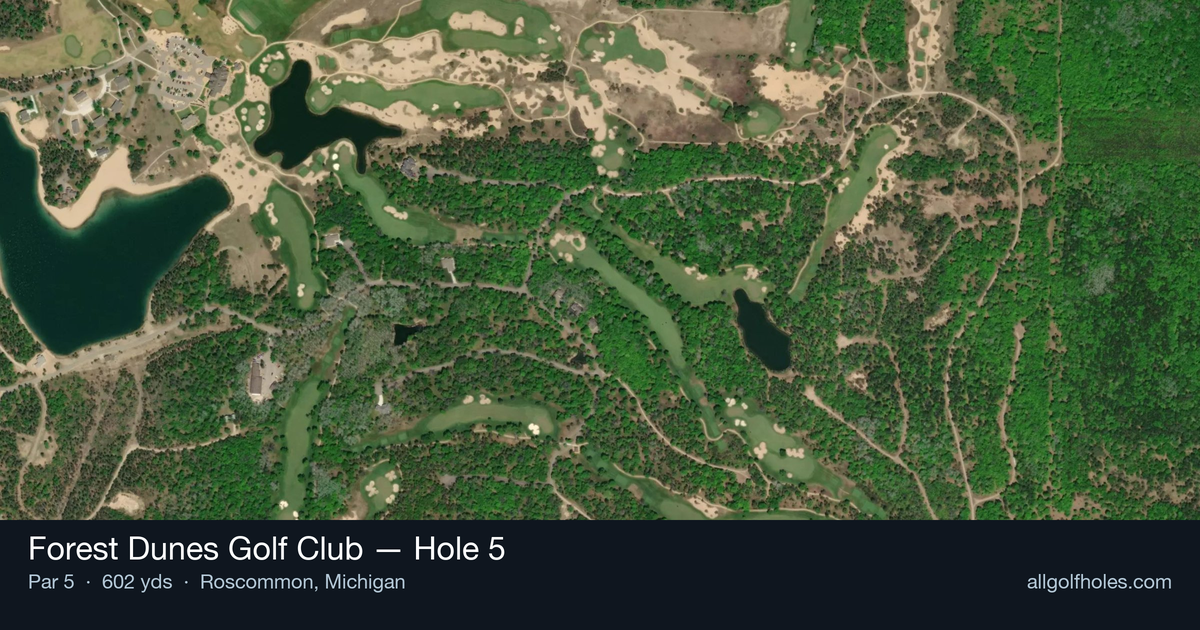
Aerial source not provided
Green size: 43 yds deep × 31 yds wide
Scorecard yardage is for Championship tees. The aerial shows its labeled reference position; distance rings measure to the green.
Championship tees · Par 5 · 602 yards
The plan for No. 5
The #1 handicap hole at Forest Dunes Golf Club, this 602-yard par 5 stands as the course's ultimate test of length and precision. Tom Weiskopf's design philosophy shines through this straight, uncompromising layout that demands three quality shots to reach the small green complex. Without the distraction of water hazards or bunkers, golfers must rely purely on course management and shot execution across this marathon hole. The generous fairway invites aggressive tee shots, but the true challenge emerges in the approach phases where distance control becomes paramount. With Michigan's northern winds often in play, this hole separates the field and rewards those who can maintain their composure over its demanding length, making it a memorable centerpiece of the Forest Dunes experience.
Off the tee
Your tee shot strategy hinges on choosing between the two fairway options and executing with confidence. The left fairway typically offers more generous landing areas, while the right side may provide better angles for your approach sequence. Regardless of your choice, avoid the temptation to aim down the middle - the pine trees will punish indecision. Select a club that ensures you stay in your chosen fairway, even if that means taking less than driver. A 3-wood or hybrid off the tee can provide the accuracy needed while still leaving a manageable distance for your second shot. The key is committing to your target line and trusting your swing.
Approach & recovery
With 602 yards to cover, most golfers will need two solid shots to reach the green in regulation. Your second shot should focus on positioning rather than distance, setting up an optimal angle and yardage for your third shot. The small green demands precision on your approach, so avoid aggressive plays that could leave difficult up-and-downs. A mid-iron to long-iron for your third shot, depending on conditions and your position after the second shot, will give you the best chance to find the putting surface. Pay attention to pin position and favor the center of the green when in doubt.
On the green
The small green size makes accuracy paramount on your approach shot. Once on the putting surface, read the slopes carefully and focus on lag putting if facing longer putts. The compact nature of the green means most putts won't have extreme breaks, but subtle slopes can still influence ball movement significantly. Position your approach shots below the hole when possible, as uphill putts on a small green are generally more manageable than downhill attempts with limited stopping room. ## RISK VS REWARD The primary risk/reward decision occurs at the tee, where choosing between fairways sets the tone for the entire hole. While longer hitters might be tempted to take aggressive lines to shorten the hole, the pine trees provide severe punishment for missed shots. The reward for smart, conservative play is significant - keeping the ball in play allows for a legitimate birdie opportunity on this reachable par 5, while aggressive mistakes can easily lead to double bogey or worse. ## DIFFERENT SKILL LEVELS **High Handicappers:** Focus on keeping the ball in play above all else. Choose the fairway that matches your natural ball flight and use clubs that ensure accuracy over distance. Play this as a three-shot hole, positioning each shot for the next rather than trying to reach in two. **Low Handicappers:** Consider the pin position and wind conditions when selecting your fairway route. You may have opportunities to reach the green in two shots, but evaluate the risk carefully given the small target. Your superior accuracy should allow for more aggressive positioning shots while still maintaining smart course management principles. The 5th hole rewards patience, precision, and strategic thinking - hallmarks of Forest Dunes' exceptional design that challenges golfers to think their way around the course rather than simply overpower it.
Watch for
- Course conditioning and mapped hazards may affect line selection; confirm from the aerial.
Hole 5 Green Complex
Mapped green boundary
Green size: 4,738 sq ft
How did Hole 5 play?
How did this hole play today?
Frequently asked questions
Yardage reference: Championship tees · 602 yards.
Can this par 5 be reached in two?
↓
At 602 yards, A true three-shot hole for most players. Position your layup to leave a comfortable wedge distance.
How difficult is hole 5?
↓
This hole is a moderate challenge for most golfers. Key challenges include: long par 5, heavily bunkered.
What hazards should I watch out for on hole 5?
↓
Key hazards include: fairway bunkers at 1866950.2-1867151.6 yards. Plan your shots to avoid these trouble spots.
How big is the green on hole 5?
↓
The green is medium-sized with moderate targets. The green is deeper than wide, so club selection is crucial. Pay attention to pin placement when selecting your approach club.
Which side of the fairway is safer on hole 5?
↓
Aim for the left side of the fairway when possible. Missing right brings more trouble into play.
What's a good score on hole 5?
↓
This hole is a true three-shot hole where birdie requires execution. This longer par 5 demands patience. Two good shots set up the scoring opportunity.