Hole 7 at Forest Dunes Golf Club
- Par
- 5
- Yardage
- 531 yds
- Stroke index
- 7
- Hazards
- 2 bunkers · Water
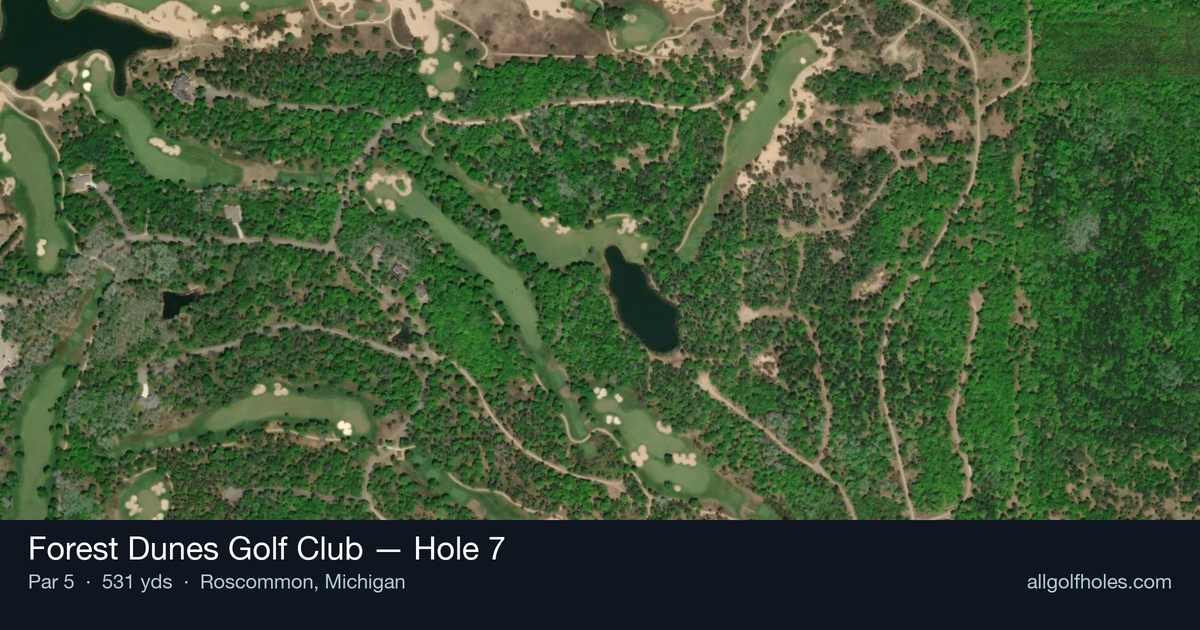
Aerial source not provided
Green size: 32 yds deep × 34 yds wide
Scorecard yardage is for Championship tees. The aerial shows its labeled reference position; distance rings measure to the green.
Championship tees · Par 5 · 531 yards
The plan for No. 7
The seventh hole at Forest Dunes Golf Club represents a classic risk-reward par 5 that epitomizes Tom Weiskopf's strategic design philosophy. At 531 yards, this straight-away hole sits within the course's renowned "forest nine," where towering mature trees demand precision from tee to green. The generous fairway invites aggressive tee shots, but accuracy becomes paramount as players navigate through the tree-lined corridor. Long hitters may be tempted to reach the compact green in two, but the approach shot requires careful club selection to a small target that punishes wayward attempts. The intimate green complex rewards those who play within their abilities while challenging scratch golfers to execute under pressure. This hole perfectly captures Forest Dunes' philosophy that golf should be both challenging and enjoyable, offering multiple strategic options that cater to every skill level.
Off the tee
Your tee shot strategy should prioritize finding the fairway center, as the towering mature trees create a natural funnel that severely penalizes errant drives. Choose a club that ensures you stay in the short grass - for many players, this might mean leaving the driver in the bag in favor of a 3-wood or hybrid. Aim for the widest part of the landing zone, typically in the fairway's center, and focus on a smooth tempo rather than maximum distance. The trees will quickly turn a slight miss into a punch-out situation that eliminates any chance of reaching the green in regulation.
Approach & recovery
From the fairway, you'll face a critical decision point. Longer hitters with a clear line to the green can consider going for it in two, but the small green size demands pinpoint accuracy. A safer play involves laying up to your preferred wedge distance, ensuring you have a full swing into the green rather than an awkward in-between yardage. When attacking the green, favor the center of the putting surface regardless of pin position - the small target leaves little margin for error, and missing the green entirely creates challenging up-and-down scenarios.
On the green
The small green at the 7th requires precise distance control on your approach shots. Once on the putting surface, focus on lag putting to avoid three-putts, as the compact size can create deceptively quick putts. Pay attention to any subtle breaks, and remember that being below the hole is crucial on smaller greens where uphill putts are more manageable than downhill sliders. ## RISK VS REWARD This hole presents a classic risk/reward scenario for accomplished players. Going for the green in two offers birdie and eagle opportunities, but the small target and surrounding trees make this a high-risk play. The conservative approach of laying up ensures you'll have a comfortable wedge shot for your third, making birdie very achievable while virtually guaranteeing par. Weather conditions and your current round momentum should influence this decision. ## DIFFERENT SKILL LEVELS **High-Handicap Players:** Embrace the three-shot strategy completely. Use a fairway wood or hybrid off the tee, advance the ball safely with your second shot to about 100 yards out, then attack the pin with your favorite wedge. This approach minimizes big numbers while keeping birdie in play. **Low-Handicap Players:** You have the option to be more aggressive, but choose your spots wisely. If you're in the fairway with a clear angle to the green, consider the aggressive play, especially if you're comfortable with your long iron or fairway wood accuracy. However, don't force the issue - the small green rewards patience and precision over heroic shots. The 7th hole at Forest Dunes rewards smart golf course management and precise execution, making it a true test of your strategic thinking within the beautiful but demanding forest setting.
Watch for
- Course conditioning and mapped hazards may affect line selection; confirm from the aerial.
Hole 7 Green Complex
Mapped green boundary
Green size: 4,726 sq ft
How did Hole 7 play?
How did this hole play today?
Frequently asked questions
Yardage reference: Championship tees · 531 yards.
Can this par 5 be reached in two?
↓
At 531 yards, A true three-shot hole for most players. Position your layup to leave a comfortable wedge distance.
How difficult is hole 7?
↓
This hole is a moderate challenge for most golfers. Key challenges include: water in play.
What hazards should I watch out for on hole 7?
↓
Key hazards include: fairway bunkers at 1867545.3-1867548.9 yards; water at 1867473.5 yards. Plan your shots to avoid these trouble spots.
How big is the green on hole 7?
↓
The green is medium-sized with moderate targets. Pay attention to pin placement when selecting your approach club.
Which side of the fairway is safer on hole 7?
↓
Aim for the right side of the fairway when possible. Missing left (water) brings more trouble into play.
What's a good score on hole 7?
↓
This hole is a solid birdie opportunity with smart layup strategy. Most golfers can reach in three. Position your layup to leave a comfortable wedge.