Hole 8 at Forest Dunes Golf Club
- Par
- 4
- Yardage
- 448 yds
- Stroke index
- 3
- Hazards
- 12 bunkers · Water
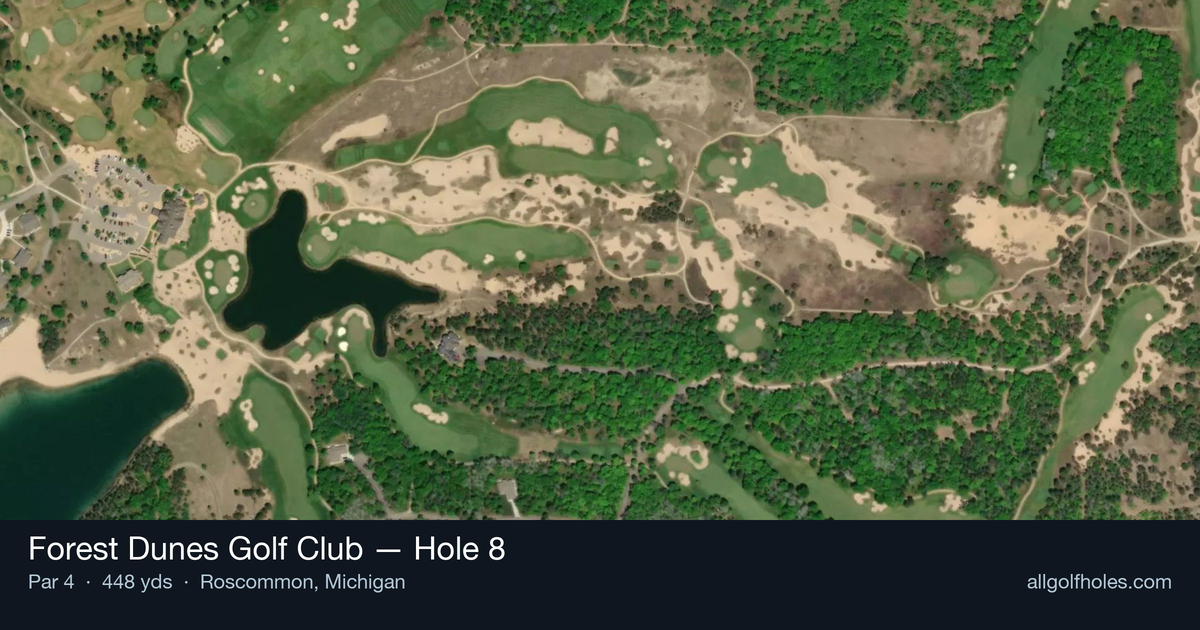
Aerial source not provided
Green size: 35 yds deep × 37 yds wide
Scorecard yardage is for Championship tees. The aerial shows its labeled reference position; distance rings measure to the green.
Championship tees · Par 4 · 448 yards
The plan for No. 8
Forest Dunes Golf Club hole 8 presents a deceptively challenging par 4 that epitomizes the strategic brilliance of The Loop's reversible design. This 448-yard test demands precision from tee to green, with the straight layout offering no hiding spots for wayward shots. The tee shot requires careful club selection to find the optimal position in the fairway, setting up a demanding approach to a small, well-defended green complex. As part of Tom Doak's innovative reversible routing, this hole showcases different strategic elements depending on which direction you're playing The Loop. The approach shot becomes the defining moment, where accuracy trumps distance in navigating to the compact putting surface. This hole rewards thoughtful course management over aggressive play.
Off the tee
Your tee shot strategy should prioritize position over pure distance. With 448 yards to work with, most golfers will need a solid drive to leave a manageable approach to the small green. Focus on finding the center of the fairway, as the straight layout rewards accuracy over aggression. Consider taking a 3-wood or hybrid if driver accuracy has been inconsistent, especially given the hole's demanding nature. The key is leaving yourself in the optimal landing zone - typically around the 150-180 yard mark from the green - where you'll have the best angle and distance control for your approach shot. Avoid the temptation to overswing, as course management is paramount on this challenging hole.
Approach & recovery
The approach shot to this small green requires precision and smart club selection. With limited green surface to work with, your margin for error is reduced significantly. Focus on hitting the center of the green rather than attacking pin positions, especially when the flag is tucked near edges. Club selection should err on the side of taking enough club to reach the middle of the green comfortably. The small target means that coming up short or flying long both present scoring difficulties. Consider the wind conditions carefully, as they'll have a magnified effect on your ability to hold this compact green. A smooth, controlled swing with a mid-iron to long-iron (depending on your tee shot distance) will serve you better than forcing a shorter club.
On the green
The small green size means putting strategy becomes critical for scoring. Focus on lag putting to the center of the green when facing longer putts, as three-putting from this surface can quickly derail your score. Pay attention to the overall slope and grain direction, as these subtle breaks become more pronounced on a smaller surface. When the pin is positioned near edges, be especially cautious with your speed control - it's better to leave yourself a slightly longer second putt than to risk rolling off the green entirely. ## RISK VS REWARD This hole presents a classic risk/reward scenario in club selection and target line choices. The primary risk comes from being overly aggressive with either your tee shot or approach shot. While longer drives set up shorter approaches, accuracy remains paramount given the small green target. The reward for conservative, strategic play is significant - keeping the ball in play and on the green gives you legitimate birdie opportunities. However, the penalty for missing the small green can quickly turn a potential par into bogey or worse, making course management the winning strategy. ## DIFFERENT SKILL LEVELS **High Handicappers:** Focus entirely on keeping the ball in play and reaching the green in regulation. Use whatever club gives you the most confidence off the tee, even if it's a 3-wood or hybrid. On your approach, aim for the center of the green regardless of pin position, and take one extra club to ensure you reach the putting surface. **Low Handicappers:** You can be more aggressive with driver off the tee if you're confident in your accuracy. Consider pin position more carefully on your approach shot, but still respect the small green size. This hole rewards precision over power, so focus on executing clean, controlled swings rather than trying to overpower the hole. The 8th hole exemplifies the strategic thinking required throughout The Loop at Forest Dunes, where every shot demands careful consideration and execution.
Watch for
- Course conditioning and mapped hazards may affect line selection; confirm from the aerial.
Hole 8 Green Complex
Mapped green boundary
Green size: 3,928 sq ft
How did Hole 8 play?
How did this hole play today?
Frequently asked questions
Yardage reference: Championship tees · 448 yards.
What's the best strategy off the tee?
↓
For this 448-yard par 4, most players will hit driver to set up a comfortable approach.
How difficult is hole 8?
↓
This hole is one of the tougher holes on the course for most golfers. Key challenges include: water in play, heavily bunkered, small green.
What hazards should I watch out for on hole 8?
↓
Key hazards include: fairway bunkers at 1867279.8-1867569.2 yards; water at 1867566.6 yards. Plan your shots to avoid these trouble spots.
How big is the green on hole 8?
↓
The green is small and requires precision. The green is deeper than wide, so club selection is crucial. Expect challenging pin positions with limited room for error.
Which side of the fairway is safer on hole 8?
↓
Aim for the right side of the fairway when possible. Missing left (water) brings more trouble into play.
What's a good score on hole 8?
↓
This hole is a demanding hole where bogey is not unusual. This longer par 4 will test most golfers. Focus on position over distance.