Hole 16 at Troon North Golf Club (Monument course)
- Par
- 3
- Yardage
- 144 yds
- Hazards
- 3 bunkers
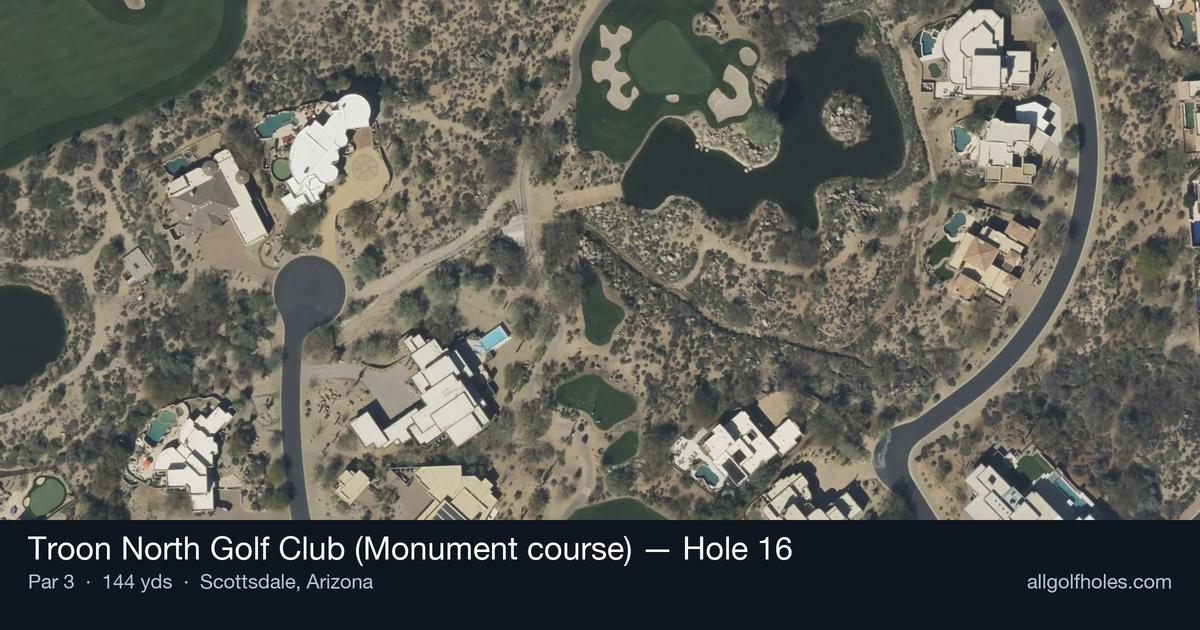
Aerial source not provided
Green size: 26 yds deep × 31 yds wide
Scorecard yardage is for Championship tees. The aerial shows its labeled reference position; distance rings measure to the green.
Championship tees · Par 3 · 144 yards
The plan for No. 16
Known as the "Post Card" hole, Troon North Golf Club Monument course's 16th is a stunning par 3 that epitomizes desert golf at its finest. This signature 144-yard gem demands precision over power, with the small green perched dramatically against the rugged Sonoran landscape. The elevated tee shot requires careful club selection, as the compact target leaves little margin for error. Desert terrain and natural rock formations frame this picturesque hole, creating one of the most photographed shots in Arizona golf. Tom Weiskopf's masterful design showcases the raw beauty of the high Sonoran Desert, making this short iron a memorable test that rewards accuracy while punishing wayward shots with the unforgiving desert floor.
Off the tee
Club selection is critical on this short par 3, typically requiring anywhere from a wedge to a short iron depending on pin position and wind conditions. The key is committing to your club choice and making a smooth, controlled swing rather than trying to finesse the distance. Aim for the center of the small green unless the pin is clearly accessible, as the desert setting likely means missing the green comes with significant penalties. Take one extra club if you're between selections - being long is usually better than coming up short into potential desert hazards.
Approach & recovery
Since this is a par 3, your tee shot IS your approach shot. Focus on tempo and balance rather than trying to get cute with distance control. The small green demands accuracy, so pick a specific target rather than just aiming at the flag. If the pin is tucked in a difficult position, play to the fat part of the green and rely on your putting to get close. The desert environment means there's little room for error, making course management more important than aggressive pin-seeking.
On the green
Small greens typically feature subtle breaks that can be deceptive, especially in desert settings where the surrounding terrain can influence putts. Take time to read the green carefully, as two-putting from anywhere on this small surface should be your primary goal. Pay attention to any slopes that might feed balls toward the edges, and remember that uphill putts are generally safer than downhill ones when dealing with potential trouble around the green. ## RISK VS REWARD The risk/reward calculation here is straightforward: there's little reward for aggressive play given the short distance, but significant risk if you miss the small target. The smart play is conservative - take enough club, aim for the center of the green, and let your putting game handle the scoring. Any attempt to get too clever with distance control or pin-seeking on such a small target increases the likelihood of finding desert trouble. ## DIFFERENT SKILL LEVELS **High Handicappers:** Focus entirely on finding the green with your most reliable short iron. Ignore pin positions and aim dead center of the green every time. Take one extra club to ensure you clear any front trouble, and make a smooth, balanced swing. Getting on the green in regulation is a victory. **Low Handicappers:** You can be slightly more aggressive with pin positions, but still respect the small target. Use the opportunity to work on distance control with your wedges, but never at the expense of missing the green entirely. This is a hole where even scratch players should prioritize the center of the green unless conditions are perfect. The 16th at Troon North Monument rewards patience and precision over heroics. In the desert setting that's made this hole famous for its scenic beauty, smart course management and committed execution are your keys to walking away with a par or better on this memorable "Post Card" hole.
Watch for
- Course conditioning and mapped hazards may affect line selection; confirm from the aerial.
Hole 16 Green Complex
Mapped green boundary
Green size: 3,799 sq ft
How did Hole 16 play?
How did this hole play today?
Frequently asked questions
Yardage reference: Championship tees · 144 yards.
What club should I use on this par 3?
↓
At 144 yards, most golfers will need a short iron (9-iron to PW) to reach this green. Adjust for elevation, wind, and pin position.
How difficult is hole 16?
↓
This hole is a good scoring opportunity for most golfers. Key challenges include: small green.
What hazards should I watch out for on hole 16?
↓
Key hazards include: 3 greenside bunkers. Plan your shots to avoid these trouble spots.
How big is the green on hole 16?
↓
The green is small and requires precision. Expect challenging pin positions with limited room for error.
What's a good score on hole 16?
↓
This hole is a legitimate birdie opportunity for accurate iron players. Most golfers should target par, with birdie chances if you hit the green in regulation.