Hole 14 at Hazeltine National Golf Club
- Par
- 4
- Yardage
- 352 yds
- Stroke index
- 0
- Hazards
- 4 bunkers · Water
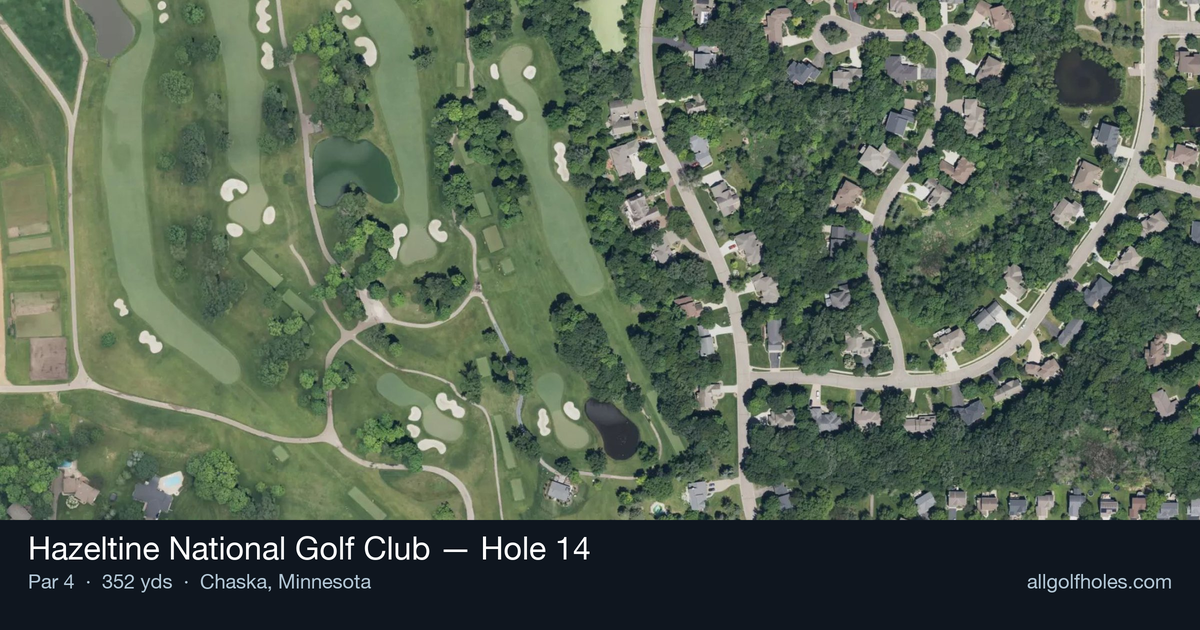
Aerial source not provided
Green size: 28 yds deep × 32 yds wide
Scorecard yardage is for Championship tees. The aerial shows its labeled reference position; distance rings measure to the green.
Championship tees · Par 4 · 352 yards
The plan for No. 14
The 14th hole at Hazeltine National is a true classic that exemplifies the course's championship pedigree. This magnificent par 4 dogleg right presents golfers with multiple strategic possibilities from the moment they step onto the tee. Known for its risk/reward nature, it's considered one of the standout holes that showcases Hazeltine's ability to challenge players at every level.
Off the tee
The tee shot presents the defining moment of this hole, offering several distinct strategic paths. Aggressive players can take on the risk/reward gamble with driver, potentially setting up a short iron approach but bringing trouble into play. The conservative approach involves laying back with a fairway wood or long iron to ensure position in the landing zone, leaving a longer but more controlled approach shot. Your target line should focus on the center-right portion of the fairway, allowing for the natural shape of most golfers' shots while providing the best angle into the green. Wind conditions and pin position should heavily influence club selection, as getting too aggressive can quickly turn this scoring opportunity into a difficult recovery situation.
Approach & recovery
The approach shot to the small green requires precision and proper club selection. The compact target demands accuracy over distance, making it crucial to take enough club to ensure solid contact and proper trajectory. Missing short often leaves difficult up-and-down opportunities, while going long can present challenging recovery shots. Pay close attention to pin position when selecting your approach strategy. Front pins may allow for more aggressive play if you've positioned your tee shot well, while back pins often call for playing to the center of the green and relying on putting to get close. The key is committing to your yardage and making a confident swing rather than trying to guide the ball to the target.
On the green
The small green size means that lag putting becomes less critical than usual, but precision in reading breaks remains essential. Focus on getting your first putt within the "make zone" rather than being overly aggressive from longer distances. The compact surface can create subtle breaks that aren't immediately apparent, so take time to read the green from multiple angles. When facing longer putts, prioritize distance control over trying to hole everything. The small green means that three-putts can be easily avoided with proper speed, and two-putting from anywhere on this surface should be considered a success when pin positions are challenging.
Watch for
- Water along the hole
- Fairway bunker crossing the landing zone
- Greenside bunker (greenside)
Hole 14 Green Complex
Mapped green boundary
Green size: 5,222 sq ft
How did Hole 14 play?
How did this hole play today?
Frequently asked questions
Yardage reference: Championship tees · 352 yards.
What's the best strategy off the tee?
↓
For this 352-yard par 4, most players will hit 3-wood or driver to set up a comfortable approach.
How difficult is hole 14?
↓
This hole is a moderate challenge for most golfers. Key challenges include: water in play, heavily bunkered.
How big is the green on hole 14?
↓
The green is medium-sized with moderate targets. Pay attention to pin placement when selecting your approach club.
Which side of the fairway is safer on hole 14?
↓
Aim for the right side of the fairway when possible. Missing left (water) brings more trouble into play.
What's a good score on hole 14?
↓
This hole is a medium-length test where par is a solid result. A straightforward par 4 where course management pays off.