Hole 10 at Forest Dunes Golf Club
- Par
- 4
- Yardage
- 439 yds
- Stroke index
- 6
- Hazards
- 6 bunkers · Water
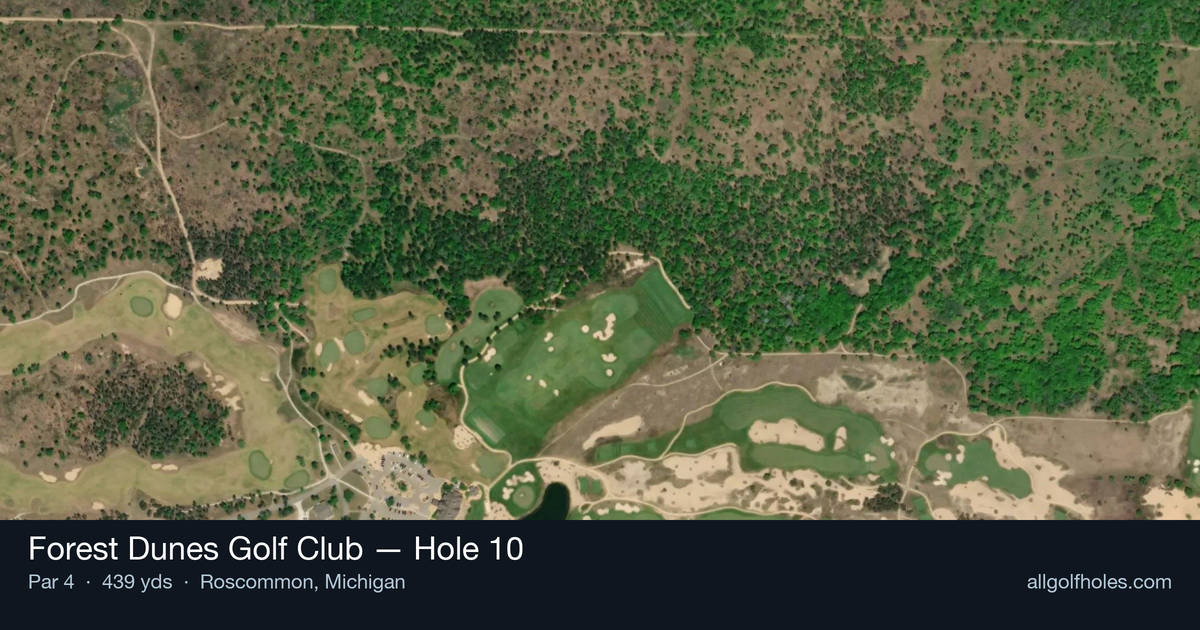
Aerial source not provided
Green size: 33 yds deep × 40 yds wide
Scorecard yardage is for Championship tees. The aerial shows its labeled reference position; distance rings measure to the green.
Championship tees · Par 4 · 439 yards
The plan for No. 10
The 10th hole at Forest Dunes Golf Club marks the beginning of Tom Weiskopf's dramatic transition from forest to dunes, serving as the gateway to the back nine's glacial sand landscape. This straightforward par 4 stretches 439 yards through a more open corridor, offering players their first glimpse of the course's dueling personalities. The tee shot demands precision over power, as the fairway provides a generous target but sets up a crucial approach to a compact, well-guarded green. With minimal hazards flanking the hole, success hinges on distance control and reading the subtle undulations that characterize Weiskopf's green complexes. The hole's deceptive simplicity makes it a pivotal scoring opportunity before the back nine's dune-laden challenges intensify.
Off the tee
The tee shot strategy centers on finding the optimal position in the landing zone for your approach angle. With no significant hazards to navigate, focus on placing your drive in the center-right portion of the fairway, which typically provides the best sight lines to the small green. Most players should consider a conservative approach with driver or 3-wood, prioritizing accuracy over maximum distance. The straight layout rewards precision, so avoid the temptation to overpower the tee shot. Target line should favor the right side of the fairway, as this angle often provides better access to pin positions on the small green.
Approach & recovery
The approach shot becomes the defining moment of this hole, where the small green demands pinpoint accuracy. From a well-positioned drive, you'll likely face a mid-iron to long-iron depending on conditions and tee position. The compact putting surface leaves little margin for error, making club selection critical - always take enough club to ensure you reach the green rather than coming up short. Focus on the center of the green regardless of pin position, as the small target makes aggressive pin-hunting a high-risk strategy. Pay attention to wind conditions, which can significantly impact ball flight on this exposed back nine terrain.
On the green
Forest Dunes' greens are known for their speed and subtle undulations, and the 10th's small putting surface amplifies these challenges. Any two-putt should be considered a victory on this tricky green. Read putts carefully, as the compact size means even slight breaks can dramatically affect ball roll. Lag putting becomes essential - focus on getting your first putt close rather than being aggressive with longer attempts. The small green size means you're likely putting from closer distances, but don't underestimate the difficulty of these shorter putts on Weiskopf's slick surfaces. ## RISK VS REWARD This hole presents a subtle risk/reward scenario where the reward comes from restraint rather than aggression. The scoring opportunity exists for players who can consistently hit the small green in regulation, but the risk lies in short-siding yourself or missing the putting surface entirely. The smart play rewards patient, strategic golf over heroic shots. Consider the pin position when deciding on approach aggressiveness - back pins might allow for more aggressive play, while front pins demand conservative club selection. ## DIFFERENT SKILL LEVELS **High-Handicap Players:** Focus entirely on finding the fairway with your tee shot, even if it means using a 3-wood or hybrid for better accuracy. On the approach, aim for the center of the green regardless of pin position, and take plenty of club to ensure you reach the putting surface. Two-putt pars are excellent scores here. **Low-Handicap Players:** Use the straight layout to work on precision placement off the tee, setting up specific yardages for your preferred approach clubs. You can be slightly more aggressive with pin positions, but respect the small green size. Focus on leaving uphill putts when possible, and use your short game skills around the green if you do miss the target. The 10th hole exemplifies Weiskopf's architectural philosophy at Forest Dunes - creating strategic interest through subtle features rather than obvious hazards. Success here comes from embracing precision over power and respecting the challenge of the small green.
Watch for
- Course conditioning and mapped hazards may affect line selection; confirm from the aerial.
Hole 10 Green Complex
Mapped green boundary
Green size: 4,504 sq ft
How did Hole 10 play?
How did this hole play today?
Frequently asked questions
Yardage reference: Championship tees · 439 yards.
What's the best strategy off the tee?
↓
For this 439-yard par 4, most players will hit driver to set up a comfortable approach.
How difficult is hole 10?
↓
This hole is one of the tougher holes on the course for most golfers. Key challenges include: water in play, heavily bunkered.
What hazards should I watch out for on hole 10?
↓
Key hazards include: fairway bunkers at 2319531.6-2319668.6 yards; water at 2319862.5 yards. Plan your shots to avoid these trouble spots.
How big is the green on hole 10?
↓
The green is medium-sized with moderate targets. Pay attention to pin placement when selecting your approach club.
Which side of the fairway is safer on hole 10?
↓
Aim for the left side of the fairway when possible. Missing right (water) brings more trouble into play.
What's a good score on hole 10?
↓
This hole is a demanding hole where bogey is not unusual. This longer par 4 will test most golfers. Focus on position over distance.