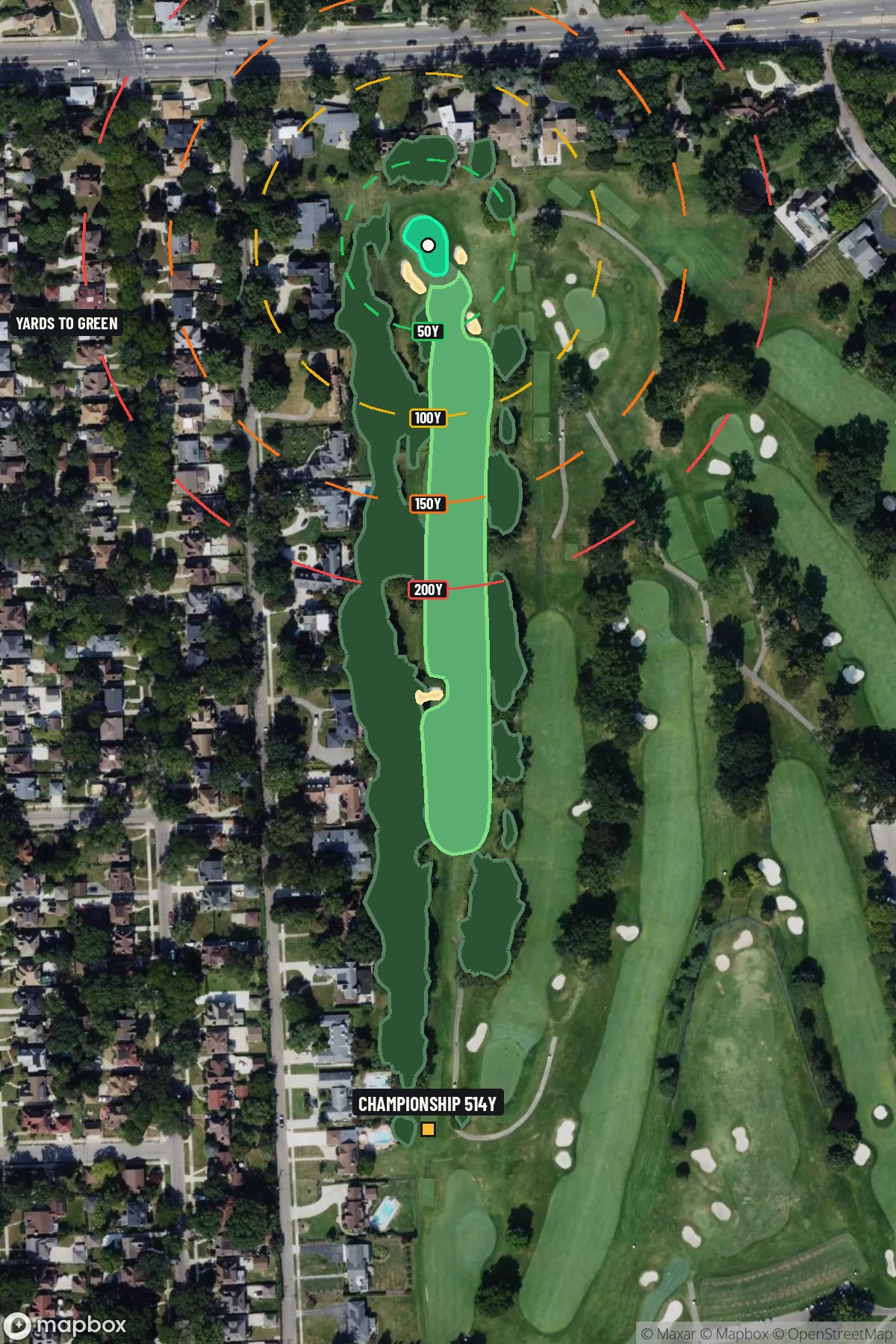
Hole 5 of 18 · Highland Park, Michigan

Hole 5 at Detroit Golf Club (North)

Par
5
Yards
514
Handicap
7
Bunkers
4
Hole 5 aerial at Detroit Golf Club (North)
Map distances from Championship tee · 514 yds

The map's printed distances are measured from the Championship tee to the green; they do not move when you change tees.

Green size: 36 yds deep × 27 yds wide

Mapbox Satellite composite · capture date not provided. Green at the top.

Where this map comes from

Satellite photo
Date not published
Mapbox satellite
Green contours
2017 survey
USGS lidar survey
Report a map problem
100%
Hole 5 aerial at Detroit Golf Club (North)

The plan for No. 5

The play: This classic Donald Ross par 5 at Detroit Golf Club (North) hole 5 exemplifies the master architect's strategic brilliance across 514 yards of demanding golf. The straight layout deceives players into thinking length alone will suffice, but Ross's genius lies in the subtle complexities that emerge with each shot. The tee shot must navigate carefully positioned fairway bunkers that dictate optimal positioning for the approach, while the undulating fairway can send wayward drives tumbling toward trouble. The small, well-guarded green complex rewards precision over power, with its undulating surface making even short irons treacherous. Long hitters may be tempted to reach in two, but the risk-reward calculation demands careful consideration of pin position and wind conditions on this quintessential Ross design.

Shot by shot

  1. Off the tee

    The tee shot strategy revolves around avoiding the three strategically placed fairway bunkers that Ross positioned to catch aggressive drives. Your primary target should be the widest part of the fairway, typically found by playing conservatively down the center or slightly favoring the side that offers the best angle for your second shot. Given the tight fairway conditions mentioned in tournament play, consider using a 3-wood or hybrid off the tee to ensure accuracy over distance. The undulating fairways can kick balls offline, so finding the short grass is paramount. Long hitters may be tempted to challenge the bunkers, but the risk rarely justifies the reward on this hole - a well-positioned drive in the fairway center sets up a much better approach than a longer drive from the rough or sand.

  2. Approach & recovery

    Your approach strategy depends entirely on your tee shot execution. From an ideal fairway position, you'll likely face a mid to long iron for your second shot, with the prevailing wind requiring an extra club or two. The small green size demands precision - this isn't a target you can attack aggressively with anything less than perfect lie and distance control. Focus on hitting to the center of the green rather than chasing pins, especially when they're tucked near the well-guarded edges. The undulating green surface means even center-green approaches can leave challenging putts, but they're far preferable to recovery shots from greenside trouble. If you're not confident in reaching the green in regulation, lay up to your favorite wedge distance for the best chance at an up-and-down.

  3. On the green

    The small, undulating green presents its own set of challenges. Ross's greens are famous for their subtle breaks and collection areas that can confound even experienced players. Study the green's natural flow and favor the side that feeds toward the pin rather than fighting against the slope. Speed control becomes critical on the undulating surface - it's better to leave putts short and straight than to charge them and face difficult comebacks. The green's size means most putts will be relatively short, but don't let that fool you into being careless with your read and pace. ## RISK VS REWARD The primary risk/reward decision comes off the tee: challenging the fairway bunkers for a shorter approach versus playing safely for a longer but cleaner second shot. Given the small green and prevailing wind, the conservative play usually wins out. The reward for an aggressive drive rarely compensates for the penalty of finding sand or rough. For longer hitters, the temptation to go for the green in two exists, but the combination of wind, small target, and well-guarded green makes this a low-percentage play except under ideal conditions. ## DIFFERENT SKILL LEVELS **High Handicappers:** Focus entirely on course management. Use a fairway wood or hybrid off the tee to ensure you find the short grass. Plan for a three-shot approach to the green, laying up to a comfortable wedge distance rather than forcing longer approaches. The small green rewards accuracy over aggression at every skill level. **Low Handicappers:** You have more options but should still respect the hole's demands. A well-struck driver can work if you're confident in your accuracy, but don't let ego override strategy. You can be more aggressive with approaches from ideal positions, but remember that Ross designed this green to punish overly bold play. Focus on hitting quality shots rather than forcing birdies - par is never a bad score on a Ross par 5. The key to success on this hole lies in patience and precision. Ross designed it to reward strategic thinking over power, and that philosophy remains as relevant today as it was over a century ago.

  4. Watch for

    • Course conditioning and mapped hazards may affect line selection; confirm from the aerial.

The green on No. 5

Mapped boundary
Wide × deepyards
27×36
Areasq ft
5,413
Golfer feedback

How did Hole 5 play?

⚡ Quick Golfer Pulse

How did this hole play today?

1-tap anonymous vote

Frequently asked questions

Yardage reference: Championship tees · 514 yards.

Can this par 5 be reached in two?

↓

At 514 yards, Reachable in two for longer hitters. Consider laying up short of hazards if going for it is risky.

How difficult is hole 5?

↓

This hole is a good scoring opportunity for most golfers. Key challenges include: heavily bunkered.

How big is the green on hole 5?

↓

The green is medium-sized with moderate targets. Pay attention to pin placement when selecting your approach club.

What's a good score on hole 5?

↓

This hole is a solid birdie opportunity with smart layup strategy. Most golfers can reach in three. Position your layup to leave a comfortable wedge.