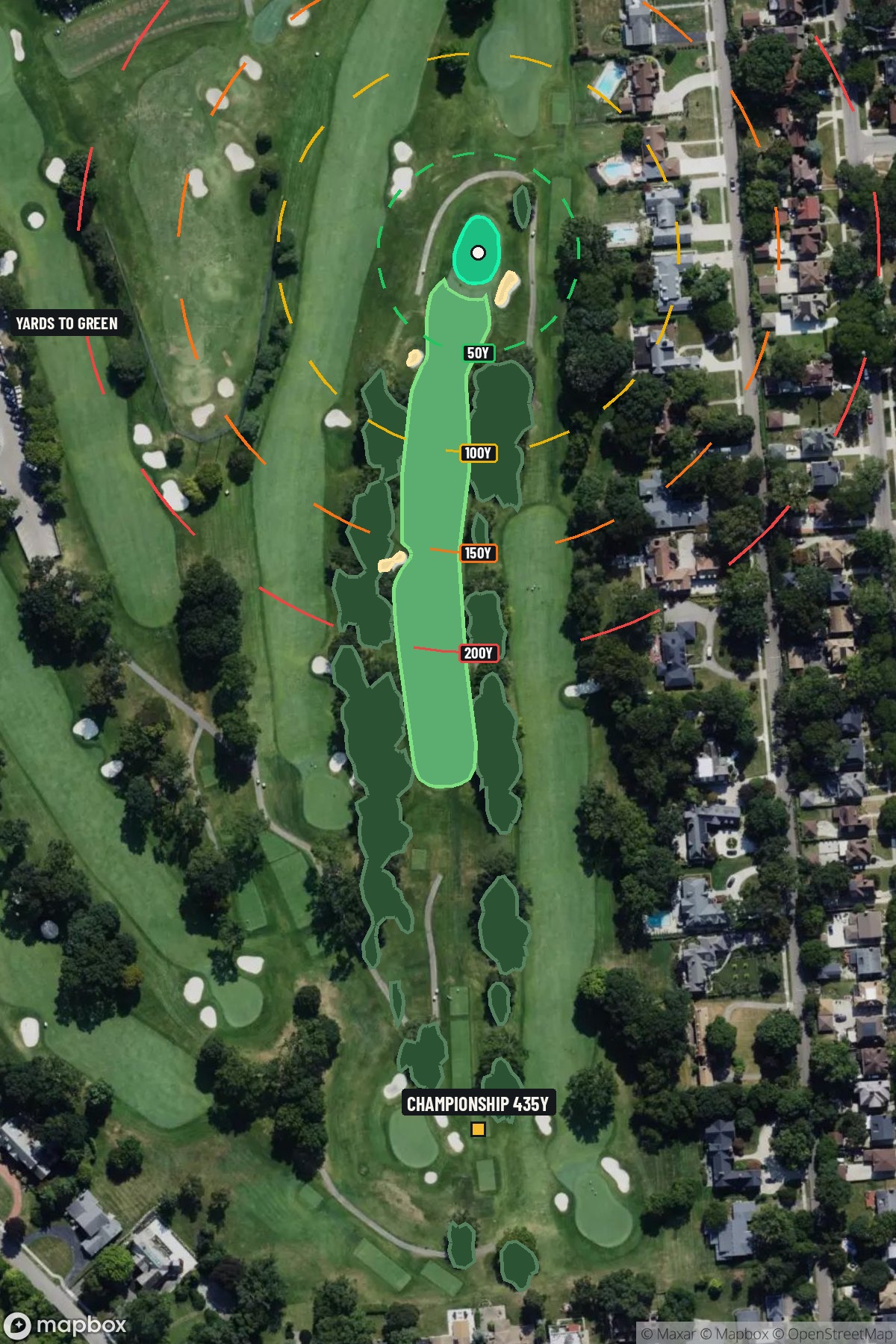
Hole 4 of 18 · Highland Park, Michigan

Hole 4 at Detroit Golf Club (North)

Par
4
Yards
435
Handicap
5
Bunkers
3
Hole 4 aerial at Detroit Golf Club (North)
Map distances from Championship tee · 435 yds

The map's printed distances are measured from the Championship tee to the green; they do not move when you change tees.

Green size: 35 yds deep × 24 yds wide

Mapbox Satellite composite · capture date not provided. Green at the top.

Where this map comes from

Satellite photo
Date not published
Mapbox satellite
Green contours
2017 survey
USGS lidar survey
Report a map problem
100%
Hole 4 aerial at Detroit Golf Club (North)

The plan for No. 4

The play: Detroit Golf Club (North) hole 4 presents a classic Donald Ross design challenge that demands precision from tee to green. This straight 435-yard par 4 requires careful navigation around strategically placed fairway bunkers that guard the optimal landing area for approach shots. The elevated green complex, small and well-protected, features Ross's signature undulations that create multiple pin positions and challenging reads. Trees flanking the left side tighten the driving zone, while a fairway bunker on the right punishes aggressive lines. The approach shot, typically a mid-iron, must find the correct level of this tiered green to avoid lengthy putts on one of Ross's most demanding putting surfaces.

Shot by shot

  1. Off the tee

    Your tee shot strategy must account for the three fairway bunkers that define the landing area. The key is finding the optimal position that avoids these hazards while setting up the best approach angle. Aim for the center-left portion of the fairway to give yourself the widest margin for error, as this line typically provides the clearest path to the green. Club selection should prioritize accuracy over distance - many players will benefit from hitting a 3-wood or hybrid to ensure they stay in the fairway and avoid the bunker complex. Long hitters who can carry the bunkers may opt for driver, but the risk-reward calculation heavily favors the conservative play given the difficulty of the approach shot from the sand.

  2. Approach & recovery

    The approach shot to this elevated, small green requires careful club selection and precise execution. The green's undulating nature and well-guarded perimeter make accuracy paramount. Aim for the center of the green regardless of pin position, as the small target and elevation change can easily turn a slightly mishit shot into a difficult recovery. Expect to hit anywhere from a mid-iron to long-iron depending on your tee shot position and wind conditions. The elevated nature of the green means you'll need an extra half-club to account for the uphill shot. Focus on a smooth, controlled swing rather than trying to attack specific pin positions on this unforgiving target.

  3. On the green

    This small, undulating green rewards conservative putting strategy. The elevation changes and subtle breaks can be deceptive, so take extra time to read the green from multiple angles. Generally, putts will break away from the higher portions of the green, and the front bowl mentioned in course descriptions can create challenging uphill putts if you're short of the pin. When the pin is tucked in difficult positions, aim for the fat part of the green and focus on two-putting. The undulations can help feed balls toward certain hole locations, but they can just as easily kick putts away from the cup if you're not careful with your speed control. ## RISK VS REWARD The primary risk-reward decision comes on the tee shot: attempting to drive past the fairway bunkers versus laying back for position. While longer hitters might be tempted to challenge the bunkers for a shorter approach, the small green and elevated target make the shorter iron advantage less significant than on other holes. The conservative play of ensuring a clean lie in the fairway almost always trumps the aggressive line, especially given that even a wedge approach to this green requires precision. The penalty for finding the fairway bunkers - a difficult stance and limited green to work with - far outweighs the benefit of a slightly shorter approach. ## DIFFERENT SKILL LEVELS **High-Handicap Players:** Focus entirely on finding the fairway with your tee shot, even if it means hitting a 5-wood or hybrid. From the fairway, aim for the center of the green with whatever club gets you there comfortably. Don't get greedy with pin hunting - par is an excellent score on this hole. **Low-Handicap Players:** You have more options for attacking the fairway bunkers with driver, but carefully assess wind conditions and pin position before committing to the aggressive line. When the pin is accessible, you can be more precise with your approach, but always respect the small target and elevation change. This is a hole where course management trumps raw skill - even scratch players should prioritize position over perfection. The 4th hole embodies classic Ross design principles: rewarding strategic thinking while punishing overly aggressive play. Success here comes from understanding your limitations and playing within them, making it a true test of golf strategy and mental discipline.

  4. Watch for

    • Course conditioning and mapped hazards may affect line selection; confirm from the aerial.

The green on No. 4

Mapped boundary
Wide × deepyards
24×35
Areasq ft
5,342
Golfer feedback

How did Hole 4 play?

⚡ Quick Golfer Pulse

How did this hole play today?

1-tap anonymous vote

Frequently asked questions

Yardage reference: Championship tees · 435 yards.

What's the best strategy off the tee?

↓

For this 435-yard par 4, most players will hit driver to set up a comfortable approach.

How difficult is hole 4?

↓

This hole is a good scoring opportunity for most golfers.

How big is the green on hole 4?

↓

The green is medium-sized with moderate targets. Pay attention to pin placement when selecting your approach club.

What's a good score on hole 4?

↓

This hole is a demanding hole where bogey is not unusual. This longer par 4 will test most golfers. Focus on position over distance.