Hole 15 at TPC Southwind
- Par
- 4
- Yardage
- 395 yds
- Stroke index
- 12
- Hazards
- 2 bunkers · Water
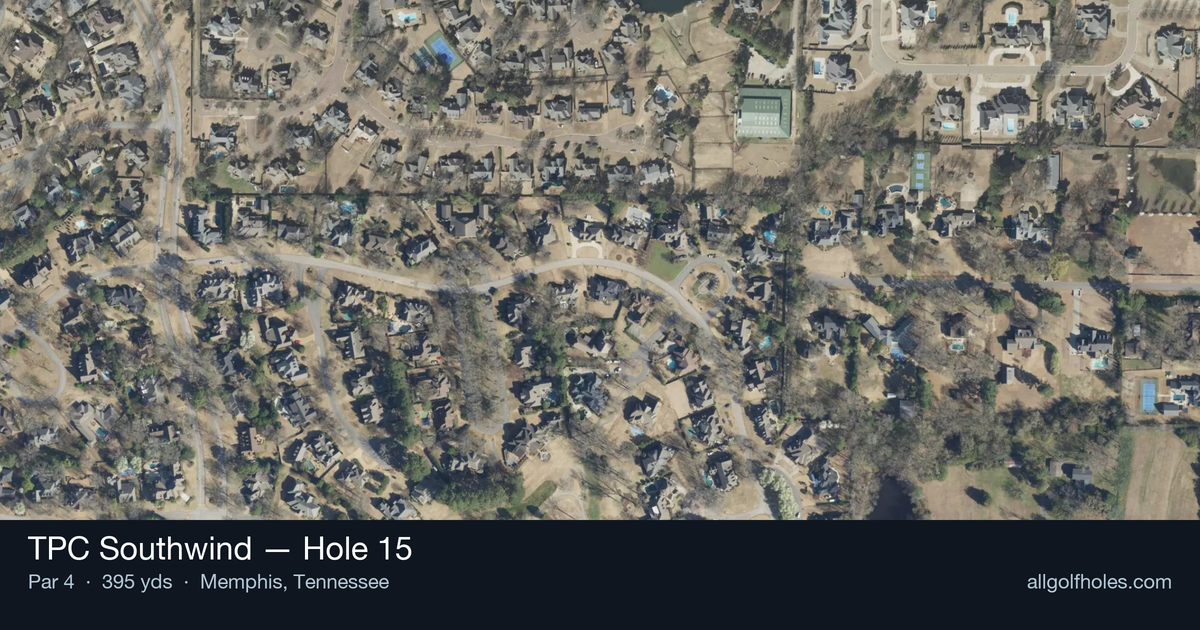
Aerial source not provided
Green size: 36 yds deep × 19 yds wide
Scorecard yardage is for Championship tees. The aerial shows its labeled reference position; distance rings measure to the green.
Championship tees · Par 4 · 395 yards
The plan for No. 15
TPC Southwind hole 15 presents a deceptively challenging par 4 that demands both precision and course management. At 395 yards, this strategic test features a creek that runs along the left side of the tee shot before cutting across to the right side of the green complex. The ideal drive must navigate past a prominent tree while avoiding the water hazard that becomes increasingly relevant on the approach shot. The green sits precariously close to the creek, with recent stone work enhancing the visual intimidation factor. A small pot bunker guards the front edge, making distance control crucial on what's typically a short iron approach. This hole rewards aggressive play but severely punishes miscalculation, embodying the strategic design philosophy that makes TPC Southwind a favorite venue for PGA Tour professionals.
Off the tee
The key to success starts with positioning your drive past the large tree that serves as a prominent landmark in the landing zone. Target the right-center of the fairway to avoid the creek running down the left side while giving yourself the best angle for the approach. A smooth driver or strong 3-wood should provide adequate distance without requiring heroic carries. The fairway offers reasonable width, but accuracy trumps distance here - being in the short grass with a clear view of the green is far more valuable than an extra 20 yards in the rough or near the hazard.
Approach & recovery
The approach shot transforms this hole into a mini-version of TPC Sawgrass's famous 17th, requiring a short iron over water to reach the green. The creek now runs to the right side of the green, making right pin positions particularly treacherous. A small pot bunker guards the front edge, so err toward the middle or back portions of the green rather than attacking front pins aggressively. Club selection should favor one extra club to ensure you clear the water comfortably - the penalty for coming up short is severe, while long putts are manageable on this small green.
On the green
The compact green size demands precision with your approach, as there's little room for error once you're putting. Focus on lag putting to avoid three-putts, as the green's small dimensions can create deceptively quick putts if you're not careful with speed control. Pin positions near the water or bunker should be treated with extra respect - aim for the center of the green and take your par rather than chasing birdies that could easily turn into bogeys or worse. ## RISK VS REWARD The primary risk/reward decision comes on the approach shot - how aggressively to attack pins near the hazards versus playing safe to the green's center. Conservative play targeting the middle of the green virtually guarantees a two-putt par, while aggressive approaches to tucked pins offer birdie opportunities but carry significant penalty stroke risk. The tee shot offers minimal risk/reward dynamics, as the safe play is clearly the optimal strategy. ## DIFFERENT SKILL LEVELS **High-handicap players** should focus on keeping the ball dry above all else. Use a fairway wood or hybrid off the tee for accuracy, then take an extra club on the approach to ensure water clearance. Always aim for the center of the green regardless of pin position - pars are excellent scores here for recreational golfers. **Low-handicap players** can be more aggressive with driver off the tee to shorten the approach, but should still respect the water on the second shot. Consider attacking pins away from the hazards while playing conservatively to pins near the water. The key is recognizing when birdie opportunities are worth pursuing versus when par represents a good score in tournament conditions.
Hole 15 Green Complex
Mapped green boundary
Green size: 3,944 sq ft
Course coverage
Tournament and creator videos about TPC Southwind — shared course coverage, not hole-specific clips.
Tournament coverage
FedEx St. Jude Championship highlights
FedEx St. Jude Championship | Final Round Highlights
2025
How did Hole 15 play?
How did this hole play today?
Frequently asked questions
Yardage reference: Championship tees · 395 yards.
What's the best strategy off the tee?
↓
For this 395-yard par 4, most players will hit driver to set up a comfortable approach.
How difficult is hole 15?
↓
This hole is a moderate challenge for most golfers. Key challenges include: water in play, small green.
What hazards should I watch out for on hole 15?
↓
Key hazards include: 2 greenside bunkers; water at 340.7 yards. Plan your shots to avoid these trouble spots.
How big is the green on hole 15?
↓
The green is small and requires precision. The green is deeper than wide, so club selection is crucial. Expect challenging pin positions with limited room for error.
What's a good score on hole 15?
↓
This hole is a medium-length test where par is a solid result. A straightforward par 4 where course management pays off.