Hole 18 at Sea Island Golf Club (Seaside)
- Par
- 4
- Yardage
- 439 yds
- Stroke index
- 8
- Hazards
- 5 bunkers · Water
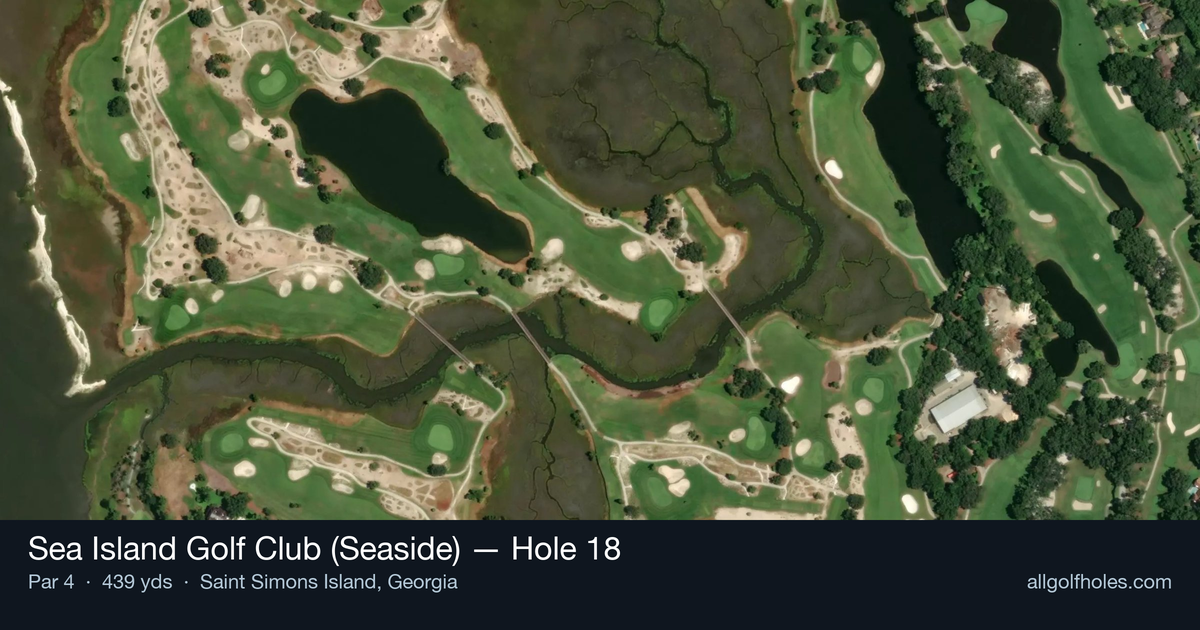
Aerial source not provided
Green size: 36 yds deep × 29 yds wide
Scorecard yardage is for Championship tees. The aerial shows its labeled reference position; distance rings measure to the green.
Championship tees · Par 4 · 439 yards
The plan for No. 18
The 18th hole at Sea Island Golf Club (Seaside) delivers a fitting finale to Tom Fazio's coastal masterpiece, where this 439-yard par 4 embodies the true spirit of links golf. The straight layout may appear straightforward, but the ever-present Georgia coastal winds transform this finishing hole into a strategic chess match. Players must commit to their tee shot knowing the wind conditions will dictate club selection for the crucial approach shot to the small, well-protected green. Without traditional hazards to navigate, the challenge lies in reading the wind patterns that can turn a comfortable 7-iron into a gripping 5-iron decision. This is proper links golf at its finest, where atmospheric conditions create the drama and the compact green complex demands precision to secure a memorable closing score.
Off the tee
Your tee shot strategy hinges entirely on wind direction and strength. On calm days, position your drive in the center of the fairway around the 250-yard mark to leave an optimal approach angle. When facing headwinds, consider taking extra club and focusing on solid contact rather than distance. With tailwinds, you may need to dial back your swing to avoid running through the ideal landing zone. The straight layout provides flexibility in target line selection - favor the side that gives you the best angle based on pin position. Since there are no significant hazards, err on the side of distance control rather than perfect positioning, as the small green will demand precision regardless of your approach angle.
Approach & recovery
The approach shot to this small green requires careful club selection based on wind conditions. What might typically be a comfortable 7-iron could easily become a 5-iron when the coastal winds are against you. Focus on committing to your club choice after thoroughly reading the wind - indecision leads to poor contact and missed greens. Aim for the center of the green unless the pin position clearly favors one side. The small target rewards conservative play, especially late in the round when nerves might affect your swing. Consider the wind's effect not just on distance but also on ball flight trajectory and landing angle.
On the green
The putting surface demands respect for both break and wind influence. Coastal winds can affect even short putts, so take extra time to read both the green's natural contours and any wind impact. The small green size means most putts will be relatively straight, but don't underestimate subtle breaks that links-style greens often feature. Pay attention to grain direction, which can be influenced by prevailing winds over time. Uphill putts into the wind may need more aggressive speed, while downhill putts with wind assistance require a delicate touch. ## RISK VS REWARD This hole offers a unique risk/reward scenario based entirely on wind conditions. Aggressive play in favorable winds can set up birdie opportunities, while conservative course management in challenging conditions protects against big numbers. The absence of major hazards means the primary risk comes from misjudging wind impact and missing the small green. Consider your position in the round and match - sometimes par is a winning score on this hole, especially in difficult wind conditions. ## DIFFERENT SKILL LEVELS **High-Handicap Players:** Focus on two solid shots rather than trying to overpower the hole. Use one extra club on both tee shot and approach when in doubt about wind impact. Aim for the center of the green regardless of pin position, and don't be afraid to putt conservatively for two-putt pars. **Low-Handicap Players:** Use your superior ball-striking ability to be more aggressive with pin hunting, but only when wind conditions allow. Your better distance control should enable you to take advantage of favorable winds for birdie opportunities while still managing risk effectively in challenging conditions. The key for all skill levels is patience and adaptation - this is links golf at its finest, where the elements are as much your opponent as the course itself.
Watch for
- Course conditioning and mapped hazards may affect line selection; confirm from the aerial.
Hole 18 Green Complex
Mapped green boundary
Green size: 4,619 sq ft
How did Hole 18 play?
How did this hole play today?
Frequently asked questions
Yardage reference: Championship tees · 439 yards.
What's the best strategy off the tee?
↓
For this 439-yard par 4, most players will hit driver to set up a comfortable approach.
How difficult is hole 18?
↓
This hole is one of the tougher holes on the course for most golfers. Key challenges include: water in play, heavily bunkered.
How big is the green on hole 18?
↓
The green is medium-sized with moderate targets. Pay attention to pin placement when selecting your approach club.
What's a good score on hole 18?
↓
This hole is a demanding hole where bogey is not unusual. This longer par 4 will test most golfers. Focus on position over distance.