Hole 16 at Sea Island Golf Club (Seaside)
- Par
- 4
- Yardage
- 378 yds
- Stroke index
- 4
- Hazards
- 2 bunkers · Water
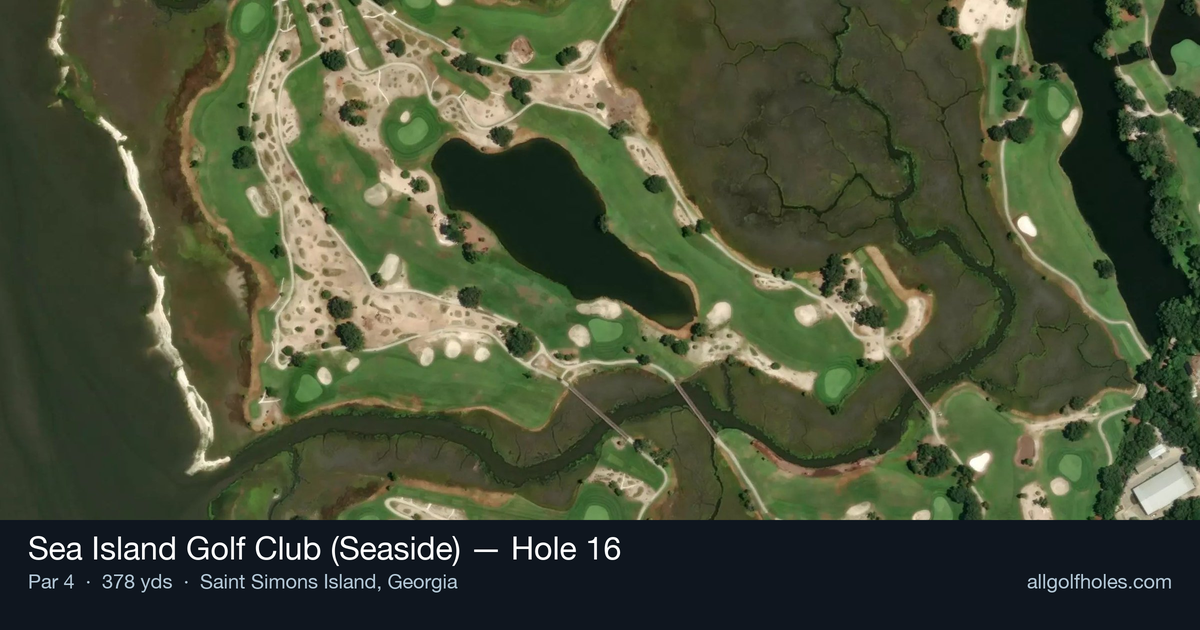
Aerial source not provided
Green size: 25 yds deep × 41 yds wide
Scorecard yardage is for Championship tees. The aerial shows its labeled reference position; distance rings measure to the green.
Championship tees · Par 4 · 378 yards
The plan for No. 16
The 16th hole at Sea Island Golf Club (Seaside) embodies the unpredictable nature of true links golf, where wind conditions transform this 378-yard par 4 from a straightforward approach into a strategic puzzle. This deceptively simple straight hole demands precision over power, as the ever-present coastal breeze can turn a comfortable mid-iron approach into a white-knuckle long iron battle. The small green rewards accuracy, punishing wayward approach shots that fail to account for the swirling winds off the Georgia coast. With no significant hazards to navigate, the challenge lies entirely in reading the elements and executing under pressure. This is proper links golf at its finest, where club selection changes with each gust, making Sea Island Golf Club (Seaside) hole 16 a memorable test of adaptability and course management that defines the Seaside experience.
Off the tee
Your tee shot strategy must begin with a thorough wind assessment. On calm days, a driver or 3-wood down the center of the fairway sets up an ideal approach angle. However, when the coastal winds are up, consider taking less club to maintain control and accuracy. The straight layout allows for aggressive play when conditions permit, but smart golfers will prioritize finding the fairway over maximum distance. Aim for the center of the landing zone, typically around the 250-yard mark, which provides the best angle into the small green.
Approach & recovery
The approach shot to this small green requires careful club selection based on wind conditions. What might normally be a comfortable 7-iron on a calm day could easily become a hard 5-iron when fighting a headwind. Take extra time to feel the wind at ground level, as it can differ significantly from what you experience on the tee. Target the center of the green regardless of pin position, as the small target leaves little margin for error. When the wind is helping, be cautious not to fly the green, as recovery shots from beyond can be challenging.
On the green
The small green at the 16th demands respect with your putter. While specific break patterns aren't documented, expect subtle undulations typical of links-style greens. Pay particular attention to wind effects on longer putts, as the coastal breeze can influence ball roll even on the putting surface. Conservative putting strategy often pays dividends here—focus on two-putting rather than being aggressive with birdie attempts that could lead to three-putts. ## RISK VS REWARD This hole offers a classic risk/reward scenario based entirely on conditions. On calm days, aggressive play with driver followed by a short iron can yield birdie opportunities. However, when winds are swirling, the reward shifts toward playing conservatively and accepting par. The small green punishes overly aggressive approaches, making course management more valuable than raw distance. ## DIFFERENT SKILL LEVELS **High-handicap players** should prioritize accuracy over distance, especially in windy conditions. Consider hitting 3-wood or hybrid off the tee to ensure finding the fairway, then focus on hitting the center of the green with whatever club gets you there safely. Don't be afraid to take extra club when fighting the wind. **Low-handicap players** can be more aggressive in calm conditions but should still respect the wind when it's up. These players have the skill to work the ball with the wind rather than fighting it, potentially using draws or fades to their advantage. However, even scratch golfers should prioritize the center of the small green over attacking pins. The 16th hole at Sea Island's Seaside Course perfectly embodies the essence of links golf—where Mother Nature serves as the primary architect of your round. Success here comes from reading conditions, making smart decisions, and executing with precision rather than power.
Watch for
- Course conditioning and mapped hazards may affect line selection; confirm from the aerial.
Hole 16 Green Complex
Mapped green boundary
Green size: 5,408 sq ft
How did Hole 16 play?
How did this hole play today?
Frequently asked questions
Yardage reference: Championship tees · 378 yards.
What's the best strategy off the tee?
↓
For this 378-yard par 4, most players will hit 3-wood or driver to set up a comfortable approach.
How difficult is hole 16?
↓
This hole is a moderate challenge for most golfers. Key challenges include: water in play.
How big is the green on hole 16?
↓
The green is medium-sized with moderate targets. The green is deeper than wide, so club selection is crucial. Pay attention to pin placement when selecting your approach club.
Which side of the fairway is safer on hole 16?
↓
Aim for the right side of the fairway when possible. Missing left (water) brings more trouble into play.
What's a good score on hole 16?
↓
This hole is a medium-length test where par is a solid result. A straightforward par 4 where course management pays off.