Hole 5 at Sea Island Golf Club (Seaside)
- Par
- 4
- Yardage
- 388 yds
- Stroke index
- 7
- Hazards
- 2 bunkers
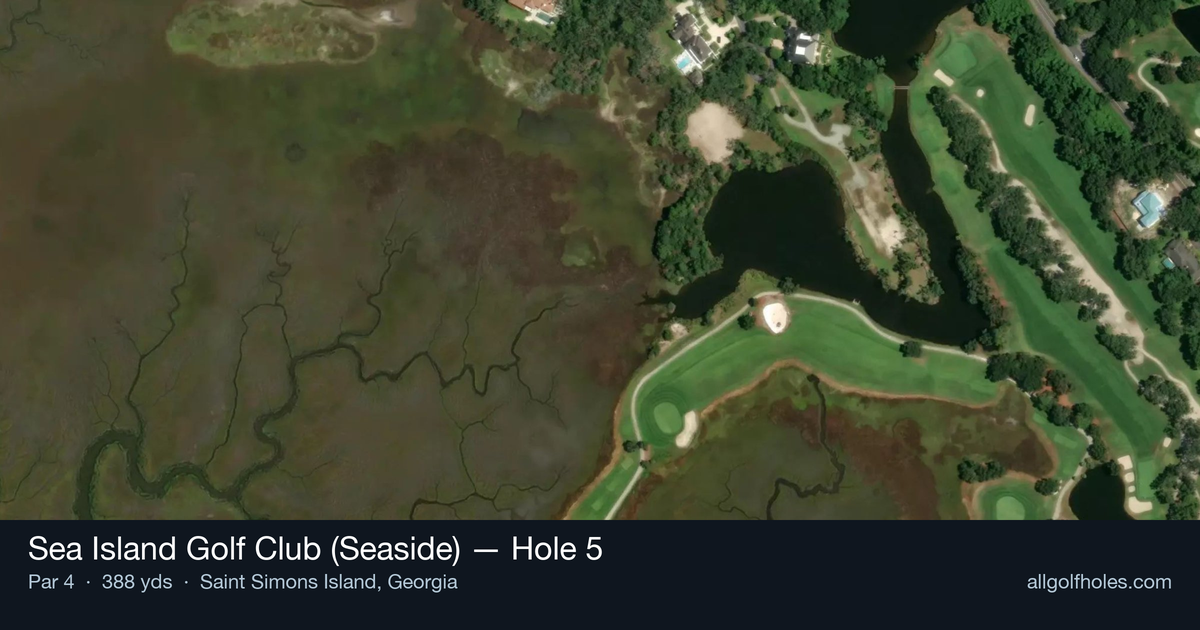
Aerial source not provided
Green size: 30 yds deep × 29 yds wide
Scorecard yardage is for Championship tees. The aerial shows its labeled reference position; distance rings measure to the green.
Championship tees · Par 4 · 388 yards
The plan for No. 5
The fifth hole at Sea Island Golf Club (Seaside) embodies the essence of proper links golf, where coastal winds transform this 388-yard par 4 into a strategic puzzle that demands respect. This seemingly straightforward layout deceives players with its wind-swept challenges, often requiring a 5-iron where you'd normally reach for a comfortable 7. The tee shot must navigate the ever-present Georgia coastal breeze to find the generous fairway, while the approach shot to the small green requires precise club selection and wind calculation. Walking in the footsteps of Bobby Jones, who praised this historic course during his Grand Slam year, golfers experience authentic seaside conditions where reading the wind becomes as crucial as reading the greens, making every round a memorable test of links golf mastery.
Off the tee
Your tee shot strategy must prioritize positioning over distance, setting up the optimal angle for your approach to the small green. With no significant hazards threatening the landing zone, focus your target line down the center-left portion of the fairway to provide the best approach angle. Club selection depends entirely on wind conditions – into the wind, consider driver or 3-wood to maintain adequate distance, while downwind conditions might call for a more controlled fairway wood or long iron to avoid running through the ideal landing zone. The key is leaving yourself with a comfortable approach distance that accounts for wind impact on your next shot.
Approach & recovery
The approach shot represents the hole's greatest challenge, particularly with the small green demanding pinpoint accuracy. Wind conditions will dramatically affect club selection – you might find yourself gripping a 5-iron where you'd normally hit a comfortable 7, as the coastal breeze plays havoc with ball flight. Aim for the center of the green regardless of pin position, as the small target leaves little margin for error. Consider taking one extra club and swinging smoothly rather than forcing a shot, allowing for better control in windy conditions. The green's compact size means any approach shot that finds the putting surface gives you a reasonable birdie opportunity.
On the green
Putting strategy centers on careful green reading, as the coastal winds can affect even short putts. The small green typically features subtle breaks that become more pronounced in windy conditions. Focus on lag putting to the center of the green when facing longer putts, as the compact surface means three-putts should be rare if you maintain conservative target lines. Pay particular attention to grain direction, which can be influenced by the prevailing coastal winds. ## RISK VS REWARD This hole offers a unique risk/reward proposition where the reward comes from precision rather than aggression. The primary risk lies in misjudging wind conditions, leading to approach shots that miss the small green entirely. The reward for accurate course management is a legitimate birdie opportunity on a hole where par represents a solid score for most players. Avoid the temptation to attack difficult pin positions – the small green makes center-green approaches the smart play. ## DIFFERENT SKILL LEVELS **High-handicap players** should embrace conservative course management, focusing on finding the fairway with their most reliable tee shot and aiming for the center of the green regardless of pin position. Accept that wind conditions may require significant club adjustments, and don't hesitate to take extra club on the approach shot. **Low-handicap players** can be more aggressive with pin hunting, but must still respect the wind's influence on club selection. These players should focus on precise distance control and consider working the ball with or against the wind to optimize their approach angle. The small green rewards accuracy over aggression, making this a hole where course management trumps raw distance. This hole exemplifies why Bobby Jones praised Sea Island's Seaside course, offering a pure test of links golf strategy where success depends on reading conditions and executing with precision rather than power.
Watch for
- Course conditioning and mapped hazards may affect line selection; confirm from the aerial.
Hole 5 Green Complex
Mapped green boundary
Green size: 4,583 sq ft
How did Hole 5 play?
How did this hole play today?
Frequently asked questions
Yardage reference: Championship tees · 388 yards.
What's the best strategy off the tee?
↓
For this 388-yard par 4, most players will hit driver to set up a comfortable approach.
How difficult is hole 5?
↓
This hole is a good scoring opportunity for most golfers.
How big is the green on hole 5?
↓
The green is medium-sized with moderate targets. Pay attention to pin placement when selecting your approach club.
What's a good score on hole 5?
↓
This hole is a medium-length test where par is a solid result. A straightforward par 4 where course management pays off.