Hole 17 at Sea Island Golf Club (Seaside)
- Par
- 3
- Yardage
- 176 yds
- Stroke index
- 18
- Hazards
- 2 bunkers · Water
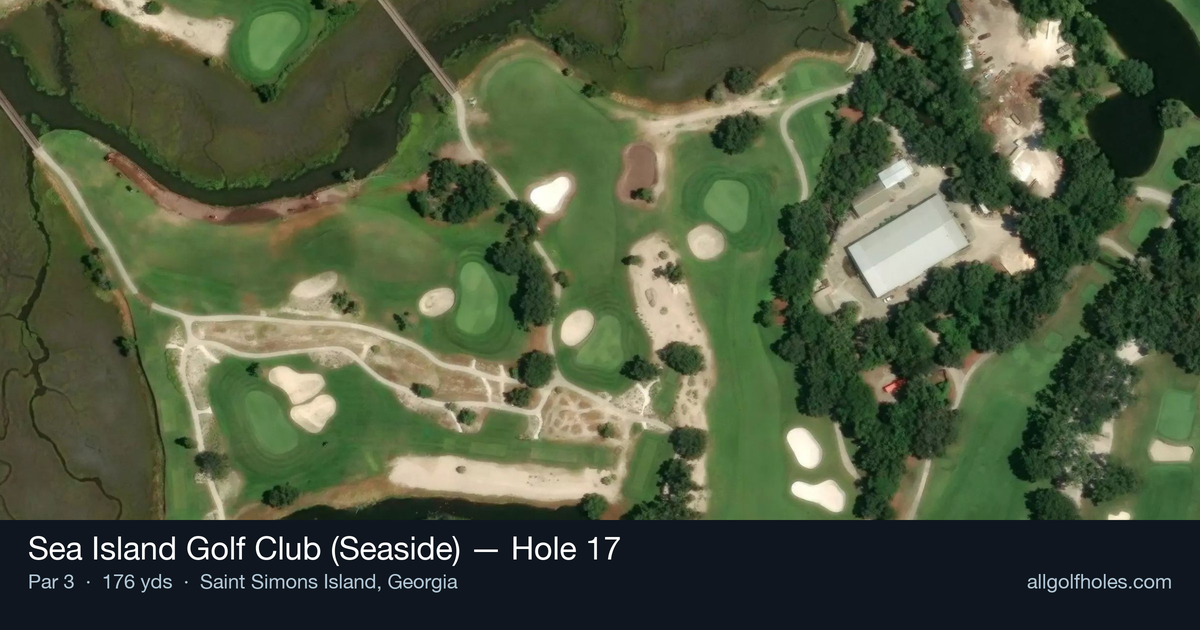
Aerial source not provided
Green size: 35 yds deep × 37 yds wide
Scorecard yardage is for Championship tees. The aerial shows its labeled reference position; distance rings measure to the green.
Championship tees · Par 3 · 176 yards
The plan for No. 17
The 17th at Sea Island Golf Club (Seaside) embodies the essence of proper links golf, where wind management trumps distance calculation. This deceptively challenging par 3 stretches 176 yards to a compact green that demands precision over power. The coastal winds that sweep across St. Simons Island transform what appears to be a comfortable mid-iron into a club selection puzzle that has golfers reaching for everything from a smooth 5-iron to a punched 8-iron depending on conditions. The small target green offers little margin for error, rewarding only the most committed swings. Bobby Jones himself praised this historic course after playing here during his Grand Slam year, and this hole exemplifies why the Seaside layout remains a favorite among touring professionals who call Sea Island home.
Off the tee
Club selection is everything on this tee shot, and it starts with reading the wind conditions. Spend extra time observing flag movement, feeling the breeze on your face, and watching how the wind affects the ball flight of players ahead. Your normal 176-yard club may be completely inadequate - be prepared to take up to two clubs more in strong headwinds or crosswinds. Target the center of the small green regardless of pin position. The margin for error is slim, and trying to get cute with pin hunting often leads to missed greens and difficult up-and-downs. Focus on a smooth, controlled swing that ensures solid contact rather than trying to muscle the ball through the wind.
Approach & recovery
Since this is a par 3, your tee shot IS your approach shot. The key is committing fully to your club selection after reading the wind. Half-hearted swings with too little club or overly aggressive swings with too much club both spell trouble on this hole. Pay attention to the ground conditions around the green. Links-style courses often feature firm, fast-running surfaces that can help a well-struck shot that lands short of the green kick forward onto the putting surface. Conversely, these same conditions can send an overly aggressive shot bounding over the back.
On the green
The small green size means you'll likely face relatively short putts if you hit the green in regulation. However, don't underestimate the subtleties of reading breaks on a links-style green. The coastal winds that affect your tee shot also influence ball roll on the putting surface. Take time to read your putts carefully - as the saying goes about Sea Island, you'll spend as much time reading the wind on putts as you do on full shots. Pay attention to the grain direction, which often follows the prevailing wind patterns, and be aware that putts may break differently than they appear due to wind influence. ## RISK VS REWARD This hole presents a classic risk/reward scenario disguised as a straightforward par 3. The reward for aggressive play is minimal - attacking pins on a small green rarely pays off. The smart play is always center green, accepting a 20-30 foot putt for birdie rather than risking a missed green and a difficult chip shot. The biggest risk comes from underestimating the wind and coming up short, or overcompensating and flying the green entirely. Both scenarios make par a challenge and bogey a real possibility. ## DIFFERENT SKILL LEVELS **High Handicappers:** Focus entirely on hitting the green, regardless of pin position. Take an extra club in any doubt situation - it's better to be long and putting than short and chipping. Don't let the wind intimidate you; make a confident swing with your selected club. **Low Handicappers:** Use your experience reading wind conditions to make precise club selections. Consider the pin position only if you're completely confident in your wind read and contact quality. This is a hole where course management trumps aggressive play - even tour professionals prioritize the center of the green here. The 17th hole at Sea Island's Seaside Course rewards patience, precision, and respect for the elements. Master the wind reading, commit to your club selection, and aim for the heart of the green to score well on this historic and challenging par 3.
Watch for
- Course conditioning and mapped hazards may affect line selection; confirm from the aerial.
Hole 17 Green Complex
Mapped green boundary
Green size: 5,415 sq ft
How did Hole 17 play?
How did this hole play today?
Frequently asked questions
Yardage reference: Championship tees · 176 yards.
What club should I use on this par 3?
↓
At 176 yards, most golfers will need a mid-iron (7-iron to 8-iron) to reach this green. Adjust for elevation, wind, and pin position.
How difficult is hole 17?
↓
This hole is a moderate challenge for most golfers. Key challenges include: water in play.
What hazards should I watch out for on hole 17?
↓
Key hazards include: 2 greenside bunkers; water at 118.3 yards. Plan your shots to avoid these trouble spots.
How big is the green on hole 17?
↓
The green is medium-sized with moderate targets. Pay attention to pin placement when selecting your approach club.
Where is the best miss on hole 17?
↓
If you're going to miss the green, favor the right side. The left (water) brings more trouble into play and makes recovery difficult.
What's a good score on hole 17?
↓
This hole is a solid par with birdie chances for precise approach shots. Making par is a good result here. Focus on hitting the green and avoiding three-putts.