Hole 13 at Sea Island Golf Club (Seaside)
- Par
- 4
- Yardage
- 409 yds
- Stroke index
- 2
- Hazards
- 5 bunkers · Water
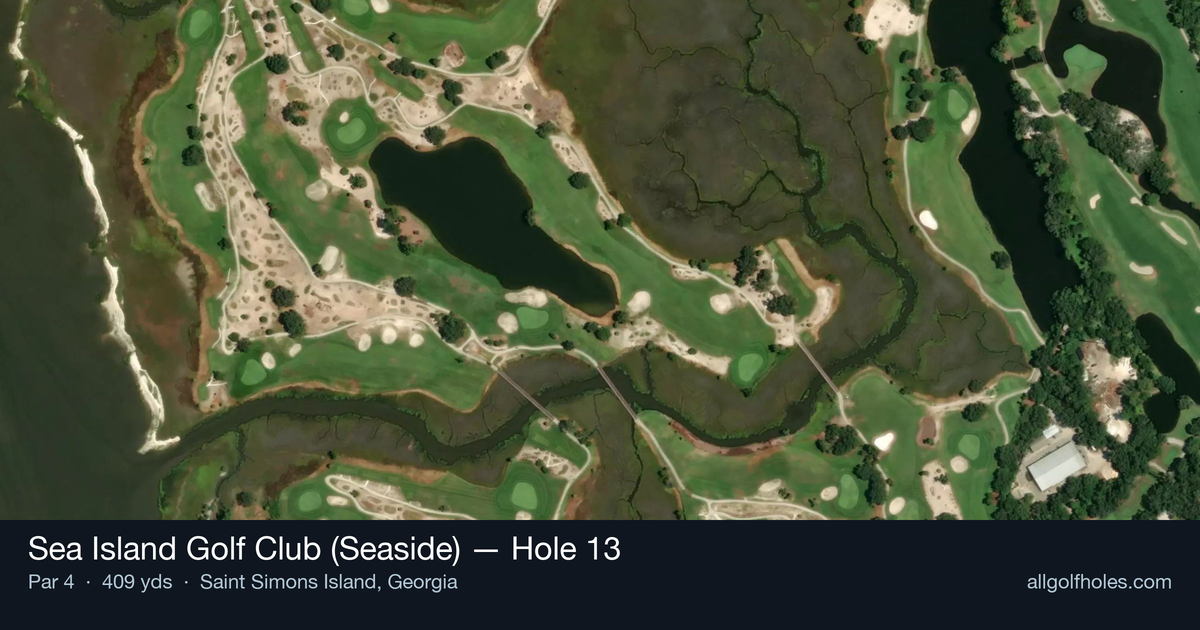
Aerial source not provided
Green size: 29 yds deep × 33 yds wide
Scorecard yardage is for Championship tees. The aerial shows its labeled reference position; distance rings measure to the green.
Championship tees · Par 4 · 409 yards
The plan for No. 13
The 13th hole at Sea Island Golf Club (Seaside) embodies the unpredictable nature of links golf that has captivated players since Bobby Jones praised this coastal gem in 1930. This 409-yard par 4 presents a deceptively straightforward challenge where the Atlantic winds transform strategy with each round. The generous fairway invites an aggressive tee shot, but the ever-changing coastal breezes demand careful club selection and course management. The small green complex requires precision on the approach shot, as wind conditions can turn a comfortable 7-iron into a gripping 5-iron decision. With its #2 handicap ranking, this hole exemplifies proper links golf where reading the wind becomes as crucial as reading putts, creating a memorable test that changes personality with each passing breeze.
Off the tee
Your tee shot strategy must begin with a careful wind assessment. On calm days, a driver or 3-wood down the center provides the ideal angle for your approach. However, when the wind is up—which is often at Seaside—club selection becomes critical. A helping wind might require throttling back to avoid running through the ideal landing zone, while a headwind could demand a longer club to reach optimal position. Target the center-left portion of the fairway to set up the best angle to the small green. Avoid the temptation to get too aggressive with your line, as the straight layout rewards conservative positioning over distance. Focus on finding the short grass rather than maximizing yardage.
Approach & recovery
The approach shot to this small green is where the hole shows its teeth. Wind direction will dictate everything from club selection to target line. What might be a comfortable 7-iron on a still day could easily become a hard 5-iron when battling a stiff headwind. Aim for the center of the green regardless of pin position—the small target leaves little room for error. Take extra club in headwinds and consider the ball's reaction upon landing, as firm conditions are typical of links golf. Pay special attention to crosswinds, which can move the ball significantly during its flight to the green.
On the green
The small green at the 13th demands precision with your putter. Coastal winds can affect even short putts, so factor in any breeze when reading breaks. The putting surface typically reflects links characteristics, meaning firm conditions and subtle undulations that may not be immediately apparent. Focus on distance control above all else, as three-putting this small green is a scoring killer. When the pin is tucked near an edge, aim for the fat part of the green and accept a longer first putt rather than risk missing the surface entirely. ## RISK VS REWARD This hole's risk/reward equation centers entirely around wind management and target selection. The reward comes from accepting what the conditions give you rather than fighting them. Aggressive lines or club selections in windy conditions rarely pay off on this unforgiving test. The smart play is to embrace the links philosophy: work with the wind rather than against it, and prioritize finding the green over attacking pins. Par is always a good score on the #2 handicap hole. ## DIFFERENT SKILL LEVELS **High-handicap players** should focus on keeping the ball in play off the tee, even if it means using a hybrid or long iron for accuracy. On the approach, aim for the center of the green regardless of conditions and take plenty of club to ensure you reach the putting surface. **Low-handicap players** can be more aggressive with driver off the tee but must still respect the wind. Your better ball-striking ability allows for more precise club selection on approach shots, but resist the urge to attack tucked pins on this small target. Even skilled players benefit from conservative target selection here. **Mid-handicap players** should play this hole like a low-handicapper on windy days and like a high-handicapper when conditions are calm. Your developing course management skills will be tested, making this an excellent hole to practice patience and strategic thinking. The key for all skill levels is remembering that at Seaside, as Bobby Jones noted, you're playing "one of the very best" tests of golf—and that means respecting both the design and the elements that make each round unique.
Watch for
- Course conditioning and mapped hazards may affect line selection; confirm from the aerial.
Hole 13 Green Complex
Mapped green boundary
Green size: 4,817 sq ft
How did Hole 13 play?
How did this hole play today?
Frequently asked questions
Yardage reference: Championship tees · 409 yards.
What's the best strategy off the tee?
↓
For this 409-yard par 4, most players will hit driver to set up a comfortable approach.
How difficult is hole 13?
↓
This hole is one of the tougher holes on the course for most golfers. Key challenges include: water in play, heavily bunkered.
How big is the green on hole 13?
↓
The green is medium-sized with moderate targets. Pay attention to pin placement when selecting your approach club.
Which side of the fairway is safer on hole 13?
↓
Aim for the left side of the fairway when possible. Missing right (water) brings more trouble into play.