Hole 16 at PGA West (Nicklaus Tournament course)
- Par
- 4
- Yardage
- 440 yds
- Stroke index
- 4
- Hazards
- 11 bunkers · Water
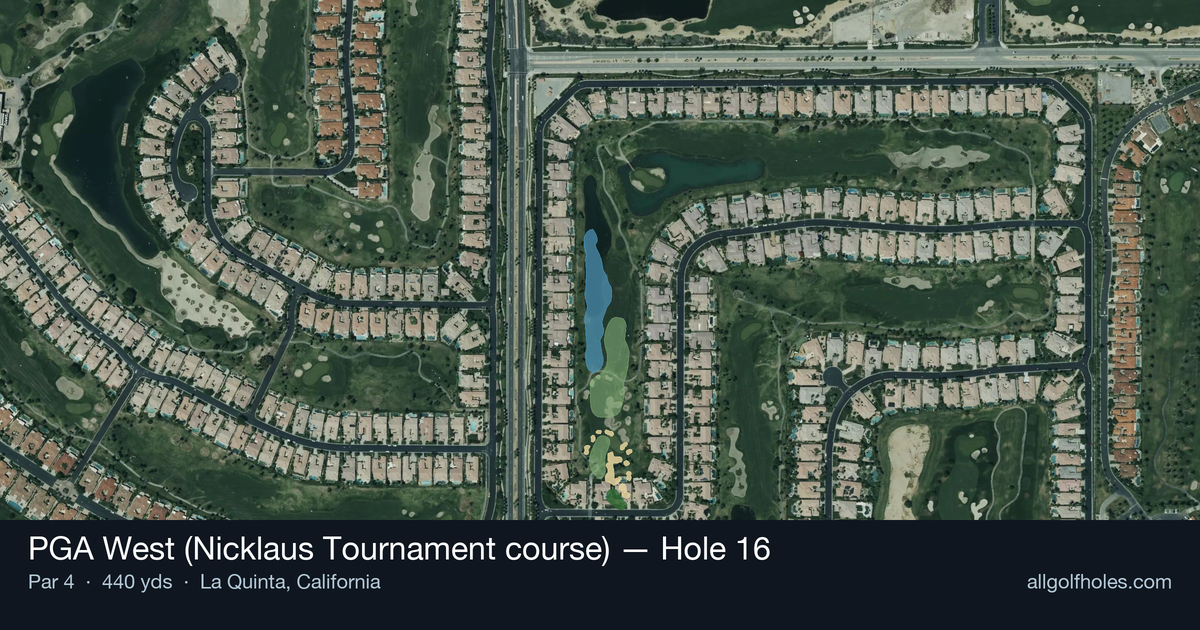
Aerial source not provided
Green size: 32 yds deep × 30 yds wide
Scorecard yardage is for Championship tees. The aerial shows its labeled reference position; distance rings measure to the green.
Championship tees · Par 4 · 440 yards
The plan for No. 16
The 16th hole at PGA West's Nicklaus Tournament course presents a deceptive challenge that demands precision over power. This straight par 4 stretches 440 yards through the desert landscape, offering golfers a seemingly straightforward test that reveals its true character upon closer inspection. The tee shot requires careful placement to set up the optimal approach angle, as the fairway's subtle contours can influence ball position and stance. What makes this hole particularly intriguing is the small green complex that serves as the ultimate target, demanding pinpoint accuracy on the approach shot. Without significant hazards to distract, golfers must focus entirely on execution and course management. The hole's beauty lies in its pure golf challenge – rewarding those who can consistently find the proper positions while punishing wayward shots with difficult recovery situations.
Off the tee
The tee shot strategy centers on gaining optimal position for your approach while maximizing distance down this 440-yard hole. With no significant hazards flanking the fairway, you can be aggressive with your driver, focusing on the center-left portion of the fairway to set up the best angle to the green. The key is committing to a full swing while maintaining balance and tempo - this hole rewards confidence off the tee. Players should aim to carry their drive at least 250 yards to leave a manageable approach shot, as coming up short on this lengthy par 4 can leave an intimidating long-iron or hybrid into that small green.
Approach & recovery
The approach shot represents the hole's primary defense, with the small green demanding pinpoint accuracy. From the optimal driving position, you'll likely face a mid-iron to long-iron depending on conditions and your driving distance. Focus on the center of the green regardless of pin position - the compact putting surface leaves little room for error, and missing short-sided can lead to difficult up-and-downs. Take one extra club and swing smoothly rather than forcing a shot, as the green's size makes distance control more critical than pin-hunting. Pay attention to wind conditions, as they can significantly affect club selection on this exposed approach.
On the green
While the green shape remains unknown, its small size suggests that lag putting becomes crucial for avoiding three-putts. Focus on getting your first putt within a comfortable two-putt range rather than being overly aggressive toward difficult pin positions. The elevated nature of many desert course greens means putts may be faster than they appear, so err on the side of caution with your speed. Study the slopes carefully during your approach - small greens often feature subtle breaks that become magnified over shorter distances. ## RISK VS REWARD This hole presents a classic risk/reward scenario in club selection rather than target selection. The primary decision point comes with approach shot aggressiveness - playing safely to the center of the green versus attacking pins. Given the small target, the smart play is almost always the center of the green, treating this as a par hole where bogey isn't disastrous. The reward for precise execution is a legitimate birdie opportunity, but the risk of missing the green entirely can quickly turn this into a difficult bogey or worse. ## DIFFERENT SKILL LEVELS **High-Handicap Players:** Focus on two solid shots rather than trying to overpower the hole. Use a fairway wood or hybrid off the tee if driver accuracy is inconsistent, prioritizing position over distance. On the approach, take plenty of club and aim for the center of the green, accepting the longer putt in exchange for avoiding short-sided situations. **Low-Handicap Players:** This hole rewards aggressive play matched with precise execution. Attack with driver off the tee to leave the shortest possible approach, then trust your distance control to attack pins when conditions allow. The small green makes this an excellent scoring opportunity for players who can consistently hit their numbers, but respect the target size when pins are tucked in difficult positions.
Watch for
- Course conditioning and mapped hazards may affect line selection; confirm from the aerial.
Hole 16 Green Complex
Mapped green boundary
Green size: 4,286 sq ft
How did Hole 16 play?
How did this hole play today?
Frequently asked questions
Yardage reference: Championship tees · 440 yards.
What's the best strategy off the tee?
↓
For this 440-yard par 4, most players will hit driver to set up a comfortable approach.
How difficult is hole 16?
↓
This hole is one of the tougher holes on the course for most golfers. Key challenges include: water in play, small green.
What hazards should I watch out for on hole 16?
↓
Key hazards include: water at 135.3 yards. Plan your shots to avoid these trouble spots.
How big is the green on hole 16?
↓
The green is small and requires precision. Expect challenging pin positions with limited room for error.
What's a good score on hole 16?
↓
This hole is a demanding hole where bogey is not unusual. This longer par 4 will test most golfers. Focus on position over distance.