Hole 15 at PGA West (Nicklaus Tournament course)
- Par
- 5
- Yardage
- 572 yds
- Stroke index
- 6
- Hazards
- 4 bunkers · Water
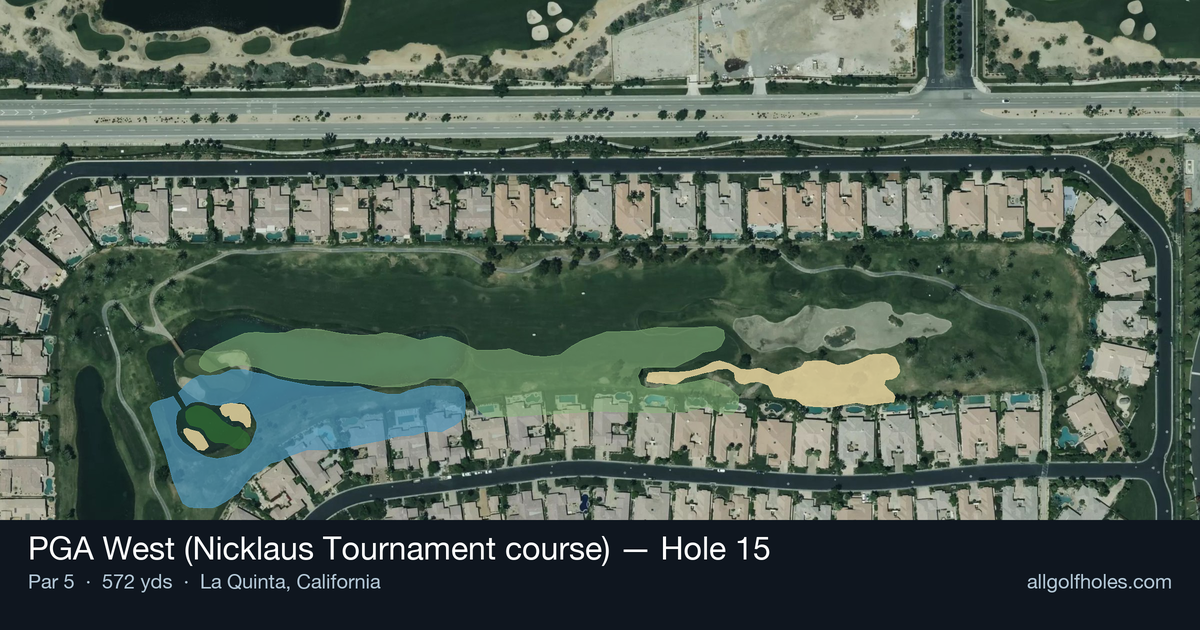
Aerial source not provided
Green size: 44 yds deep × 32 yds wide
Scorecard yardage is for Championship tees. The aerial shows its labeled reference position; distance rings measure to the green.
Championship tees · Par 5 · 572 yards
The plan for No. 15
The 15th hole at PGA West's Nicklaus Tournament course presents a compelling par 5 that rewards aggressive play while punishing wayward shots. At 572 yards, this straight-away layout appears deceptively simple, but the absence of major hazards creates its own strategic complexity. The generous fairway invites drivers to unleash their power, yet precise positioning becomes crucial for optimal approach angles to the small, well-guarded green complex. What makes this hole particularly challenging is the premium it places on accuracy over distance - players must thread their second shots carefully to set up manageable approaches to the compact putting surface. The hole exemplifies Nicklaus's design philosophy of rewarding thoughtful course management over pure length.
Off the tee
The opening shot sets the tone for your entire hole strategy. With a straight layout and minimal trouble, focus on finding the optimal position for your second shot rather than maximum distance. Most golfers should aim for the center-right portion of the fairway, which typically provides the best angle for the approach. Driver is often the right choice here, but don't force it if conditions are windy or you're struggling with accuracy. A well-struck 3-wood that finds the short grass is infinitely better than a driver that strays into the rough. Your target line should favor avoiding any subtle slopes or undulations that might create an awkward lie for your second shot. Pay attention to pin position when selecting your target - if the flag is tucked on one side of the small green, positioning yourself for the best approach angle becomes even more critical.
Approach & recovery
This is where strategic thinking becomes paramount. For most golfers, the second shot is about advancing the ball into prime position for a manageable third shot into the small green. Resist the temptation to force a heroic second shot unless you're confident you can execute it perfectly. The ideal second shot leaves you with a comfortable wedge or short iron for your third, typically positioning the ball somewhere in the 80-120 yard range from the green. Longer hitters who can legitimately reach the green in two should carefully assess conditions - wind, lie, and pin position all factor into this high-risk, high-reward decision. When hitting your approach into the green (whether second or third shot), the small target demands precision. Favor the center of the green unless you have a short iron and perfect conditions. The putting surface's compact size means even slight misses can leave challenging up-and-down situations.
On the green
The small green creates interesting dynamics for putting strategy. While shorter putts are more common due to the compact surface, the reduced target size on approaches often means you'll face more challenging pin positions relative to your ball position. Read putts carefully, as subtle breaks can be magnified on smaller greens. Focus on lag putting to the center of the green when facing longer putts, as the limited real estate makes three-putting a real possibility if you're overly aggressive. When the pin is near an edge, be especially cautious about putting beyond the hole. ## RISK VS REWARD The primary risk/reward decision centers on whether to attempt reaching the green in two shots. This gamble typically only makes sense for low-handicap players with perfect conditions and optimal positioning after the tee shot. The reward - a potential eagle opportunity - must be weighed against the increased likelihood of missing the small green and facing a difficult recovery. For most golfers, the smarter play is treating this as a strategic three-shot hole where the reward comes from methodical course management rather than heroic shot-making. A well-executed plan often yields birdie opportunities with significantly less risk. ## DIFFERENT SKILL LEVELS **High-Handicap Players:** Embrace the three-shot strategy completely. Focus on two solid shots that leave a comfortable wedge into the green. Don't be tempted by the lack of obvious hazards - the small green is defense enough. Prioritize keeping the ball in play and giving yourself the best chance for a manageable third shot. **Low-Handicap Players:** You have more options, including the legitimate possibility of reaching in two under favorable conditions. However, don't let ego override smart course management. Assess each shot individually and be honest about execution capabilities. When in doubt, take the conservative approach and rely on your short game to create birdie opportunities. The key for all skill levels is recognizing that this hole rewards patience and precision over power and aggression.
Watch for
- Course conditioning and mapped hazards may affect line selection; confirm from the aerial.
Hole 15 Green Complex
Mapped green boundary
Green size: 4,918 sq ft
How did Hole 15 play?
How did this hole play today?
Frequently asked questions
Yardage reference: Championship tees · 572 yards.
Can this par 5 be reached in two?
↓
At 572 yards, A true three-shot hole for most players. Position your layup to leave a comfortable wedge distance.
How difficult is hole 15?
↓
This hole is a moderate challenge for most golfers. Key challenges include: long par 5, water in play.
What hazards should I watch out for on hole 15?
↓
Key hazards include: water at 516.6 yards. Plan your shots to avoid these trouble spots.
How big is the green on hole 15?
↓
The green is medium-sized with moderate targets. The green is wider than it is deep, rewarding shots that find the correct tier. Pay attention to pin placement when selecting your approach club.
What's a good score on hole 15?
↓
This hole is a true three-shot hole where birdie requires execution. This longer par 5 demands patience. Two good shots set up the scoring opportunity.