Hole 13 at PGA West (Nicklaus Tournament course)
- Par
- 4
- Yardage
- 419 yds
- Stroke index
- 8
- Hazards
- 5 bunkers · Water
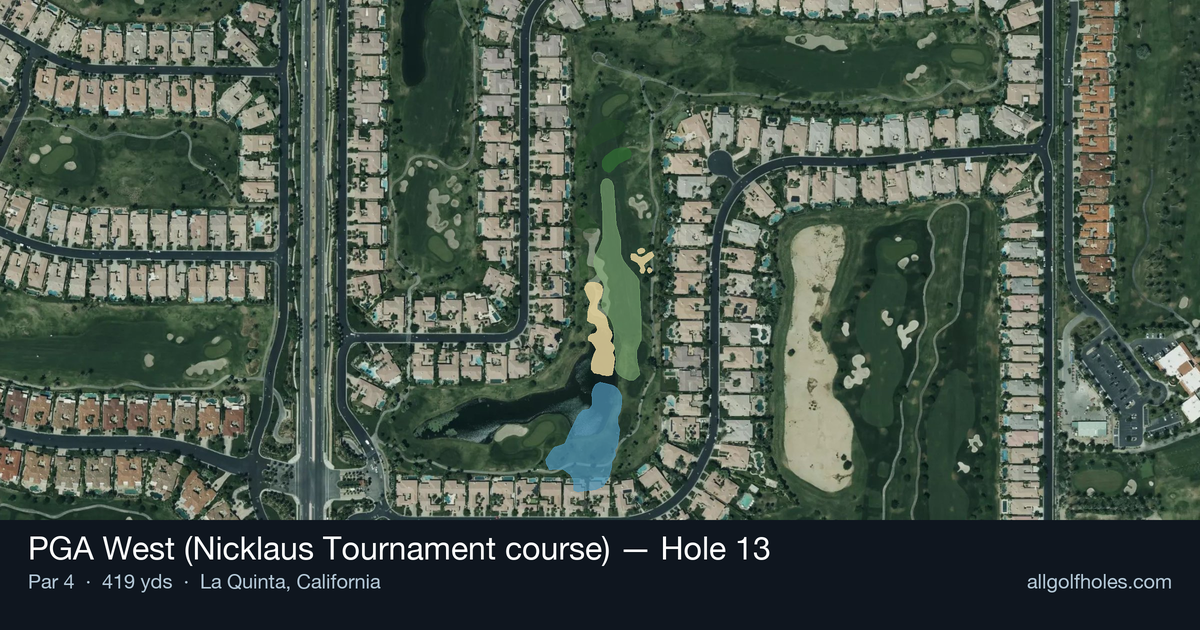
Aerial source not provided
Green size: 30 yds deep × 34 yds wide
Scorecard yardage is for Championship tees. The aerial shows its labeled reference position; distance rings measure to the green.
Championship tees · Par 4 · 419 yards
The plan for No. 13
The 13th hole at PGA West's Nicklaus Tournament course presents a deceptively straightforward par 4 that demands precision over power. At 419 yards, this straight-away challenge features a generous fairway that welcomes aggressive tee shots, but the real test awaits at the green complex. The small, subtly contoured putting surface requires a well-calculated approach shot, as anything short or long leaves difficult recovery options. Without significant hazards to navigate, golfers must focus on distance control and green reading. This hole exemplifies Jack Nicklaus's design philosophy of rewarding strategic thinking, where the absence of obvious trouble creates its own psychological pressure and makes par a satisfying achievement.
Off the tee
The tee shot strategy centers on finding the optimal position for your approach shot while avoiding the temptation to overpower this relatively short par 4. Most players should focus on a controlled drive with a fairway wood or hybrid, aiming for the center-left portion of the fairway to create the best angle into the small green. Longer hitters might consider a 3-wood or even a long iron to ensure they stay in the prime landing zone, as distance control is more valuable than raw length on this hole. The straight layout means accuracy trumps distance - prioritize finding the short grass over trying to get as close as possible to the green.
Approach & recovery
The approach shot is where this hole's true challenge reveals itself. With a small green as your target, club selection becomes critical - take one more club than you think you need and focus on smooth tempo rather than aggressive swings. Aim for the center of the green regardless of pin position, as the small target makes going flag-hunting a risky proposition. Pay attention to wind conditions, as they'll have a magnified effect on approach shots to such a compact target. If you find yourself between clubs, always take the longer option and focus on solid contact rather than trying to manufacture distance.
On the green
The small green demands respect with your putter selection and read. Approach putts conservatively, focusing on getting your first putt close rather than being aggressive toward the hole. The compact surface means even modest slopes can create tricky breaking putts, so take extra time to read the green from multiple angles. Lag putting becomes especially important here - leaving yourself a tap-in second putt is often more valuable than risking a three-putt by being too aggressive on longer attempts. ## RISK VS REWARD The primary risk/reward decision comes with tee shot club selection. Aggressive players might be tempted to hit driver to leave a short wedge into the green, but this increases the chance of finding trouble or awkward lies that make the approach more difficult. The safer play - hitting a controlled fairway wood or hybrid - leaves a mid-iron approach but from a perfect lie and angle. Given the small green, the difference between a wedge and a 7-iron approach is less significant than ensuring you're hitting from the fairway. ## DIFFERENT SKILL LEVELS **High-Handicap Players:** Focus on course management over aggressive play. Use a fairway wood or hybrid off the tee to ensure you find the fairway, then take plenty of club for your approach shot and aim for the center of the green. Don't worry about pin positions - the small green makes center-green the smart target every time. **Low-Handicap Players:** You can be more aggressive with driver off the tee if course conditions allow, but still prioritize accuracy over distance. Your superior iron play gives you more flexibility to attack different pin positions, but respect the small green size and avoid getting too cute with your approach shots. Focus on creating birdie opportunities through precision rather than power.
Watch for
- Course conditioning and mapped hazards may affect line selection; confirm from the aerial.
Hole 13 Green Complex
Mapped green boundary
Green size: 4,316 sq ft
How did Hole 13 play?
How did this hole play today?
Frequently asked questions
Yardage reference: Championship tees · 419 yards.
What's the best strategy off the tee?
↓
For this 419-yard par 4, most players will hit driver to set up a comfortable approach.
How difficult is hole 13?
↓
This hole is one of the tougher holes on the course for most golfers. Key challenges include: water in play, small green.
What hazards should I watch out for on hole 13?
↓
Key hazards include: water at 82.6 yards. Plan your shots to avoid these trouble spots.
How big is the green on hole 13?
↓
The green is small and requires precision. Expect challenging pin positions with limited room for error.