Hole 10 at PGA West (Nicklaus Tournament course)
- Par
- 4
- Yardage
- 370 yds
- Stroke index
- 14
- Hazards
- 6 bunkers
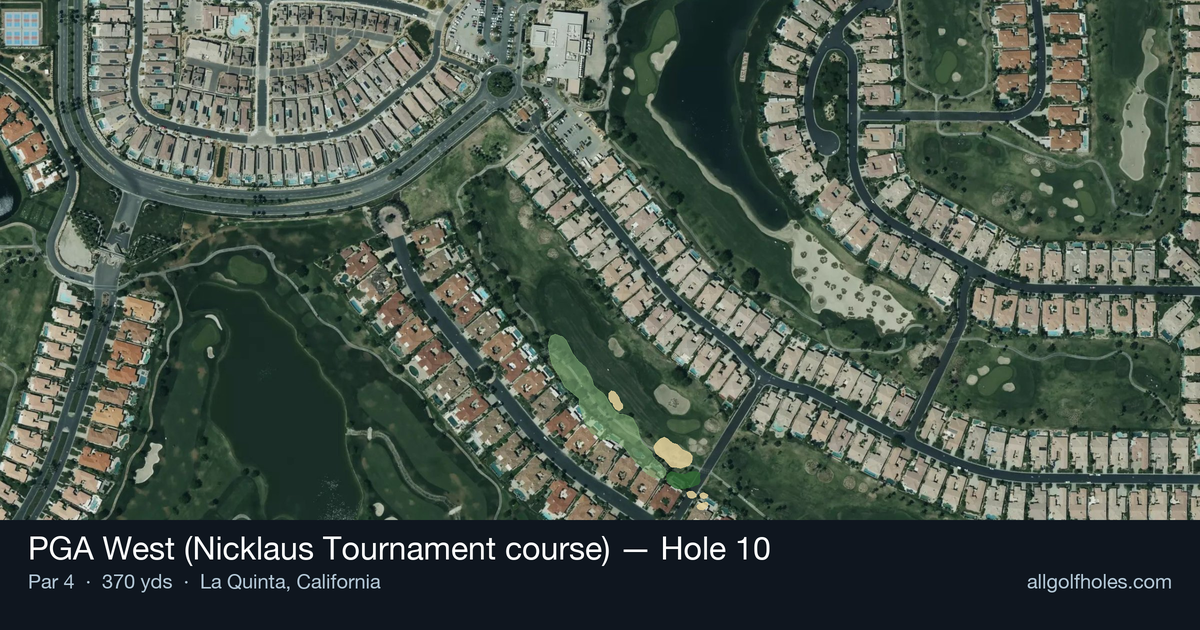
Aerial source not provided
Green size: 31 yds deep × 35 yds wide
Scorecard yardage is for Championship tees. The aerial shows its labeled reference position; distance rings measure to the green.
Championship tees · Par 4 · 370 yards
The plan for No. 10
The 10th hole at PGA West's Nicklaus Tournament course offers a deceptively straightforward par 4 that rewards precision over power. At 370 yards, this straight-away hole presents a generous fairway that invites aggressive tee shots, but the real challenge lies in the approach to a small, well-protected green complex. The absence of major hazards doesn't diminish the strategic demands - golfers must navigate subtle elevation changes and consider pin position carefully when selecting their approach club. The compact green requires accurate iron play, as missing the putting surface leaves challenging up-and-down opportunities. This hole exemplifies Jack Nicklaus's design philosophy of rewarding thoughtful course management over brute force, making it a memorable test of accuracy and strategic thinking in the desert landscape of La Quinta.
Off the tee
The key off the tee is finding the optimal distance that leaves your favorite approach yardage. Most golfers should focus on accuracy over distance, targeting the center of the fairway with a controlled swing. Consider hitting 3-wood or hybrid if you tend to struggle with driver accuracy - the shorter length of this hole means you don't need maximum distance to set up a manageable approach shot. Your target line should be straight down the middle, taking advantage of the hole's straightforward design. Avoid the temptation to "grip it and rip it" just because there aren't obvious hazards visible. The real challenge comes on the approach, so position yourself in the fairway's center for the best angle into that small green.
Approach & recovery
This is where the hole's true test reveals itself. The small green size means your approach shot must be both accurate and have proper distance control. Club selection becomes critical - it's better to be slightly short and in position for an uphill chip than to fly the green and face a difficult recovery. Study the pin position carefully during your pre-round preparation or practice rounds. With a small green, pin placement dramatically affects the effective target size. When the pin is tucked, aim for the center of the green and take your par. When it's in an accessible location, you can be more aggressive with your approach. Consider the wind conditions heavily on your approach. A small green provides little margin for error if wind affects your ball flight. Take one more club and swing smoothly rather than forcing a shot that might get caught up in the breeze.
On the green
Small greens typically feature more dramatic slopes and breaks than their larger counterparts. Spend extra time reading putts from multiple angles, as subtle breaks can be magnified on compact putting surfaces. The key is controlling your speed - with less green to work with, pace becomes even more critical than line. Focus on leaving yourself below the hole whenever possible. Uphill putts are much more manageable on small greens where downhill putts can quickly run away from you. If you find yourself above the hole, prioritize getting the ball close rather than trying to make everything. ## RISK VS REWARD The primary risk/reward decision comes with tee shot club selection and approach aggressiveness. While there's temptation to fire at every pin on a hole without major hazards, the small green punishes overly aggressive play. The reward for conservative, center-of-green approaches often outweighs the risk of short-siding yourself or missing the putting surface entirely. Smart golfers will view this as a "two-putt birdie hole" rather than forcing difficult shots. Par is never a bad score, and the straightforward nature of the hole means bogey should be easily avoidable with sound strategy. ## DIFFERENT SKILL LEVELS **High-Handicap Players:** Focus entirely on finding the fairway with your tee shot, even if it means using a more lofted club. On the approach, aim for the center of the green regardless of pin position. Your primary goal should be avoiding big numbers - this hole's design allows for steady pars with smart course management. **Low-Handicap Players:** You can be more aggressive with pin-seeking approach shots, but still respect the small green size. Use your distance control skills to attack accessible pins while laying back to safe areas when the pin is tucked. This is an excellent hole to work on your short iron precision and putting under pressure. The key for all skill levels is recognizing that this hole rewards patience and precision over power and aggression. Take advantage of the scoring opportunity, but do so with calculated risks rather than reckless abandon.
Watch for
- Course conditioning and mapped hazards may affect line selection; confirm from the aerial.
Hole 10 Green Complex
Mapped green boundary
Green size: 4,409 sq ft
How did Hole 10 play?
How did this hole play today?
Frequently asked questions
Yardage reference: Championship tees · 370 yards.
What's the best strategy off the tee?
↓
For this 370-yard par 4, most players will hit 3-wood or driver to set up a comfortable approach.
How difficult is hole 10?
↓
This hole is a good scoring opportunity for most golfers. Key challenges include: small green.
How big is the green on hole 10?
↓
The green is small and requires precision. The green is wider than it is deep, rewarding shots that find the correct tier. Expect challenging pin positions with limited room for error.
What's a good score on hole 10?
↓
This hole is a medium-length test where par is a solid result. A straightforward par 4 where course management pays off.