Hole 7 at Caledonia Golf & Fish Club
- Par
- 4
- Yardage
- 399 yds
- Stroke index
- 4
- Hazards
- Water
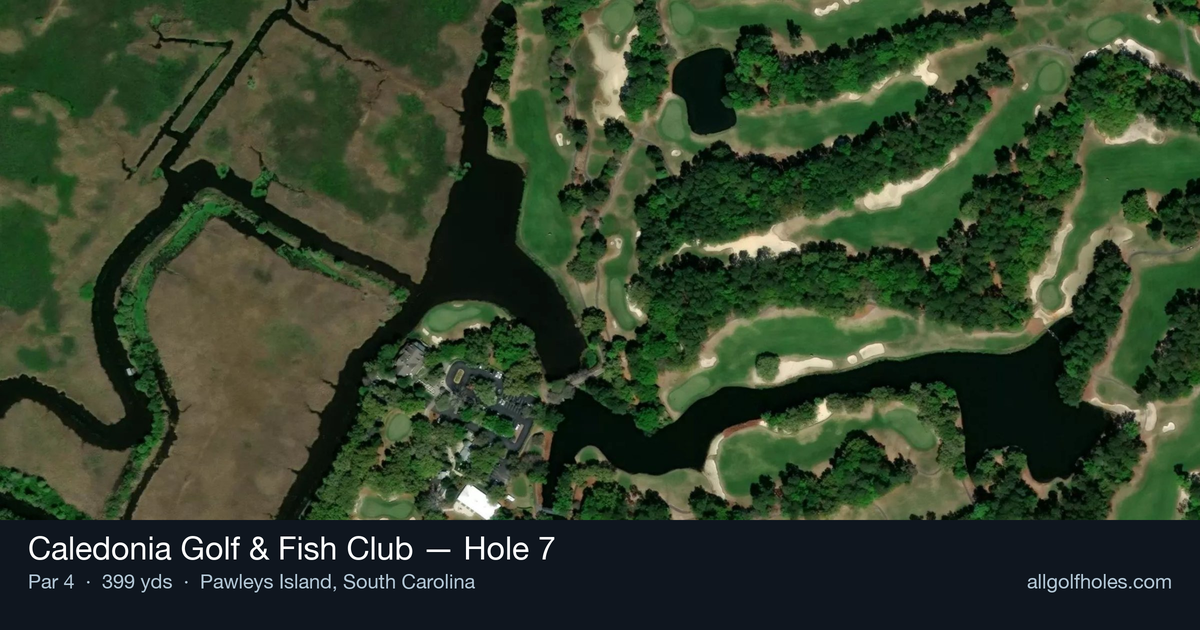
Aerial source not provided
Green size: 45 yds deep × 41 yds wide
Scorecard yardage is for Championship tees. The aerial shows its labeled reference position; distance rings measure to the green.
Championship tees · Par 4 · 399 yards
The plan for No. 7
Caledonia Golf & Fish Club hole 7 presents one of the most visually striking and strategically demanding par 4s on this storied South Carolina layout. At 399 yards, this straight hole appears deceptively straightforward until players encounter its signature challenge: a massive moss-draped live oak tree that guards the approach to the small green. With right-side pin placements, nine out of ten golfers must navigate their second shot either over or under this ancient sentinel, creating a risk-reward scenario that defines the hole's character. The tee shot allows for aggressive positioning, but the approach shot demands precise club selection and execution. This iconic hole perfectly captures Caledonia's Old South charm while testing every aspect of a player's short game, making it a memorable centerpiece in one of America's top-rated golf experiences.
Off the tee
Your tee shot strategy centers on positioning for the optimal approach angle. Drive down the left side of the fairway to open up the best line to the green, especially when pins are positioned right. A well-struck driver or strong 3-wood should find the landing zone comfortably, but accuracy trumps distance here. Avoid the temptation to bomb it - the key is leaving yourself the most manageable approach shot possible. The straight layout allows for confident swings, but focus on your target line rather than just trying to find fairway. Position is everything on this hole, as your approach angle will determine whether you're playing over, under, or around that famous oak.
Approach & recovery
This is where the hole's true character emerges. With right-side pin placements, you'll likely join the 9 out of 10 golfers who must navigate over or under the massive oak tree. The small green demands precision, making club selection critical. When the pin is right, assess the oak's position relative to your ball and the flag. Going over requires a higher trajectory shot with enough carry to clear the branches, while going under demands a lower, more controlled approach. Left-side pins offer more straightforward approaches but still require accuracy to the small target. Consider the wind conditions carefully - the oak's canopy can create unpredictable air currents that affect ball flight. Take one extra club if you're uncertain, as coming up short in the tree is far worse than being long.
On the green
The small green places a premium on approach shot accuracy, as recovery from missed greens can be challenging. Once on the putting surface, read putts carefully as subtle breaks can be deceiving. The green's compact size means most putts will be makeable, but don't underestimate the importance of lag putting on longer attempts. Pay attention to grain direction, common in South Carolina's coastal climate, as it can significantly affect ball roll, especially on breaking putts. ## RISK VS REWARD The primary risk/reward decision comes on approach shots to right pins. The aggressive play over the oak can yield closer proximity to the flag, but the penalty for catching branches is severe. The conservative play around or under the tree might leave longer putts but ensures you're putting rather than chipping. Consider your lie, confidence level, and where you stand in your round. Sometimes the smart play is accepting a 25-footer rather than risking a double bogey by being too aggressive with the oak. ## DIFFERENT SKILL LEVELS **High Handicappers:** Focus on course management over heroics. Play for the center of the green regardless of pin position, and don't be afraid to lay up short of the oak if your approach shot feels uncertain. A bogey here beats a big number, and the small green rewards conservative approaches. **Low Handicappers:** Use your shot-shaping ability to work around the oak when necessary. Consider drawing or fading the ball to create better angles, and don't hesitate to attack right pins when you have the right lie and conditions. Your precision should allow you to take advantage of scoring opportunities while managing the tree strategically. The 7th hole at Caledonia rewards patience and precision over power, making it a true test of golf strategy and execution in one of America's most beautiful settings.
Watch for
- Course conditioning and mapped hazards may affect line selection; confirm from the aerial.
Hole 7 Green Complex
Mapped green boundary
Green size: 8,051 sq ft
How did Hole 7 play?
How did this hole play today?
Frequently asked questions
Yardage reference: Championship tees · 399 yards.
What's the best strategy off the tee?
↓
For this 399-yard par 4, most players will hit driver to set up a comfortable approach.
How difficult is hole 7?
↓
This hole is a moderate challenge for most golfers. Key challenges include: water in play, large green requiring good lag putting.
What hazards should I watch out for on hole 7?
↓
Key hazards include: water at 55.9 yards. Plan your shots to avoid these trouble spots.
How big is the green on hole 7?
↓
The green is large and can play quite long. Three-putt territory if you don't manage your approach distance well.
What's a good score on hole 7?
↓
This hole is a medium-length test where par is a solid result. A straightforward par 4 where course management pays off.