Hole 7 at Aronimink Golf Club
- Par
- 4
- Yardage
- 393 yds
- Stroke index
- 11
- Hazards
- 3 bunkers
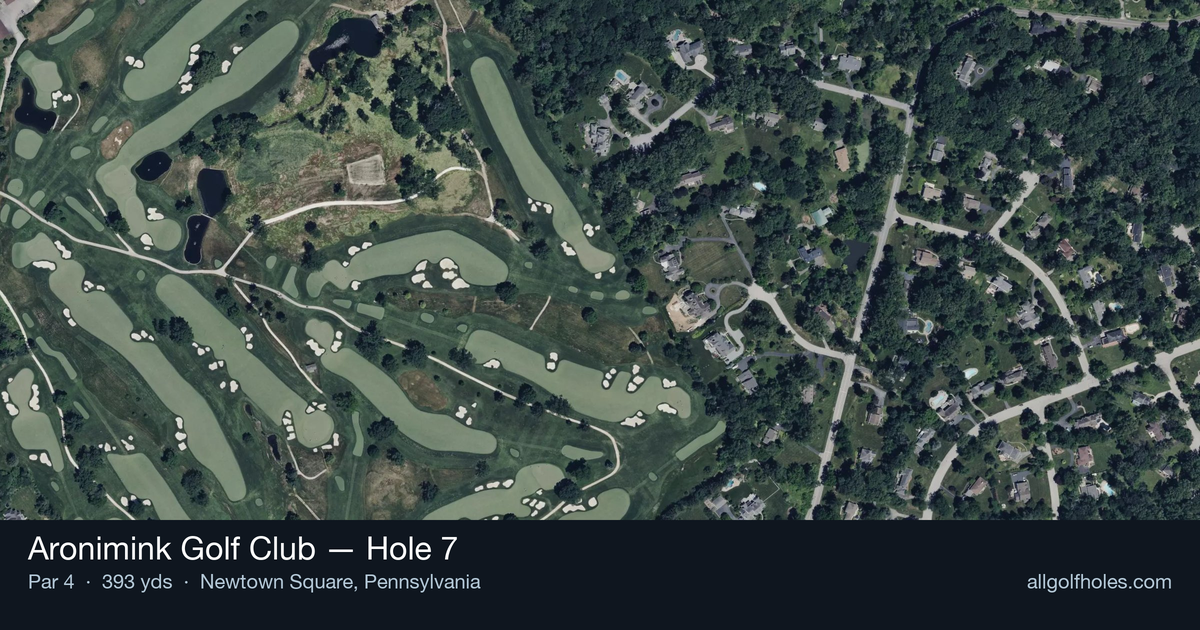
Aerial source not provided
Green size: 37 yds deep × 26 yds wide
Scorecard yardage is for Championship tees. The aerial shows its labeled reference position; distance rings measure to the green.
Championship tees · Par 4 · 393 yards
The plan for No. 7
Known affectionately as "Shawnee," Aronimink Golf Club hole 7 exemplifies Donald Ross's masterful use of natural terrain in this classic dogleg right par 4. The tee shot presents golfers with strategic options as the hole curves gently around distinctive fairway mounding, rewarding those who can work the ball with the contours. The downhill approach to the green adds complexity, as the elevated tee position can deceive distance judgment. This shorter par 4 at 393 yards invites aggressive play, but the small green demands precision on the approach shot. The rolling topography that defines Aronimink is beautifully showcased here, creating a hole that balances risk and reward while maintaining the Golden Age charm that makes this Pennsylvania gem a future PGA Championship venue.
Off the tee
The key decision off the tee involves choosing your target line around the dogleg. The fairway mounding creates natural collection areas and deflection points that can work for or against you. Aim for the left-center of the fairway to maximize your angle into the green, but be mindful of how aggressive to play the corner. A driver may be tempting given the downhill slope, but course management often favors a 3-wood or long iron to ensure proper positioning. The rolling terrain means even well-struck shots can kick in unexpected directions, so favor accuracy over pure distance.
Approach & recovery
The slightly downhill approach shot plays shorter than the yardage suggests, making club selection critical. The small green demands precision, and the angle of your approach significantly affects the difficulty of your shot. Playing from the left side of the fairway provides the best angle to attack most pin positions. Expect to hit anything from a wedge to a mid-iron depending on your tee shot placement and pin location. The green's compact size means missing in the correct spots is crucial – short and right typically offers the best recovery options.
On the green
Donald Ross greens are renowned for their subtle breaks and strategic pin positions, and the 7th is no exception. The small putting surface means lag putting becomes essential, as three-putts can quickly derail a good score. Pay attention to the overall slope and grain direction during your pre-round preparation. Most putts will have more break than initially apparent, particularly those from the back of the green. Focus on speed control rather than trying to make everything – two-putt pars are excellent scores here. ## RISK VS REWARD The primary risk/reward decision comes with tee shot aggression around the dogleg. Playing aggressively toward the corner can leave a shorter iron into the green but risks finding the mounding or rough. The conservative play to the left side of the fairway ensures a clean lie but may leave a longer approach to the small target. Given the green's size, the safer tee shot strategy often proves more effective for consistent scoring. ## DIFFERENT SKILL LEVELS **High-handicap players** should prioritize keeping the ball in play off the tee, even if it means laying back with a hybrid or long iron. Focus on finding the fairway and giving yourself a clean approach shot. Don't be afraid to aim for the center of the green regardless of pin position. **Low-handicap players** can be more aggressive with their target line off the tee, using the mounding to their advantage when possible. These players should vary their strategy based on pin position, being willing to attack when the flag is accessible but showing restraint when it's tucked in difficult spots. The downhill lie on the approach requires particular attention to distance control and spin rates. The 7th at Aronimink rewards patience and precision over power, making it a true test of golf strategy and execution in the Ross tradition.
Watch for
- Course conditioning and mapped hazards may affect line selection; confirm from the aerial.
Hole 7 Green Complex
Mapped green boundary
Green size: 5,462 sq ft
Course coverage
Tournament and creator videos about Aronimink Golf Club — shared course coverage, not hole-specific clips.
Featured by these creators
Creator videos about this course
YouTube creators who filmed or featured Aronimink Golf Club. · Stats as of Oct 12, 2026 · 5d ago
2026 PGA Championship Preview: Who Will Win at Aronimink Golf Club? | The Fried Egg Golf Podcast
How did Hole 7 play?
How did this hole play today?
Frequently asked questions
Yardage reference: Championship tees · 393 yards.
What's the best strategy off the tee?
↓
For this 393-yard par 4, most players will hit driver to set up a comfortable approach.
How difficult is hole 7?
↓
This hole is a good scoring opportunity for most golfers.
What hazards should I watch out for on hole 7?
↓
Key hazards include: 3 greenside bunkers. Plan your shots to avoid these trouble spots.
How big is the green on hole 7?
↓
The green is medium-sized with moderate targets. Pay attention to pin placement when selecting your approach club.
What's a good score on hole 7?
↓
This hole is a medium-length test where par is a solid result. A straightforward par 4 where course management pays off.