Hole 16 at Aronimink Golf Club
- Par
- 5
- Yardage
- 549 yds
- Stroke index
- 8
- Hazards
- 5 bunkers
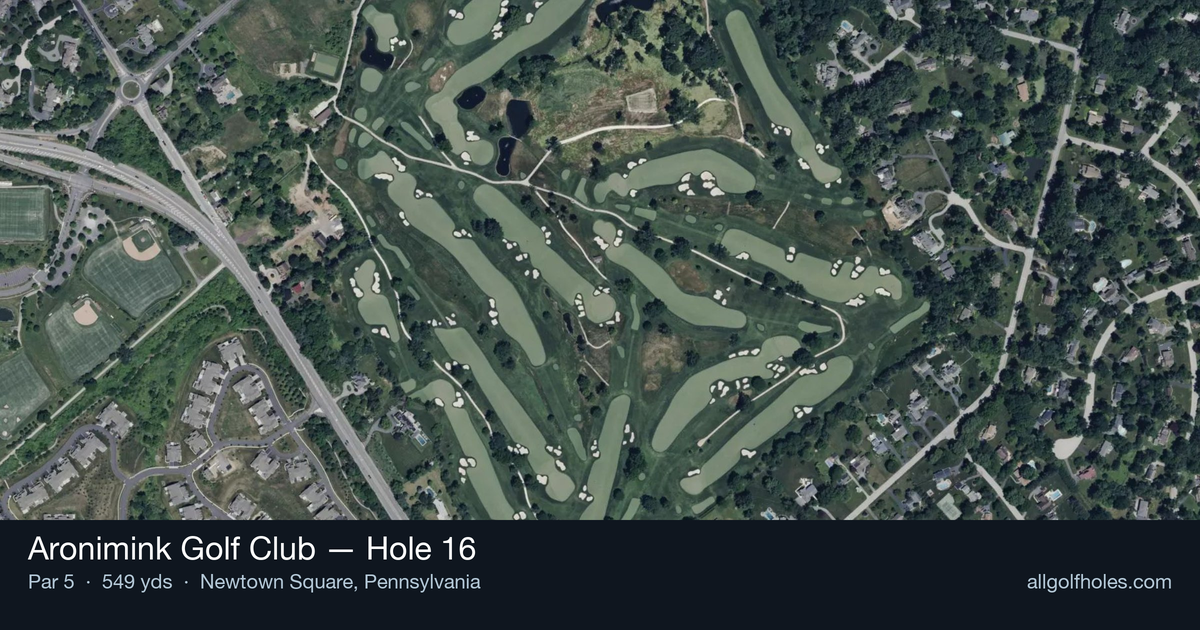
Aerial source not provided
Green size: 33 yds deep × 34 yds wide
Scorecard yardage is for Championship tees. The aerial shows its labeled reference position; distance rings measure to the green.
Championship tees · Par 5 · 549 yards
The plan for No. 16
Aronimink Golf Club hole 16 presents one of the course's premier scoring opportunities, a reachable par 5 stretching 549 yards through Donald Ross's masterful design. The tee shot plays slightly downhill to a fairway that angles invitingly to the left, demanding precision over length to find the optimal position. This classic Ross creation embodies the architect's philosophy of rewarding strategic thinking, as players must navigate the angled landing area to set up their approach. With minimal hazards protecting the small green complex, the hole's defense lies in its subtle contours and the premium placed on accurate iron play. The 16th stands as a testament to Ross's genius—appearing straightforward yet requiring thoughtful execution to capitalize on its birdie potential.
Off the tee
The tee shot plays slightly downhill to a fairway that angles left, creating a natural draw bias for your target line. Your primary objective is finding the fairway while positioning yourself for the best approach angle. Aim for the right-center of the fairway to account for the leftward slope and give yourself the optimal angle for your second shot. Driver is the preferred club selection for most players, as the downhill nature of the shot adds distance and the fairway is generous enough to accommodate a full swing. However, players struggling with accuracy should consider a 3-wood or driving iron to ensure they find the short grass. The absence of significant hazards off the tee allows for aggressive play, but staying in the fairway is paramount for setting up a birdie opportunity.
Approach & recovery
Your approach strategy depends entirely on your tee shot execution and personal capabilities. For players who can reach the green in two, the second shot becomes a critical risk/reward decision. The small green demands precision, and anything short or long will leave a challenging recovery. If going for the green in two, favor a fade or straight ball flight to hold the putting surface. The small target requires your best swing, so only attempt this shot when you're confident in your execution. For most players, laying up to a comfortable wedge distance (around 100 yards) provides the best scoring opportunity. This conservative approach allows you to attack the pin with a full wedge shot rather than hoping to hold a long iron on a small green.
On the green
The small green at the 16th requires precise distance control and careful green reading. While specific break patterns aren't documented, typical Ross greens feature subtle undulations that can fool the eye. Focus on getting your approach shot below the hole when possible, as uphill putts are generally more makeable than downhill sliders. Pay special attention to pin position when planning your approach. With limited green space, certain pin locations will be more accessible than others. Conservative approach shots to the center of the green often yield better results than aggressive pins hunting on such a small target. ## RISK VS REWARD The 16th hole presents one of the clearest risk/reward scenarios at Aronimink. The reachable length creates genuine birdie and even eagle opportunities, but the small green severely punishes missed approaches. Players must honestly assess their long iron capabilities before attempting to reach in two. The reward is significant - this hole offers one of your best birdie chances on the course. However, the risk of missing the small green and facing a difficult up-and-down can quickly turn a scoring opportunity into a bogey or worse. The conservative play of laying up to wedge distance often produces better scoring averages than aggressive attempts to reach in two. ## DIFFERENT SKILL LEVELS **Low Handicap Players:** Should consider going for the green in two when conditions favor it and they've executed a quality drive. These players have the precision and distance control necessary to attack the small green with longer clubs. However, even skilled players should lay up when the pin position is particularly challenging or conditions are difficult. **High Handicap Players:** Should almost always lay up to a comfortable wedge distance. The small green makes holding long approaches extremely difficult for players with less precise ball striking. Focus on hitting a solid drive, laying up to your favorite wedge yardage, and then attacking with your most reliable scoring club. This strategy maximizes your chances of making par while keeping bogey as your worst-case scenario. The 16th hole rewards patient, strategic golf over aggressive play. While the length suggests a birdie opportunity, the small green demands respect and careful club selection throughout the hole.
Watch for
- Course conditioning and mapped hazards may affect line selection; confirm from the aerial.
Hole 16 Green Complex
Mapped green boundary
Green size: 6,385 sq ft
Course coverage
Tournament and creator videos about Aronimink Golf Club — shared course coverage, not hole-specific clips.
Featured by these creators
Creator videos about this course
YouTube creators who filmed or featured Aronimink Golf Club. · Stats as of Oct 12, 2026 · 6d ago
2026 PGA Championship Preview: Who Will Win at Aronimink Golf Club? | The Fried Egg Golf Podcast
How did Hole 16 play?
How did this hole play today?
Frequently asked questions
Yardage reference: Championship tees · 549 yards.
Can this par 5 be reached in two?
↓
At 549 yards, A true three-shot hole for most players. Position your layup to leave a comfortable wedge distance.
How difficult is hole 16?
↓
This hole is a good scoring opportunity for most golfers. Key challenges include: heavily bunkered.
How big is the green on hole 16?
↓
The green is fairly large with multiple pin positions. Lag putting becomes important on longer putts.