Hole 15 at Aronimink Golf Club
- Par
- 4
- Yardage
- 497 yds
- Stroke index
- 2
- Hazards
- 7 bunkers
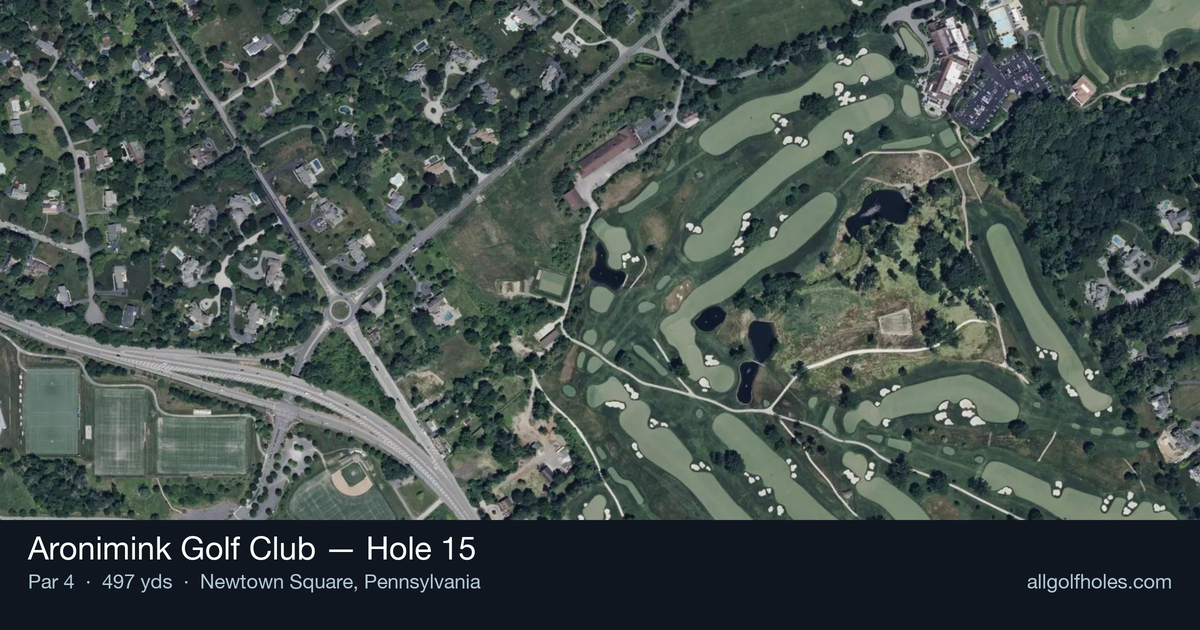
Aerial source not provided
Green size: 32 yds deep × 33 yds wide
Scorecard yardage is for Championship tees. The aerial shows its labeled reference position; distance rings measure to the green.
Championship tees · Par 4 · 497 yards
The plan for No. 15
The 15th hole at Aronimink Golf Club stands as Donald Ross's penultimate test of precision and power, stretching 497 yards through Pennsylvania's rolling terrain. This demanding par 4 embodies Ross's philosophy of challenging even elite golfers with exceptional long-iron play, requiring both distance and accuracy from the championship tees. The straight layout may appear straightforward, but the substantial length transforms what could be a manageable hole into a true examination of skill. Players face the daunting prospect of reaching a small green complex with a long approach shot, demanding precise club selection and unwavering commitment. With its #2 handicap ranking, this hole separates contenders from pretenders, serving as the perfect setup before the closing stretch. The absence of major hazards places the emphasis squarely on execution, making every shot count in Ross's masterful design.
Off the tee
Driver is essential here for most players, as leaving yourself with anything longer than a mid-iron approach to this small green significantly reduces your scoring chances. Focus on finding the center of the fairway with your most reliable swing - accuracy trumps an extra 10-15 yards when facing such a demanding approach shot. The straight layout allows you to commit fully to your target line down the middle, but resist the temptation to overswing in pursuit of maximum distance.
Approach & recovery
This is where Ross's "supreme test" of long-iron play truly reveals itself. Most players will face a long-iron or hybrid approach to a small green that offers little margin for error. Club selection is critical - take enough club to ensure you reach the green, as coming up short leaves a difficult chip to a small target. Aim for the center of the green regardless of pin position, as the small putting surface makes precision more important than attacking specific quadrants.
On the green
The small green demands respect with your approach club selection and putting strategy. Focus on lag putting to avoid three-putts, as the compact surface can create challenging comebacks if you're too aggressive with longer putts. Pay attention to subtle breaks and grain direction, as even small greens can have surprising undulations that affect ball roll. ## RISK VS REWARD The primary risk/reward decision occurs with tee shot strategy - how aggressive to be with driver versus ensuring you stay in play. Given the hole's length, most players must commit to driver and accept the inherent risks. The reward for two solid strikes is a legitimate birdie opportunity, while conservative play likely results in a challenging par attempt at best. ## DIFFERENT SKILL LEVELS **Low Handicappers:** Embrace the challenge with aggressive driver play and commit to attacking the green with long irons. This hole separates good players from great ones through execution under pressure. **Mid Handicappers:** Focus on two solid, centered strikes rather than trying to overpower the hole. A well-struck 3-wood followed by a confident hybrid or long iron can yield excellent results. **High Handicappers:** Consider playing this as a three-shot hole, using fairway wood off the tee for accuracy, then advancing the ball as far as possible while staying in play. A bogey here represents solid course management given the hole's difficulty. This classic Ross design rewards players who can execute under pressure while punishing those who let the hole's reputation create tension in their swing. Trust your preparation and commit to each shot fully.
Watch for
- Course conditioning and mapped hazards may affect line selection; confirm from the aerial.
Hole 15 Green Complex
Mapped green boundary
Green size: 6,579 sq ft
Course and tournament history
Historical context for the course and venue. Each entry identifies the event or course it describes.
1962 · Gary Player
The finishing hole is a 436-yard (399 m) uphill par four, requires a precise tee shot and the approach shot is to a winding and sloped green with a numerous challenging pin locations.
Source →
Course coverage
Tournament and creator videos about Aronimink Golf Club — shared course coverage, not hole-specific clips.
Featured by these creators
Creator videos about this course
YouTube creators who filmed or featured Aronimink Golf Club. · Stats as of Oct 12, 2026 · 6d ago
2026 PGA Championship Preview: Who Will Win at Aronimink Golf Club? | The Fried Egg Golf Podcast
How did Hole 15 play?
How did this hole play today?
Frequently asked questions
Yardage reference: Championship tees · 497 yards.
What's the best strategy off the tee?
↓
For this 497-yard par 4, most players will hit driver to set up a comfortable approach.
How difficult is hole 15?
↓
This hole is a moderate challenge for most golfers. Key challenges include: long par 4, heavily bunkered.
How big is the green on hole 15?
↓
The green is fairly large with multiple pin positions. Lag putting becomes important on longer putts.
What's a good score on hole 15?
↓
This hole is one of the tougher holes where par feels like birdie. A challenging par 4. Accept that bogey happens and avoid big numbers.