Hole 15 at Pinehurst Resort #7
- Par
- 4
- Yardage
- 435 yds
- Stroke index
- 14
- Hazards
- 4 bunkers
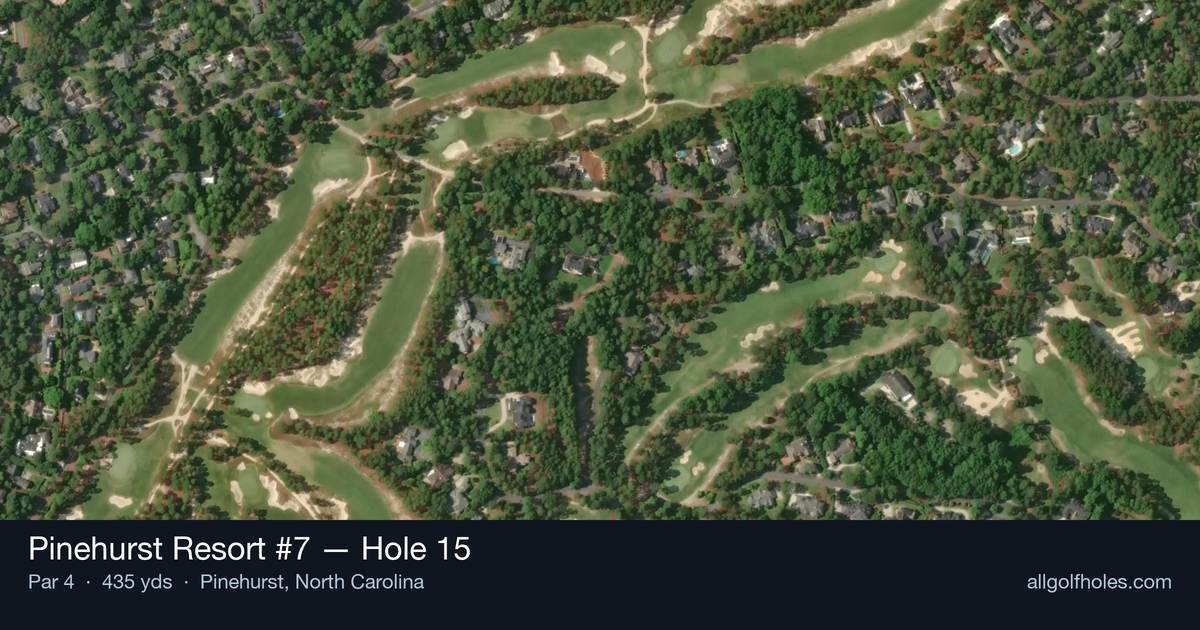
Aerial source not provided
Green size: 29 yds deep × 26 yds wide
Scorecard yardage is for Championship tees. The aerial shows its labeled reference position; distance rings measure to the green.
Championship tees · Par 4 · 435 yards
The plan for No. 15
The 15th at Pinehurst Resort #7 presents a deceptively straightforward par 4 that embodies Rees Jones' philosophy of strategic simplicity. This 435-yard hole stretches across the rugged terrain that defines this mountainous layout, offering a generous fairway that invites aggressive tee shots. The straight design allows players to open their shoulders, but the elevated terrain and natural undulations demand precise distance control. The approach shot targets a compact green that punishes wayward iron play, requiring golfers to commit fully to their yardage and club selection. With minimal hazards guarding the hole, success depends entirely on execution and course management. Like much of Pinehurst #7, this hole rewards confident, committed swings while punishing indecision—a true test of mental fortitude in the penultimate stretch.
Off the tee
Your tee shot strategy should focus on finding the optimal position in the fairway rather than maximum distance. A driver may be tempting, but consider a 3-wood or long iron to ensure you stay in the short grass and leave yourself a comfortable approach distance. The target line should favor the center of the fairway, giving yourself the best angle to attack the small green. With no significant hazards to avoid, the primary risk is missing the fairway entirely and facing a more challenging approach from the rough.
Approach & recovery
The approach shot is where this hole shows its teeth. The small green demands precision, making club selection critical. Depending on your tee shot position, you'll likely face a mid to short iron approach. Take extra club to ensure you reach the putting surface, as coming up short of a small green is one of golf's most frustrating mistakes. Study the pin position carefully - with limited green space, even a well-struck shot can leave you with a challenging putt if you're on the wrong portion of the green.
On the green
The small green size means every putt becomes crucial for your score. Focus on getting your first putt close rather than being overly aggressive, as three-putts can quickly turn a scoring opportunity into a bogey. The compact putting surface typically means shorter putts overall, but the breaks can be more pronounced due to the green's design. Take time to read the subtle slopes, as what appears to be a straight putt may have more movement than expected. ## RISK VS REWARD This hole offers an excellent scoring opportunity for players who embrace conservative strategy. The reward comes from playing within your capabilities rather than attempting heroic shots. The risk lies in getting greedy - trying to drive it too close to the green or firing aggressively at tucked pins. Smart course management here can easily yield birdie opportunities while minimizing the chance of big numbers. ## DIFFERENT SKILL LEVELS **High Handicappers**: Focus on hitting fairway with your most reliable club off the tee, even if it's a hybrid or long iron. For the approach, take an extra club and aim for the center of the green regardless of pin position. Two putts for par is an excellent result on this hole. **Low Handicappers**: This is a prime birdie opportunity if you execute properly. Consider the pin position when selecting your tee shot strategy - a back pin might warrant a shorter tee shot to leave a full wedge approach. Be aggressive with your approach only when the pin position allows it, and always respect the small target. The 15th hole at Pinehurst No. 7 exemplifies how strategic golf course design can create compelling challenges without relying on obvious hazards. Success here comes from disciplined club selection and precise execution rather than power, making it a true test of your complete golf game.
Watch for
- Course conditioning and mapped hazards may affect line selection; confirm from the aerial.
Hole 15 Green Complex
Mapped green boundary
Green size: 4,269 sq ft
How did Hole 15 play?
How did this hole play today?
Frequently asked questions
Yardage reference: Championship tees · 435 yards.
What's the best strategy off the tee?
↓
For this 435-yard par 4, most players will hit driver to set up a comfortable approach.
How difficult is hole 15?
↓
This hole is a moderate challenge for most golfers. Key challenges include: heavily bunkered, small green.
How big is the green on hole 15?
↓
The green is small and requires precision. Expect challenging pin positions with limited room for error.
What's a good score on hole 15?
↓
This hole is a demanding hole where bogey is not unusual. This longer par 4 will test most golfers. Focus on position over distance.