Hole 12 at Pinehurst Resort #7
- Par
- 5
- Yardage
- 525 yds
- Stroke index
- 4
- Hazards
- 4 bunkers
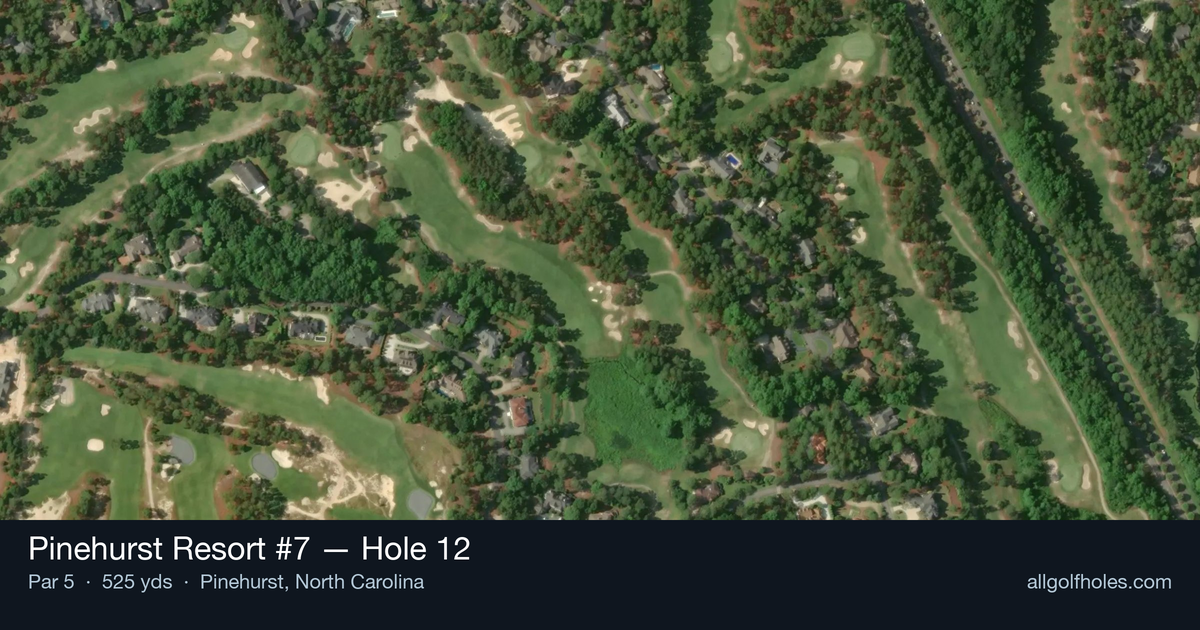
Aerial source not provided
Green size: 38 yds deep × 23 yds wide
Scorecard yardage is for Championship tees. The aerial shows its labeled reference position; distance rings measure to the green.
Championship tees · Par 5 · 525 yards
The plan for No. 12
The twelfth hole at Pinehurst Resort #7 presents a deceptively straightforward par 5 that embodies Rees Jones' philosophy of strategic design over rugged Carolina terrain. At 525 yards, this straight-away hole tempts longer hitters to unleash their driver, but the uneven topography that characterizes this dramatic layout demands precision over power. The tee shot plays across undulating fairway that reflects the course's mountainous character, where finding the optimal angle becomes crucial for the approach. The small green complex requires careful club selection and accurate iron play, as errant shots will test short game skills around the putting surface. This hole exemplifies why Pinehurst Resort #7 challenges golfers of all abilities with strategic decisions rather than overwhelming length, making it a memorable test within one of North Carolina's most respected golf destinations.
Off the tee
Your tee shot strategy should focus on finding the optimal position in the landing zone rather than pure distance. A well-struck driver or strong 3-wood will set up either a legitimate chance at reaching in two or an ideal layup position. The absence of major hazards allows you to be aggressive with your target line down the center of the fairway. Given Pinehurst No. 7's reputation for uneven terrain, pay attention to potential slopes in the landing area that could affect your ball's final position. A drive that finds the center-left portion of the fairway often provides the best angle for your second shot approach.
Approach & recovery
The approach strategy varies dramatically based on your tee shot success. For longer hitters who can reach in two, the small green size becomes the primary consideration - accuracy trumps power here. A well-positioned second shot should favor the center of the green, as the compact target leaves little room for error. For most players, the smart play involves a strategic layup to your favorite wedge distance. Position your second shot in the center of the fairway, leaving yourself a full wedge shot rather than an awkward half-swing. This approach maximizes your chances of sticking the ball close to the pin on the small green surface.
On the green
The small green at the 12th demands respect with your putter selection and read. Expect subtle breaks that can be deceiving given the green's compact nature. Focus on speed control above all else - with limited green surface, balls that run past the hole often face challenging comeback putts. When the pin is tucked near edges, play conservatively toward the center of the green. The margin for error is minimal, and two-putting from the center beats the risk of short-siding yourself on such a small target. ## RISK VS REWARD This hole presents a classic risk/reward scenario. Aggressive players who can consistently hit their targets will find birdie opportunities abundant, while those who get greedy without proper execution face potential trouble. The reward heavily favors the calculated approach - laying up to your comfort zone often yields better scoring than forcing a risky second shot. The absence of water or bunkers removes penalty stroke concerns, but the small green punishes imprecise approach shots with difficult up-and-downs from the surrounding areas. ## DIFFERENT SKILL LEVELS **High-Handicap Players:** Focus on three solid shots rather than trying to reach in two. Use a fairway wood or hybrid off the tee for accuracy, layup to your most comfortable wedge distance, and aim for the center of the green. This conservative approach typically yields pars with occasional birdie opportunities. **Low-Handicap Players:** Can be more aggressive with driver off the tee and consider going for the green in two when well-positioned. However, even skilled players should respect the small green size and consider laying up when the angle or distance isn't optimal. Your short game skills make the layup-and-wedge approach particularly effective here. The 12th hole rewards patience and precision over raw power, making it a true test of golf strategy and course management skills that Rees Jones designed into this challenging Pinehurst layout.
Watch for
- Course conditioning and mapped hazards may affect line selection; confirm from the aerial.
Hole 12 Green Complex
Mapped green boundary
Green size: 4,067 sq ft
How did Hole 12 play?
How did this hole play today?
Frequently asked questions
Yardage reference: Championship tees · 525 yards.
Can this par 5 be reached in two?
↓
At 525 yards, A true three-shot hole for most players. Position your layup to leave a comfortable wedge distance.
How difficult is hole 12?
↓
This hole is a moderate challenge for most golfers. Key challenges include: heavily bunkered, small green.
How big is the green on hole 12?
↓
The green is small and requires precision. The green is deeper than wide, so club selection is crucial. Expect challenging pin positions with limited room for error.
What's a good score on hole 12?
↓
This hole is a solid birdie opportunity with smart layup strategy. Most golfers can reach in three. Position your layup to leave a comfortable wedge.