Hole 8 at Bethpage State Park (Black Course)
- Par
- 3
- Yardage
- 210 yds
- Hazards
- Water
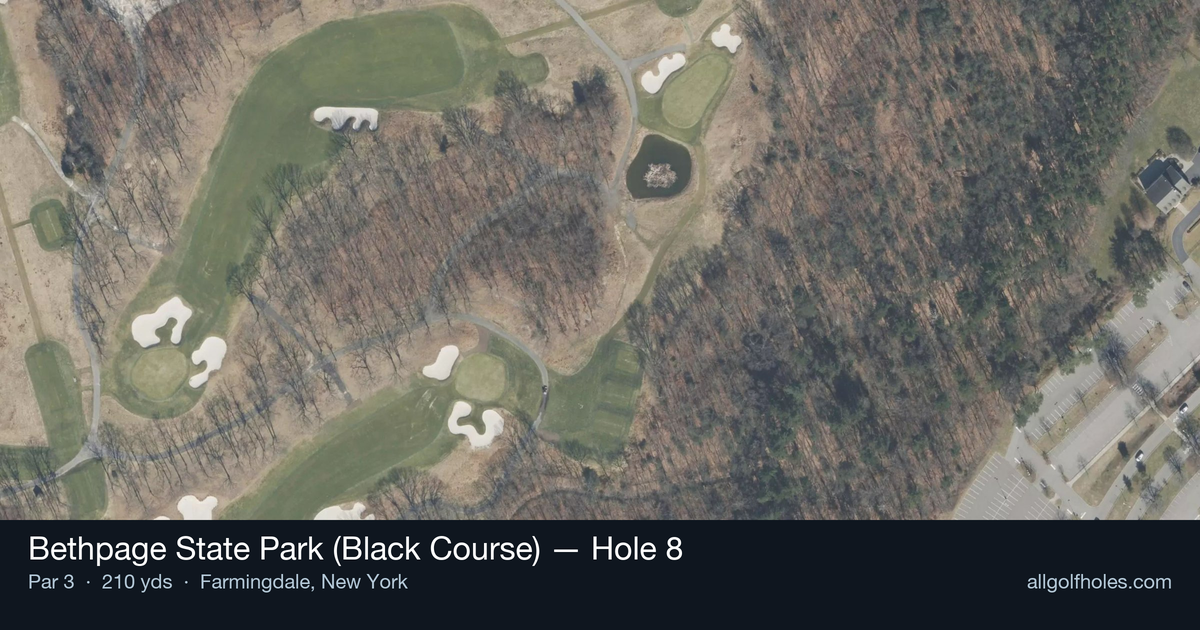
Aerial source not provided
Green size: 46 yds deep × 32 yds wide
Scorecard yardage is for Championship tees. The aerial shows its labeled reference position; distance rings measure to the green.
Championship tees · Par 3 · 210 yards
The plan for No. 8
The eighth hole at Bethpage State Park (Black Course) stands as a deceptively challenging par 3 that exemplifies the course's reputation for testing every aspect of a golfer's game. At 210 yards, this straight shot demands precision and commitment from the tee, with the small green providing an unforgiving target that punishes anything less than a well-struck iron. The hole's character lies in its simplicity – no elaborate hazards or dramatic doglegs, just pure shot-making under pressure. What makes this tee shot particularly memorable is how it separates skilled players from weekend warriors, requiring both distance control and accuracy to find the putting surface. The compact green complex rewards aggressive play while severely penalizing misses, making it a true test of nerve and execution on one of America's most revered public courses.
Off the tee
Since this is a par 3, your tee shot is your approach shot, making club selection absolutely critical. Most golfers will need anywhere from a 5-iron to a hybrid or even fairway wood depending on conditions and individual distance capabilities. The straight layout simplifies your target line - aim directly at the center of the green and commit to your swing. Wind conditions will play a major factor at this distance, so take an extra club if there's any headwind or crosswind that could affect ball flight. The key is avoiding the temptation to swing harder; instead, take more club and make a smooth, controlled swing.
Approach & recovery
Your approach strategy is built into the tee shot on this par 3. Focus on landing the ball on the green rather than trying to get close to specific pin positions. With a small green as your target, precision trumps aggression. Aim for the center of the green regardless of pin position, as missing the green entirely will likely result in a difficult up-and-down. Pay attention to the firmness of the green - if it's playing firm, consider landing the ball slightly short and letting it release onto the putting surface.
On the green
The small green size means every putt becomes crucial for scoring. Without specific hazard information, focus on reading the general slope and grain of the putting surface. Take time to study your line from behind the ball and from the low side of the hole. On a green this size, most putts will be relatively straight, but don't underestimate subtle breaks that can affect shorter putts. Lag putting becomes essential if you find yourself with a longer putt - getting close is more important than being aggressive. ## RISK VS REWARD The primary risk/reward decision comes in club selection and target choice. The conservative play is taking plenty of club and aiming for the center of the green, accepting a potential two-putt par. The aggressive approach involves going after tucked pins or trying to hit it close with a shorter club, but this significantly increases the risk of missing the green entirely. Given the hole's difficulty rating for amateur players, the percentage play strongly favors the conservative approach. ## DIFFERENT SKILL LEVELS **High-Handicap Players:** Focus entirely on getting the ball on the green. Take at least one extra club beyond what you think you need, aim for the absolute center of the green, and make a smooth swing. Don't worry about pin position - just get it on the putting surface and give yourself a chance for par. Consider this hole a success if you walk away with bogey. **Low-Handicap Players:** You can be slightly more aggressive with pin hunting, but still respect the distance and small target. Work on your pre-shot routine to handle the pressure of this demanding shot. Consider wind conditions more carefully and trust your distance control. This is a hole where your superior ball-striking ability should show, but don't let overconfidence lead to poor club selection. The 8th hole at Bethpage Black perfectly exemplifies how course management and realistic expectations separate good scores from disappointing ones. Embrace the challenge, but play within your capabilities to navigate this famous and demanding par 3 successfully.
Watch for
- No bunker is mapped on this hole; rough and green contours still define the challenge.
Hole 8 Green Complex
Mapped green boundary
Green size: 8,356 sq ft
How did Hole 8 play?
How did this hole play today?
Frequently asked questions
Yardage reference: Championship tees · 210 yards.
What club should I use on this par 3?
↓
At 210 yards, most golfers will need a fairway wood or hybrid to reach this green. Adjust for elevation, wind, and pin position.
How difficult is hole 8?
↓
This hole is one of the tougher holes on the course for most golfers. Key challenges include: long par 3, water in play, large green requiring good lag putting.
What hazards should I watch out for on hole 8?
↓
Key hazards include: water at 163.6 yards. Plan your shots to avoid these trouble spots.
How big is the green on hole 8?
↓
The green is large and can play quite long. Three-putt territory if you don't manage your approach distance well.
What's a good score on hole 8?
↓
This hole is a challenging par where bogey is acceptable. This longer par 3 will test your long iron or hybrid game. Par is a good score.