Hole 13 at Wolf Creek Golf Course
- Par
- 4
- Yardage
- 350 yds
- Stroke index
- 14
- Hazards
- 3 bunkers · Water
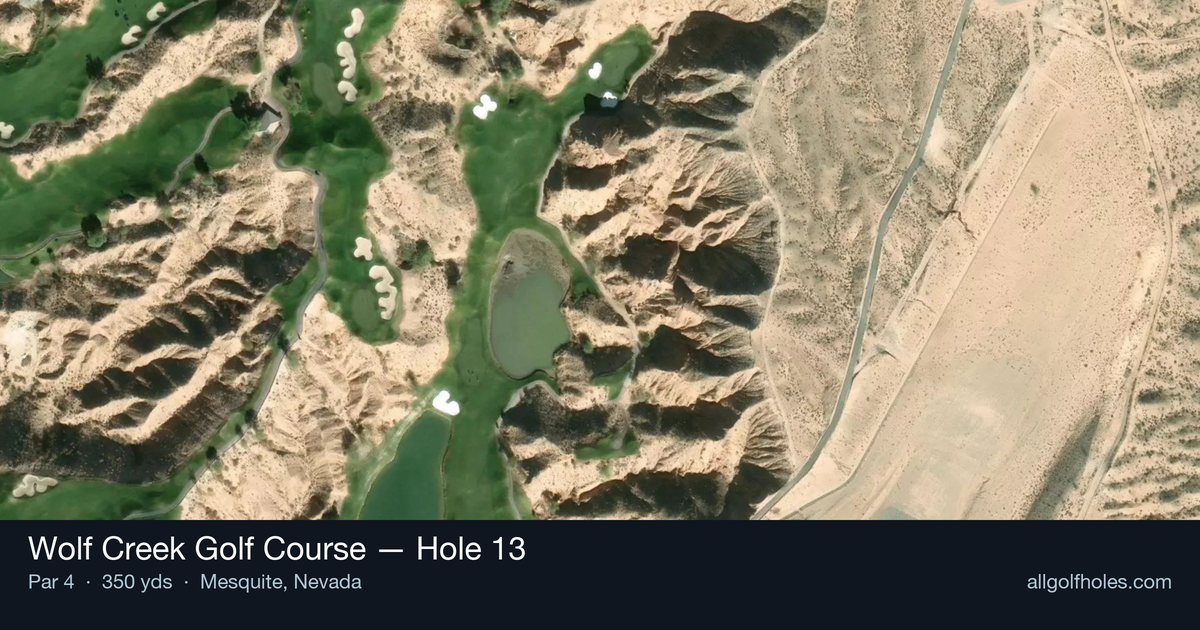
Aerial source not provided
Green size: 31 yds deep × 24 yds wide
Scorecard yardage is for Championship tees. The aerial shows its labeled reference position; distance rings measure to the green.
Championship tees · Par 4 · 350 yards
The plan for No. 13
Wolf Creek Golf Course hole 13 presents a deceptively challenging par 4 that rewards precision over power. At 350 yards, this straight hole features the course's characteristic narrow fairway that demands accuracy from the tee shot. Long hitters face a tempting risk-reward decision: carry the large hill to the right of the fairway for a direct line to the small green, or play the conservative route down the left side of the fairway. The safer approach leaves an uphill wedge shot to a compact, undulating green that sits elevated above the fairway. With Wolf Creek's reputation for strategically placed bunkers and unforgiving greens, club selection and course management become paramount. This hole exemplifies the course's philosophy where smart play trumps distance, making it a memorable test of golf strategy.
Off the tee
The tee shot presents a classic risk-reward scenario. Long hitters have the option to carry the large hill on the right side of the fairway and potentially reach the green, but this aggressive line requires precise execution and favorable conditions. The safer and more reliable strategy involves placing a well-positioned tee shot in the fairway, which sets up an uphill wedge approach to the green. For most players, a controlled mid-iron or hybrid off the tee will find the fairway and leave an ideal distance for the approach. Focus on the center-left portion of the fairway to avoid the hill on the right while maintaining a clear angle to the pin. Given Wolf Creek's narrow fairways, accuracy trumps distance on this tee shot.
Approach & recovery
The approach shot is typically an uphill wedge or short iron to a small, undulating green. The elevated nature of the shot requires one extra club to account for the uphill lie and potential headwind. Target the center of the green regardless of pin position, as the small surface area leaves little room for error. Pay special attention to the green's undulations when selecting your landing spot. With Wolf Creek's characteristic rolling greens, understanding the slope around the pin becomes crucial for setting up makeable birdie putts. A shot that lands short and releases up to the pin often works better than trying to fly it directly to the flag.
On the green
The small green size means putting strategy focuses on speed control and reading the subtle breaks correctly. These undulating greens can be tricky to read, so take time to assess the overall slope from multiple angles. Lag putting becomes essential when facing longer putts, as three-putting from distance can quickly turn a scoring opportunity into a bogey. Focus on getting your first putt within a three-foot circle of the hole. The green's size means most putts will have some break, so trust your read and commit to the line you've chosen. ## RISK VS REWARD The primary risk-reward decision comes on the tee shot. Aggressive players can attempt to drive the green or get very close, but the penalty for missing the narrow target area can be severe. The reward of a potential eagle or easy birdie must be weighed against the risk of finding trouble and making bogey or worse. The conservative play of fairway-wedge offers a high percentage birdie opportunity with minimal risk. This approach aligns well with Wolf Creek's design philosophy, where course management often trumps raw power. ## DIFFERENT SKILL LEVELS **High-handicap players** should focus entirely on the conservative strategy. Use a club that guarantees finding the fairway, even if it means a longer approach shot. The key is avoiding big numbers by staying in play and giving yourself a chance at par with good execution. **Low-handicap players** can consider the aggressive line when conditions favor it, but should still lean toward the percentage play most of the time. Your short game skills make the fairway-wedge approach a reliable birdie opportunity, so there's less need to take unnecessary risks. **Scratch players and better** have the skills to execute either strategy effectively. Choose based on tournament situation, wind conditions, and your confidence level with the driver. When in doubt, remember that Wolf Creek rewards patience and precision over aggression.
Watch for
- Course conditioning and mapped hazards may affect line selection; confirm from the aerial.
Hole 13 Green Complex
Mapped green boundary
Green size: 3,389 sq ft
How did Hole 13 play?
How did this hole play today?
Frequently asked questions
Yardage reference: Championship tees · 350 yards.
What's the best strategy off the tee?
↓
For this 350-yard par 4, most players will hit 3-wood or driver to set up a comfortable approach.
How difficult is hole 13?
↓
This hole is a moderate challenge for most golfers. Key challenges include: water in play, small green.
How big is the green on hole 13?
↓
The green is small and requires precision. Expect challenging pin positions with limited room for error.
What's a good score on hole 13?
↓
This hole is a medium-length test where par is a solid result. A straightforward par 4 where course management pays off.