Hole 16 at PGA WEST (Norman course)
- Par
- 5
- Yardage
- 537 yds
- Stroke index
- 8
- Hazards
- 8 bunkers · Water
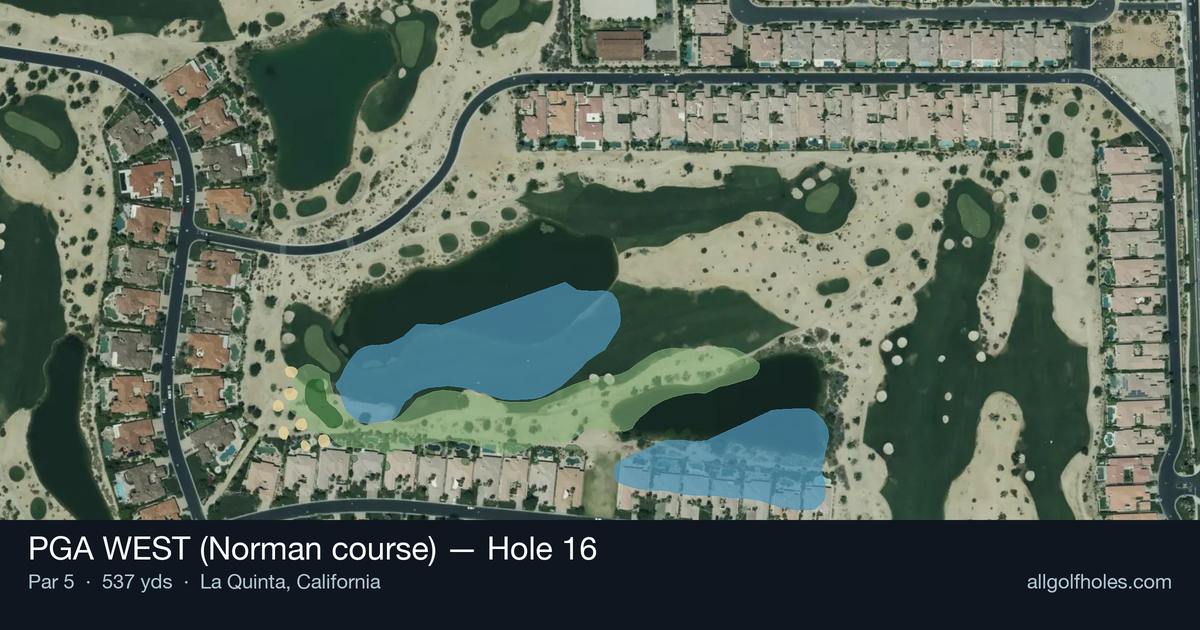
Aerial source not provided
Green size: 27 yds deep × 44 yds wide
Scorecard yardage is for Championship tees. The aerial shows its labeled reference position; distance rings measure to the green.
Championship tees · Par 5 · 537 yards
The plan for No. 16
The 16th hole at PGA WEST's Norman course presents a classic risk-reward par 5 that epitomizes Greg Norman's strategic design philosophy. At 537 yards, this straight-away hole appears deceptively straightforward, but the small green complex demands precision on every shot. The generous fairway invites aggressive tee shots, allowing longer hitters to contemplate reaching in two, while the compact target green punishes wayward approach shots with challenging recovery situations. Without significant hazards cluttering the landscape, success hinges purely on execution and distance control. The hole's understated elegance lies in its simplicity – a true test of shot-making ability where par feels like a victory and birdie opportunities reward calculated aggression.
Off the tee
The tee shot strategy centers on finding the optimal position for your second shot rather than simply bombing driver. With no hazards threatening, focus on hitting your most reliable club that gets you into the 250-280 yard range. Many players will benefit from a controlled driver or strong 3-wood that finds the center of the fairway. The straight layout eliminates directional concerns, so commit to a smooth, balanced swing that prioritizes accuracy over maximum distance. Your target line should favor the center-right portion of the fairway to open up the best angle for your approach sequence.
Approach & recovery
Your second shot becomes the critical decision point on this hole. Longer hitters may be tempted to go for the green in two, but the small green size makes this a high-risk proposition unless you're hitting a mid-iron or shorter. Most golfers should treat this as a positioning shot, laying up to their preferred wedge distance - typically 80-120 yards from the pin. Aim for the center of the fairway to avoid any awkward lies or angles. If attempting to reach in two, ensure you have enough club to clear any front protection and account for the small target area.
On the green
The small green demands pinpoint accuracy and leaves little room for error. Approach shots should target the center of the green unless the pin is clearly accessible. The compact putting surface means most putts will be relatively short, but the slopes can be tricky to read. Focus on getting your first putt close rather than being aggressive, as three-putting from this small green can be especially costly. Pay attention to the grain and any subtle breaks that may not be immediately apparent. ## RISK VS REWARD The primary risk/reward decision comes on the second shot. Going for the green in two offers birdie or eagle potential but brings bogey into play if you miss the small target. The reward calculation depends heavily on your approach club - if you're hitting anything longer than a 6-iron, the percentages favor laying up. The safe play of laying up to wedge distance virtually guarantees a look at birdie while eliminating big numbers. Consider course conditions, pin position, and your current round momentum when making this decision. ## DIFFERENT SKILL LEVELS **High Handicappers:** Embrace the three-shot strategy without hesitation. Hit your most reliable tee shot, advance your second shot to comfortable wedge range, and focus on hitting the center of the green. Avoid the temptation to force extra distance - this hole rewards patience and smart club selection over aggressive play. **Low Handicappers:** You have more flexibility in your approach strategy. If you can get within 170 yards or less for your second shot, going for the green becomes a viable option. However, don't let ego override smart course management - sometimes laying up to your favorite wedge distance is the higher percentage play, especially when chasing a good score. Use your short game skills to capitalize on the scoring opportunity this hole provides.
Watch for
- Course conditioning and mapped hazards may affect line selection; confirm from the aerial.
Hole 16 Green Complex
Mapped green boundary
Green size: 5,048 sq ft
How did Hole 16 play?
How did this hole play today?
Frequently asked questions
Yardage reference: Championship tees · 537 yards.
Can this par 5 be reached in two?
↓
At 537 yards, A true three-shot hole for most players. Position your layup to leave a comfortable wedge distance.
How difficult is hole 16?
↓
This hole is a moderate challenge for most golfers. Key challenges include: water in play.
What hazards should I watch out for on hole 16?
↓
Key hazards include: water at 238.3 yards. Plan your shots to avoid these trouble spots.
How big is the green on hole 16?
↓
The green is medium-sized with moderate targets. Pay attention to pin placement when selecting your approach club.
Which side of the fairway is safer on hole 16?
↓
Aim for the right side of the fairway when possible. Missing left (water) brings more trouble into play.
What's a good score on hole 16?
↓
This hole is a solid birdie opportunity with smart layup strategy. Most golfers can reach in three. Position your layup to leave a comfortable wedge.