Hole 16 at Sage Valley Golf Club
- Par
- 3
- Yardage
- 220 yds
- Hazards
- 2 bunkers
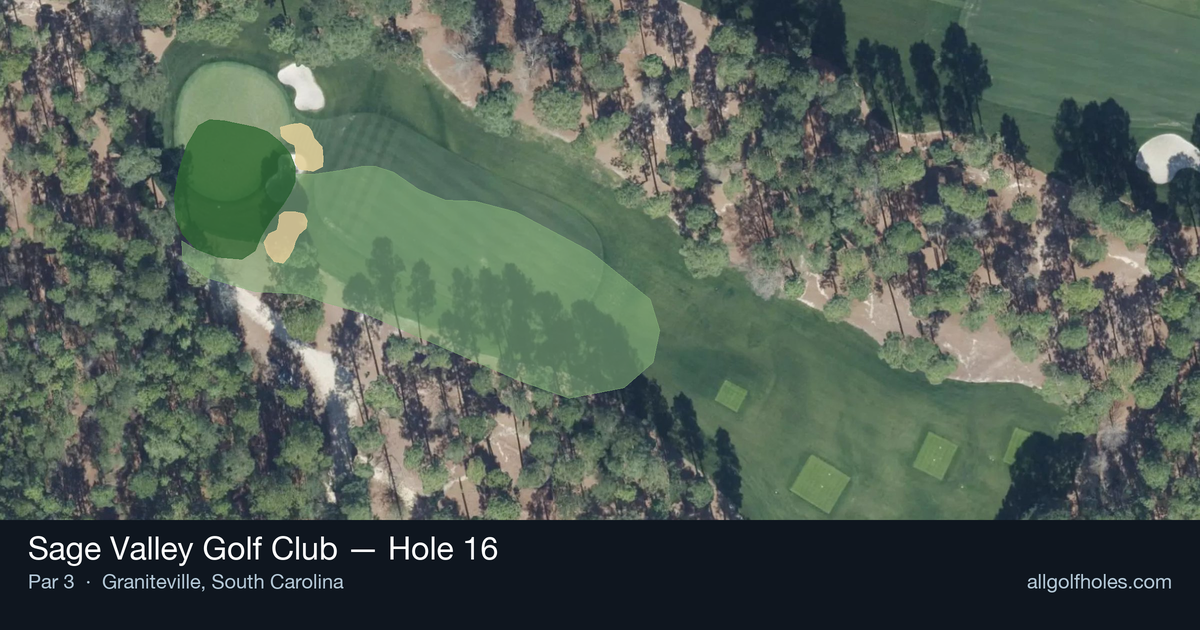
Aerial source not provided
Green size: 29 yds deep × 35 yds wide
Scorecard yardage is for Pro tees. The aerial shows its labeled reference position; distance rings measure to the green.
Pro tees · Par 3 · 220 yards
The plan for No. 16
The closing stretch at Sage Valley Golf Club demands precision, and the 220-yard par 3 16th hole epitomizes this championship test. This demanding one-shotter requires golfers to carry their tee shot the full distance to a small, well-protected green complex that offers little margin for error. Without major hazards to distract from the fundamental challenge, Sage Valley Golf Club hole 16 becomes a pure test of distance control and accuracy. The relatively compact green rewards only the most precise approach shots, making club selection critical in the often-swirling winds of the South Carolina Lowcountry. Players must commit fully to their club choice, as coming up short or flying long both spell trouble on this unforgiving par 3. It's a hole that separates contenders from pretenders in tournament play, demanding both courage and precision when the pressure mounts during Sage Valley's legendary member-guest competitions.
Off the tee
From the tee, focus on smooth tempo and solid contact over trying to muscle the shot. Most golfers will need anywhere from a 4-iron to a hybrid or fairway wood depending on conditions and individual distance. Aim for the center of the green regardless of pin position - the small target makes going for flags a high-risk proposition. Take one extra club if there's any doubt, as coming up short on a long par 3 often leads to difficult recovery shots.
Approach & recovery
Since this is a par 3, your tee shot IS your approach. The key is committing to your yardage and club selection. Factor in elevation changes, wind, and pin position when making your decision. With the green being small, prioritize finding the putting surface over getting close to the pin. A 30-foot putt is always preferable to a challenging chip shot.
On the green
The small green size means most putts will be manageable in length, but don't underestimate the importance of lag putting. Focus on getting your first putt close rather than being aggressive with longer attempts. Study the green's slope during your approach - small greens often have subtle breaks that can be deceiving. ## RISK VS REWARD The primary risk/reward decision comes in club selection. Playing aggressively with less club to get closer to back pins increases the chance of missing the green entirely. The reward of being closer to the hole rarely outweighs the risk of a missed green on such a long par 3. Conservative play to the center of the green is typically the percentage play. ## DIFFERENT SKILL LEVELS **High Handicappers:** Focus entirely on making solid contact and finding the green. Don't worry about pin position - aim dead center and take enough club to comfortably reach the putting surface. A two-putt par is an excellent result. **Low Handicappers:** You can be more aggressive with pin hunting, especially when the flag is in the front portion of the green. Still respect the small target size, but your improved distance control allows for more precise club selection and the ability to work the ball to different sections of the green. The 16th at Sage Valley rewards patience and precision over aggression, making it a true test of course management skills for players at every level.
Watch for
- Course conditioning and mapped hazards may affect line selection; confirm from the aerial.
Hole 16 Green Complex
Mapped green boundary
Green size: 6,006 sq ft
Course coverage
Tournament and creator videos about Sage Valley Golf Club — shared course coverage, not hole-specific clips.
Featured by these creators
Creator videos about this course
YouTube creators who filmed or featured Sage Valley Golf Club. · Stats as of Oct 12, 2026 · 6d ago
The First Ever YouTube Match at Sage Valley
How did Hole 16 play?
How did this hole play today?
Frequently asked questions
Yardage reference: Pro tees · 220 yards.
What club should I use on this par 3?
↓
At 220 yards, most golfers will need a fairway wood or hybrid to reach this green. Adjust for elevation, wind, and pin position.
How difficult is hole 16?
↓
This hole is a moderate challenge for most golfers. Key challenges include: long par 3.
What hazards should I watch out for on hole 16?
↓
Key hazards include: 2 greenside bunkers. Plan your shots to avoid these trouble spots.
How big is the green on hole 16?
↓
The green is fairly large with multiple pin positions. Lag putting becomes important on longer putts.
What's a good score on hole 16?
↓
This hole is a challenging par where bogey is acceptable. This longer par 3 will test your long iron or hybrid game. Par is a good score.