Hole 4 at National Golf Links of America
- Par
- 3
- Yardage
- 195 yds
- Hazards
- 4 bunkers
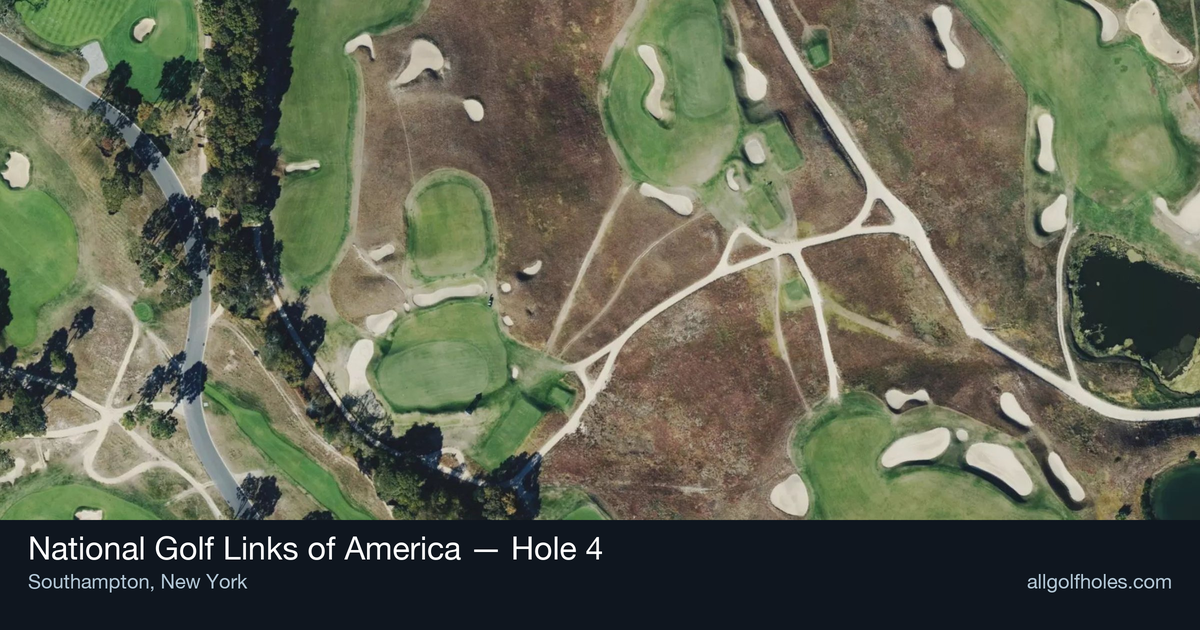
Aerial source not provided
Green size: 45 yds deep × 40 yds wide
Scorecard yardage is for Pro tees. The aerial shows its labeled reference position; distance rings measure to the green.
Pro tees · Par 3 · 195 yards
The plan for No. 4
The "Redan" at National Golf Links of America hole 4 stands as one of golf architecture's most celebrated templates, faithfully recreating the legendary 15th at North Berwick. This masterful 195-yard par 3 presents a deceptively complex challenge with its signature angled green that slopes dramatically from right to left. The small putting surface sits at an oblique angle to the tee shot, demanding precise club selection and strategic placement. Players must carry the undulating green front while accounting for the severe slope that can funnel well-struck shots toward the pin or send errant approaches tumbling away. The Redan's genius lies in its risk-reward proposition - aim directly at the flag and risk the steep falloffs, or play safely to the right side and face a challenging putt across the slope. This timeless design continues to confound and delight golfers more than a century after C.B. Macdonald's brilliant interpretation.
Off the tee
Club selection is paramount on this template hole. The 195-yard distance typically calls for a mid to long iron, but wind conditions and pin position should heavily influence your choice. Aim for the front portion of the green when the pin is tucked in back positions, as the angled nature of the green makes it nearly impossible to hold shots hit directly at back pins. The target line should favor the high side of the green, allowing the natural slope to feed the ball toward the hole. Take one extra club to ensure you clear the undulating front portion - coming up short leaves a treacherous recovery shot.
Approach & recovery
Since this is a par 3, the tee shot IS the approach shot. The key is understanding how the angled green affects your angle of attack. Shots hit to the front of the green will naturally kick and roll toward back pin positions due to the slope. When the pin is front, you must be more aggressive and precise with your distance control. The small green size demands accuracy, so focus on smooth tempo and solid contact rather than trying to overpower the hole.
On the green
The Redan green's subtle undulations create deceptive breaks that can fool even experienced players. Putts generally break toward the lower portion of the angled green, but the specific contours require careful reading. Pay attention to the overall slope of the green complex and how it relates to the surrounding terrain. Lag putting is often the best strategy here, as three-putts can quickly turn a scoring opportunity into a bogey. ## RISK VS REWARD The risk/reward calculation is subtle but important. The aggressive play is aiming directly at tucked pins, particularly when they're positioned in the back portion of the green. The conservative approach involves playing to the center or front of the green and relying on your putting to get close. Given the small green size and the penalty for missing, the conservative approach often yields better long-term scoring. ## DIFFERENT SKILL LEVELS **High Handicappers** should focus on simply finding the green. Aim for the center of the putting surface regardless of pin position, take enough club to clear the front undulations, and accept that par is an excellent score. Don't get seduced into chasing difficult pin positions. **Low Handicappers** can be more aggressive with pin hunting, especially when conditions are calm. Understanding the green's nuances and how different trajectories interact with the slope becomes crucial. These players should study the relationship between landing spot and final ball position, using the green's contours as an ally rather than fighting against them. The beauty of this famous template hole lies in its strategic depth - while appearing straightforward, it rewards golfers who understand the subtleties of the angled green and can execute shots with both precision and intelligence.
Watch for
- Course conditioning and mapped hazards may affect line selection; confirm from the aerial.
Hole 4 Green Complex
Mapped green boundary
Green size: 8,608 sq ft
Course coverage
Tournament and creator videos about National Golf Links of America — shared course coverage, not hole-specific clips.
Official & tour
Tour & network videos
Official coverage mentioning National Golf Links of America.
Inside Trump International Golf Links, Doonbeg | 3 Key Holes
Featured by these creators
Creator videos about this course
YouTube creators who filmed or featured National Golf Links of America. · Stats as of Oct 12, 2026 · 6d ago
All eyes on the leaders 👀 The final round is underway at Trump International Golf Links.
How did Hole 4 play?
How did this hole play today?
Frequently asked questions
Yardage reference: Pro tees · 195 yards.
What club should I use on this par 3?
↓
At 195 yards, most golfers will need a long iron or hybrid (5-iron to 6-iron) to reach this green. Adjust for elevation, wind, and pin position.
How difficult is hole 4?
↓
This hole is a good scoring opportunity for most golfers. Key challenges include: large green requiring good lag putting.
How big is the green on hole 4?
↓
The green is large and can play quite long. The green is deeper than wide, so club selection is crucial. Three-putt territory if you don't manage your approach distance well.