Hole 17 at TPC of Louisiana
- Par
- 3
- Yardage
- 414 yds
- Stroke index
- 10
- Hazards
- 2 bunkers · Water
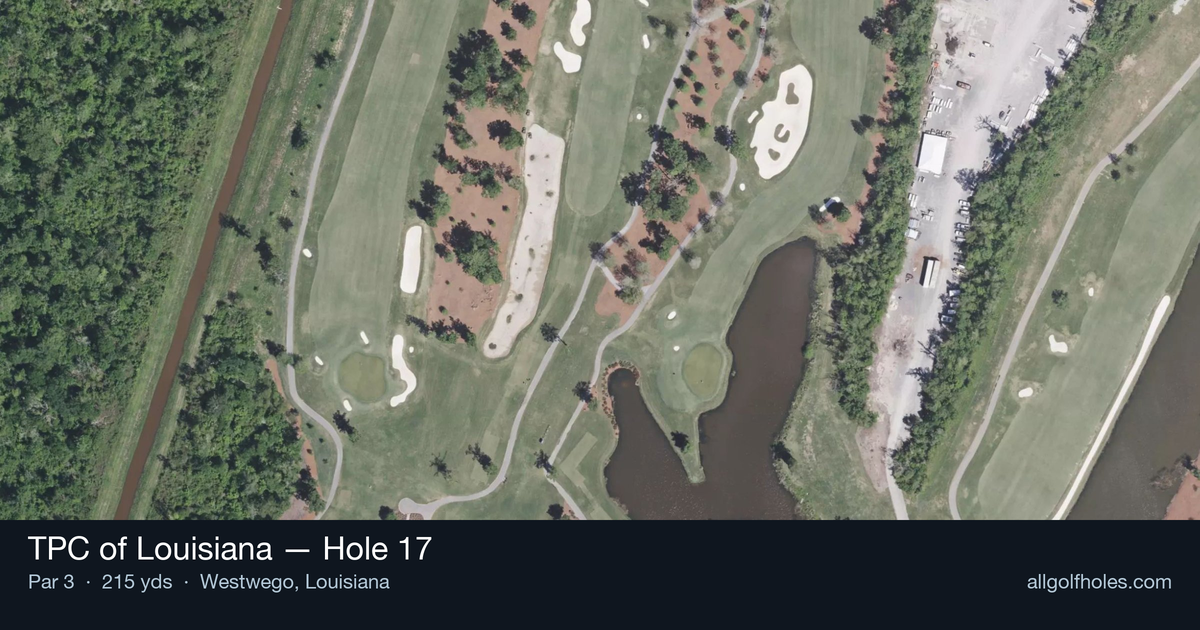
Aerial source not provided
Green size: 40 yds deep × 29 yds wide
Scorecard yardage is for Seniors' tees. The aerial shows its labeled reference position; distance rings measure to the green.
Seniors' tees · Par 3 · 414 yards
The plan for No. 17
At 414 yards, TPC of Louisiana hole 17 stands as an unusually long par 3 that demands both precision and power from the tee. This formidable one-shotter requires golfers to commit fully to their club selection, as the extended yardage leaves little room for tentative swings. The straight layout may appear straightforward, but the combination of distance and a compact green complex creates a deceptive challenge that can quickly humble even seasoned players. With minimal hazards to navigate, the primary test becomes executing a precise long iron or hybrid shot that finds and holds the small putting surface. This closing stretch hole at TPC of Louisiana rewards aggressive, confident play while punishing any lack of commitment on the tee shot.
Off the tee
For most golfers, this hole requires a driver or strong 3-wood to reach the green in regulation. Focus on making solid contact rather than trying to overpower the shot - smooth tempo is essential at this distance. Aim for the center of the green regardless of pin position, as the small green size makes precision more important than attacking specific quadrants. Check wind conditions carefully, as even a moderate breeze can significantly impact ball flight over this distance. Take an extra moment to visualize your target line and commit fully to your club selection.
Approach & recovery
Since this is a par 3, your tee shot IS your approach shot. The key is accepting that this hole plays more like a long par 4 approach than a traditional par 3. Focus on landing the ball on the green surface rather than trying to get close to the pin - with a small green, anywhere on the putting surface represents success. Consider the firmness of the green when selecting your trajectory; a higher ball flight may help hold the green better, while a lower trajectory might provide more distance in windy conditions.
On the green
Once you've successfully reached this small green, two-putting should be your primary goal. The green's compact size means most putts will be relatively short, but don't underestimate the importance of lag putting from longer distances. Read the green carefully, as subtle breaks can be magnified on shorter putts. Focus on getting your first putt to the low side of the hole and within a comfortable range for your second putt. ## RISK VS REWARD The risk/reward calculation here is straightforward but significant. The reward for reaching the green is an excellent birdie opportunity and avoiding a difficult up-and-down. However, the risk of coming up short or missing the target entirely can lead to bogey or worse. There's little middle ground on this hole - you either execute the shot successfully or face a challenging recovery. Conservative play might mean aiming for the center-back of the green to ensure you clear any front trouble and have the best angle for your next shot if needed. ## DIFFERENT SKILL LEVELS **High Handicappers:** Accept that par is an excellent score on this hole. Focus on making solid contact with your longest club, even if that means laying up short of the green. A well-executed layup followed by a good wedge shot and two putts often beats an aggressive attempt that finds trouble. Don't let the par 3 designation fool you into thinking this should be an easy birdie opportunity. **Low Handicappers:** This hole rewards the confident, aggressive player who can execute under pressure. Select your club based on carrying the ball to the green surface, accounting for wind and pin position. Trust your distance control and commit to an aggressive swing. Consider this hole a scoring opportunity if you can execute properly, but respect the challenge it presents. Your superior ball-striking ability gives you the best chance to attack this green successfully. The 17th at TPC Louisiana demands respect regardless of your skill level. Success comes from proper club selection, confident execution, and smart course management rather than trying to overpower this unique challenge.
Watch for
- Course conditioning and mapped hazards may affect line selection; confirm from the aerial.
Hole 17 Green Complex
Mapped green boundary
Green size: 4,726 sq ft
How did Hole 17 play?
How did this hole play today?
Read 1 golfer review↓
What Golfers are Saying
Yet to be reviewed.
Frequently asked questions
Yardage reference: Seniors' tees · 414 yards.
Why is hole 17 called 'What'?
↓
Based on the provided context, there is no information indicating that hole 17 at TPC Louisiana has a specific nickname or is called anything particular. The web search results appear to be about TPC Sawgrass's famous 17th hole "Island Green," not TPC Louisiana, so I cannot provide an accurate answer about TPC Louisiana's 17th hole nickname.
What club should I use on this par 3?
↓
At 414 yards, most golfers will need a fairway wood or hybrid to reach this green. Adjust for elevation, wind, and pin position.
How difficult is hole 17?
↓
This hole is one of the tougher holes on the course for most golfers. Key challenges include: long par 3, water in play.
What hazards should I watch out for on hole 17?
↓
Key hazards include: 2 greenside bunkers; water at 193.6 yards. Plan your shots to avoid these trouble spots.
How big is the green on hole 17?
↓
The green is medium-sized with moderate targets. Pay attention to pin placement when selecting your approach club.
What's a good score on hole 17?
↓
This hole is a challenging par where bogey is acceptable. This longer par 3 will test your long iron or hybrid game. Par is a good score.