Hole 14 at TPC of Louisiana
- Par
- 3
- Yardage
- 216 yds
- Stroke index
- 16
- Hazards
- 5 bunkers
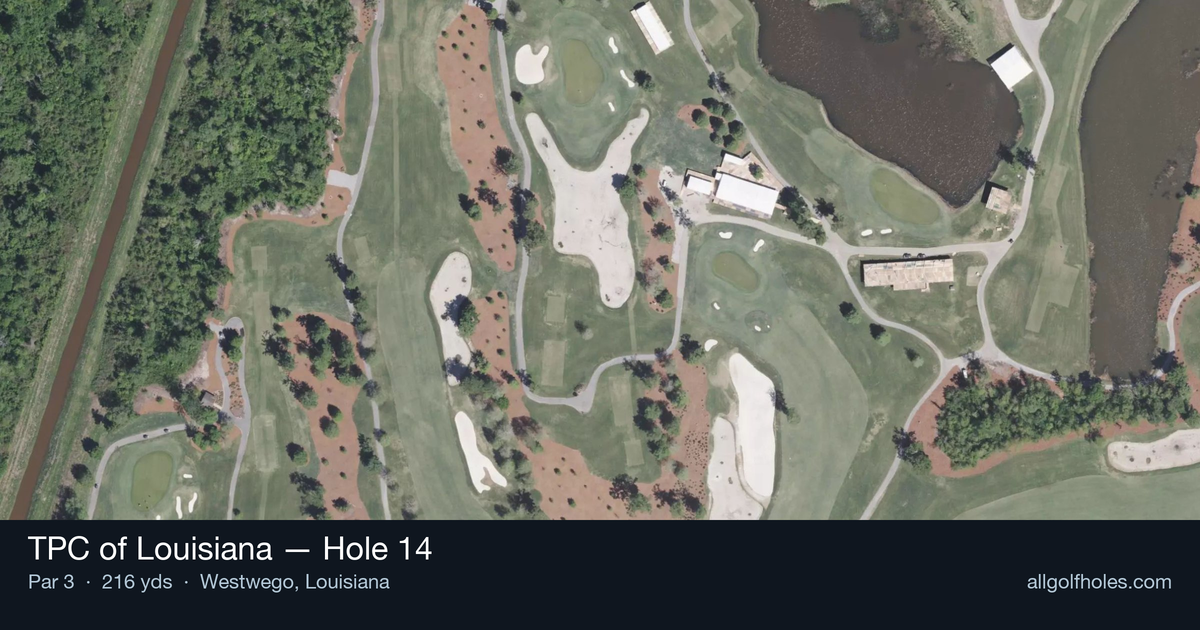
Aerial source not provided
Green size: 38 yds deep × 21 yds wide
Scorecard yardage is for Championship tees. The aerial shows its labeled reference position; distance rings measure to the green.
Championship tees · Par 3 · 216 yards
The plan for No. 14
TPC of Louisiana hole 14 presents a deceptively challenging par 3 that embodies Pete Dye's strategic design philosophy at 216 yards. This straightforward tee shot demands precision over a small green complex that punishes anything less than committed execution. The hole's understated appearance masks its difficulty, as the compact target requires golfers to select the right club and trust their swing. With Dye's signature contoured greens creating subtle slopes and collection areas, even well-struck shots can leave challenging putts. As part of a course featuring over 100 bunkers, this par 3 tests accuracy and course management, making it a memorable test where distance control proves more valuable than raw power.
Off the tee
**Club Selection**: The key decision revolves around choosing enough club to comfortably reach the green while maintaining accuracy. Most players will need a long iron or hybrid, with stronger players potentially using a mid-iron in favorable conditions. Factor in wind conditions, pin position, and green firmness when making your selection. **Target Line**: Aim for the center of the green regardless of pin position. With a small green, the margin for error is limited, making the middle of the putting surface the safest target. Trying to attack specific pin positions on a green this size often leads to short-sided situations or missed greens entirely. **Execution Keys**: Take one extra club and make a smooth, controlled swing rather than forcing a shorter iron. The small green demands precision, and an aggressive swing with insufficient club often results in a miss short or offline.
Approach & recovery
Since this is a par 3, the tee shot IS the approach shot. The strategy centers on landing the ball on the green and keeping it there. Given Pete Dye's design tendencies, expect the green to have subtle but challenging contours that can reject slightly off-line shots. **Wind Considerations**: Louisiana's coastal location means wind will be a factor. Club up in headwinds and be prepared to flight the ball lower in strong conditions. Crosswinds require adjusting your aim point while maintaining commitment to your target line.
On the green
Pete Dye's "devilishly contoured greens" come into play once you reach the putting surface. While the specific break patterns aren't detailed, expect subtle slopes that can be deceiving. The small green size means most putts will be relatively short, but don't underestimate the importance of speed control. **Putting Strategy**: Focus on lag putting to the correct level of the green rather than being overly aggressive with birdie attempts. Two-putting from anywhere on this small green should be the primary goal, with birdies coming as a bonus for well-struck approach shots. ## RISK VS REWARD The risk/reward calculation here is straightforward: there's minimal reward for aggressive play given the small target, while the risk of missing the green entirely is significant. The smart play is conservative - aim for the center of the green and accept whatever putt you're left with. **Conservative Approach**: Take enough club, aim for the middle, and focus on finding the putting surface. This strategy maximizes your chances of making par while keeping bogey or worse off the scorecard. ## DIFFERENT SKILL LEVELS **High Handicappers**: Focus entirely on getting the ball on the green. Use a club that you're confident will reach the target, even if it means potentially going long. Missing short on a Pete Dye design is typically more penal than going slightly long. Consider using a hybrid or fairway wood for more consistent contact. **Low Handicappers**: While you have the skill to attack pins, the small green size suggests a more measured approach is wise. Use your distance control to get the ball to the correct level of the green based on pin position, but don't sacrifice accuracy for the sake of getting close to every flag. **Course Management**: Regardless of skill level, this hole rewards patience and smart decision-making over heroic shots. The 16th handicap ranking suggests it's a scoring opportunity for those who play it intelligently, but it can quickly become a card-wrecker for players who get too aggressive with such a small target. The key to success on this Pete Dye par 3 is respecting the design while maintaining confidence in your club selection and swing. Make a committed pass at the center of the green, and let your putting take care of the rest.
Watch for
- Course conditioning and mapped hazards may affect line selection; confirm from the aerial.
Hole 14 Green Complex
Mapped green boundary
Green size: 4,209 sq ft
How did Hole 14 play?
How did this hole play today?
Frequently asked questions
Yardage reference: Championship tees · 216 yards.
What club should I use on this par 3?
↓
At 216 yards, most golfers will need a fairway wood or hybrid to reach this green. Adjust for elevation, wind, and pin position.
How difficult is hole 14?
↓
This hole is one of the tougher holes on the course for most golfers. Key challenges include: long par 3, heavily bunkered, small green.
How big is the green on hole 14?
↓
The green is small and requires precision. The green is deeper than wide, so club selection is crucial. Expect challenging pin positions with limited room for error.
What's a good score on hole 14?
↓
This hole is a challenging par where bogey is acceptable. This longer par 3 will test your long iron or hybrid game. Par is a good score.