Hole 3 at Olympia Fields Country Club (North Course)
- Par
- 4
- Yardage
- 439 yds
- Stroke index
- 1
- Hazards
- 4 bunkers · Water
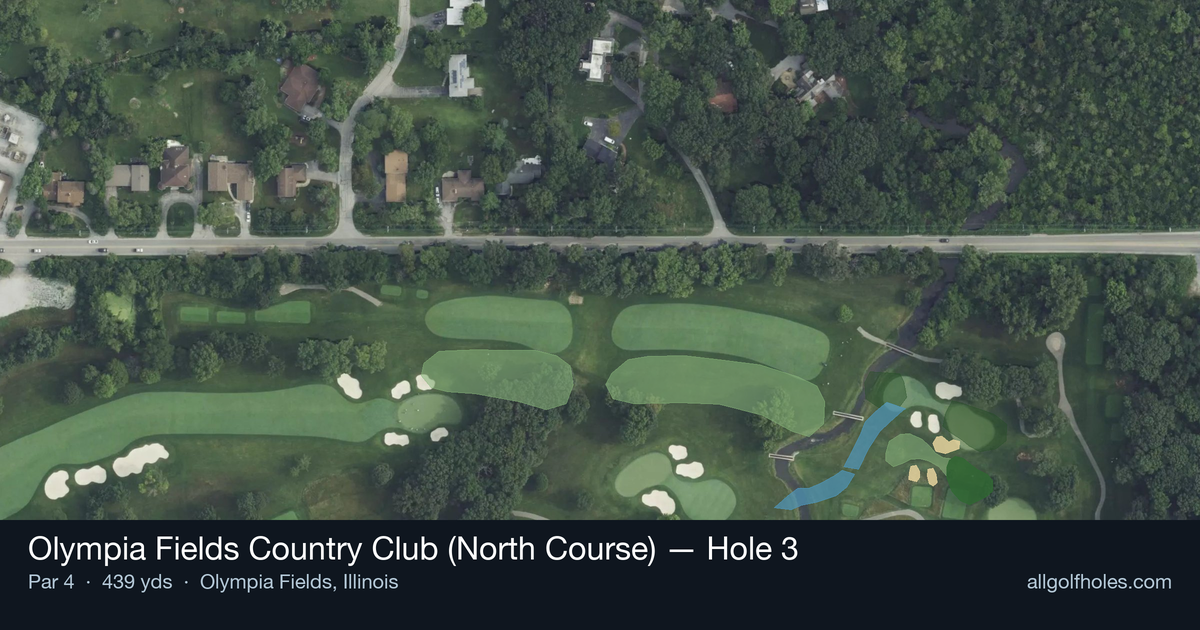
Aerial source not provided
Green size: 29 yds deep × 26 yds wide
Scorecard yardage is for Championship tees. The aerial shows its labeled reference position; distance rings measure to the green.
Championship tees · Par 4 · 439 yards
The plan for No. 3
The #1 handicap hole at Olympia Fields Country Club (North Course) demands respect from the opening tee shot. This 439-yard par 4 presents a deceptively straightforward challenge that has tested champions since hosting multiple major championships, including the 2003 U.S. Open. The straight layout offers no hiding places - precision and power are equally essential on this unforgiving test. With no significant hazards to navigate around, golfers must focus on course management and execution, as the small green becomes an elusive target from longer approach distances. The hole's difficulty lies in its demand for two quality shots, making it a true separator that rewards only the most committed swings. This is championship golf at its purest.
Off the tee
The tee shot strategy centers on finding the ideal position in the landing zone while maximizing distance. With the hole playing straight and lacking major hazards, your primary focus should be on the center-left portion of the fairway, which typically provides the best angle for approach shots to small greens. Driver is likely the right choice for most players to leave a manageable approach distance, but accuracy cannot be sacrificed for distance. A slight fade or straight ball flight works best here, avoiding any subtle trouble that may exist along the edges of the playing corridor.
Approach & recovery
The approach shot to this small green demands precision and proper club selection. From the fairway, you'll likely be hitting anywhere from a mid-iron to long-iron depending on your tee shot distance and pin position. The small green size means there's little margin for error - focus on the center of the green rather than attacking pins unless you're completely confident in your distance control. Take one extra club and swing smoothly rather than forcing a shot. Pay attention to wind conditions, as they'll have a significant impact on club selection for this longer approach.
On the green
Small greens at championship courses typically feature subtle but challenging contours that can create difficult two-putts if you're not careful with your approach shot placement. Focus on getting your approach shot below the hole when possible, as uphill putts are generally more manageable on smaller surfaces. The key is lag putting - with limited green space, three-putts can quickly derail your score on this difficult hole. Read the green carefully and prioritize getting your first putt close rather than being overly aggressive. ## RISK VS REWARD This hole's risk/reward calculation is primarily about tee shot aggression versus accuracy. The reward for a well-struck driver is a shorter, more manageable approach shot to the small green. However, the risk of missing the fairway and facing a longer, more difficult approach from rough or secondary rough can quickly turn this into a bogey or worse. The conservative play of hitting 3-wood or long iron off the tee may leave a longer approach but ensures better positioning and lie quality. ## DIFFERENT SKILL LEVELS **Low Handicap Players**: Attack with driver off the tee, focusing on optimal positioning for your preferred approach distance. Be aggressive with pin hunting only when you have a comfortable yardage and good lie. Trust your distance control and target the pin when conditions allow. **High Handicap Players**: Consider 3-wood or hybrid off the tee to ensure finding the fairway. Aim for the center of the green regardless of pin position - the small target demands a conservative approach strategy. Focus on avoiding big numbers by keeping the ball in play and accepting par as an excellent score on this challenging hole. The #1 handicap ranking demands respect from every golfer. Play within your abilities, prioritize accuracy over distance, and remember that par is always a good score on the toughest hole on the course.
Watch for
- Course conditioning and mapped hazards may affect line selection; confirm from the aerial.
Hole 3 Green Complex
Mapped green boundary
Green size: 4,037 sq ft
How did Hole 3 play?
How did this hole play today?
Frequently asked questions
Yardage reference: Championship tees · 439 yards.
What's the best strategy off the tee?
↓
For this 439-yard par 4, most players will hit driver to set up a comfortable approach.
How difficult is hole 3?
↓
This hole is one of the tougher holes on the course for most golfers. Key challenges include: water in play, small green.
What hazards should I watch out for on hole 3?
↓
Key hazards include: water at 346.8 yards. Plan your shots to avoid these trouble spots.
How big is the green on hole 3?
↓
The green is small and requires precision. Expect challenging pin positions with limited room for error.
What's a good score on hole 3?
↓
This hole is a demanding hole where bogey is not unusual. This longer par 4 will test most golfers. Focus on position over distance.