Hole 16 at Olympia Fields Country Club (North Course)
- Par
- 3
- Yardage
- 196 yds
- Stroke index
- 16
- Hazards
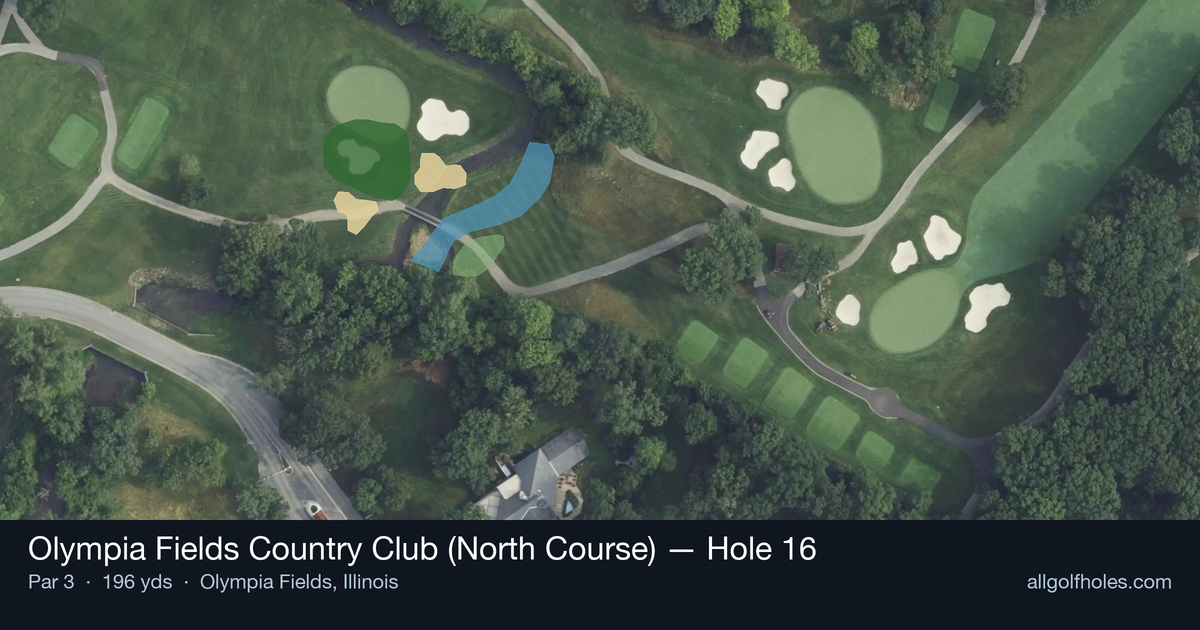
- 3 bunkers · Water
Aerial source not provided
Green size: 30 yds deep × 25 yds wide
Scorecard yardage is for Championship tees. The aerial shows its labeled reference position; distance rings measure to the green.
Championship tees · Par 3 · 196 yards
The plan for No. 16
The 16th hole at Olympia Fields Country Club (North Course) presents a deceptively challenging par 3 that demands precision over its 196 yards. This seemingly straightforward tee shot plays to a small, well-guarded green that punishes anything less than a committed strike. The absence of major hazards might fool golfers into complacency, but the compact target requires exact distance control and proper club selection. Wind conditions can significantly influence play on this exposed hole, making club choice critical. What appears as a routine mid-iron quickly reveals itself as a test of accuracy under pressure. The small green offers little margin for error, rewarding only the most precise approach shots with realistic birdie opportunities.
Off the tee
From 196 yards, most golfers will need a mid to long iron depending on conditions and pin position. Focus on smooth tempo and solid contact rather than trying to muscle the shot. Aim for the center of the green initially, as the small target demands conservative strategy. Wind conditions will play a significant role in club selection - be prepared to take one more or one less club based on the breeze. Trust your yardage and commit fully to your club choice, as indecision leads to poor contact on longer par-3s.
Approach & recovery
Since this is a par-3, your tee shot IS your approach shot. The key is picking the right target within the small green. Early in the round or when pin positions are unknown, play to the center. If you can see the flag, consider the following: front pins allow for more aggressive play with potential for spin, while back pins require carrying the shot all the way to avoid coming up short. The small green size means any miss will likely leave a challenging up-and-down.
On the green
Small greens typically feature subtle but important breaks that become magnified on longer putts. Lag putting becomes critical - focus on getting your first putt close rather than being aggressive from long range. Pay attention to the overall slope of the green and how it relates to surrounding terrain. Pin positions on small greens can dramatically affect difficulty, so adjust your approach strategy accordingly throughout different rounds. ## RISK VS REWARD This hole offers limited risk/reward opportunities due to its straightforward design. The main strategic decision is club selection and target choice. Being aggressive toward pins can pay off with birdie chances, but the penalty for missing a small green is typically a difficult chip or pitch shot. The conservative play to the center of the green is often the smartest choice, especially in competitive situations. ## DIFFERENT SKILL LEVELS **High-Handicap Players:** Focus on making solid contact and getting the ball somewhere on or near the green. Club up if uncertain and aim for the center of the green regardless of pin position. A bogey from the middle of the green is better than a double bogey from short-sided positions around the green. **Low-Handicap Players:** Can be more aggressive with pin hunting, especially with favorable wind conditions. Consider the pin position in relation to your natural shot shape. Use course management skills to identify when to attack pins versus when to play safe. Focus on distance control and landing the ball in the correct section of the green to leave manageable putts. The 16th at Olympia Fields rewards patience and precision over power, making it a true test of iron play and course management skills.
Watch for
- Course conditioning and mapped hazards may affect line selection; confirm from the aerial.
Hole 16 Green Complex
Mapped green boundary
Green size: 4,514 sq ft
How did Hole 16 play?
How did this hole play today?
Frequently asked questions
Yardage reference: Championship tees · 196 yards.
What club should I use on this par 3?
↓
At 196 yards, most golfers will need a long iron or hybrid (5-iron to 6-iron) to reach this green. Adjust for elevation, wind, and pin position.
How difficult is hole 16?
↓
This hole is a moderate challenge for most golfers. Key challenges include: water in play.
What hazards should I watch out for on hole 16?
↓
Key hazards include: water at 156.2 yards. Plan your shots to avoid these trouble spots.
How big is the green on hole 16?
↓
The green is medium-sized with moderate targets. Pay attention to pin placement when selecting your approach club.