Hole 17 at Olympia Fields Country Club (North Course)
- Par
- 4
- Yardage
- 404 yds
- Stroke index
- 12
- Hazards
- 5 bunkers · Water
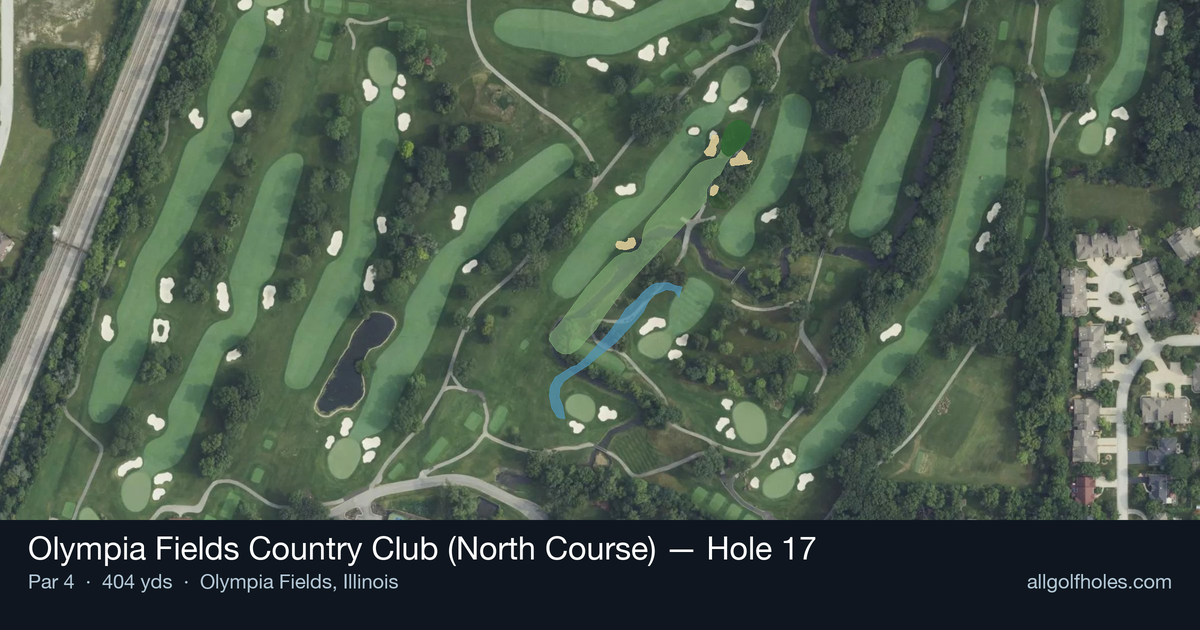
Aerial source not provided
Green size: 33 yds deep × 22 yds wide
Scorecard yardage is for Championship tees. The aerial shows its labeled reference position; distance rings measure to the green.
Championship tees · Par 4 · 404 yards
The plan for No. 17
The 17th hole at Olympia Fields Country Club (North Course) presents a deceptively challenging par 4 that has tested champions throughout this storied venue's history. At 404 yards, this straight-away hole demands precision over power, with its small green serving as the primary defense against scoring. The tee shot plays to a generous fairway, allowing golfers to focus on position rather than distance. However, the approach shot reveals the hole's true character - the compact green complex requires pinpoint accuracy and proper club selection. Without bunkers or water hazards to distract, golfers must rely on course management and execution. This understated design exemplifies the strategic architecture that made Olympia Fields a multiple major championship host, where par feels like a victory and birdies are truly earned through skillful play.
Off the tee
The tee shot strategy centers on finding the optimal position in the fairway for your approach. With no significant hazards to navigate, focus on hitting to your preferred yardage for the approach shot. Most players will benefit from a controlled driver or 3-wood, aiming for the center-left portion of the fairway to open up the best angle to the green. Avoid the urge to overswing – smooth tempo and solid contact will set up a much more manageable second shot than a poorly struck driver that finds the rough.
Approach & recovery
The approach shot is where this hole shows its teeth. The small green demands precision, making club selection critical. Depending on your tee shot position, you'll likely face a mid-iron to long-iron into the green. Focus on hitting the center of the green rather than chasing pins, as the compact target leaves little margin for error. Take one extra club if between selections – being long is often preferable to coming up short on a smaller green where recovery shots become more challenging.
On the green
With a small green, putting becomes a premium skill on the 17th. Expect subtle breaks that can be deceiving, and prioritize lag putting to avoid three-putts. The compact surface means most putts will be relatively straight, but pay attention to the grain and any subtle slopes. Conservative putting strategy pays dividends here – aim for the center of the hole on longer putts and trust your stroke on shorter ones. ## RISK VS REWARD This hole offers a classic risk/reward scenario in club selection rather than target selection. The reward for aggressive play is limited – even a perfect approach might only gain you a birdie opportunity. The risk of missing the small green, however, can quickly turn a scoring hole into a bogey or worse. Smart players recognize this as a "par-and-move-on" hole unless conditions strongly favor aggressive play. ## DIFFERENT SKILL LEVELS **High-handicap players** should embrace conservative strategy throughout. Use a fairway wood or hybrid off the tee to ensure finding the fairway, then focus on hitting the center of the green with whatever club gives you confidence. Don't chase pins – the small green rewards players who simply find the putting surface. **Low-handicap players** can be more aggressive with driver off the tee to set up shorter irons, but should still respect the small green on approach shots. Consider the pin position carefully – some locations may warrant attacking, while others call for playing to the center of the green and relying on putting prowess to make birdie. The 17th at Olympia Fields North exemplifies how strategic golf course design can create challenge without relying on obvious hazards. Success here comes from disciplined course management and precise execution rather than heroic shots.
Watch for
- Course conditioning and mapped hazards may affect line selection; confirm from the aerial.
Hole 17 Green Complex
Mapped green boundary
Green size: 4,515 sq ft
How did Hole 17 play?
How did this hole play today?
Frequently asked questions
Yardage reference: Championship tees · 404 yards.
What's the best strategy off the tee?
↓
For this 404-yard par 4, most players will hit driver to set up a comfortable approach.
How difficult is hole 17?
↓
This hole is a moderate challenge for most golfers. Key challenges include: water in play.
What hazards should I watch out for on hole 17?
↓
Key hazards include: water at 202.0 yards. Plan your shots to avoid these trouble spots.
How big is the green on hole 17?
↓
The green is medium-sized with moderate targets. Pay attention to pin placement when selecting your approach club.