Hole 8 at PGA National Resort & Spa (Champion)
- Par
- 4
- Yardage
- 427 yds
- Stroke index
- 7
- Hazards
- 3 bunkers · Water
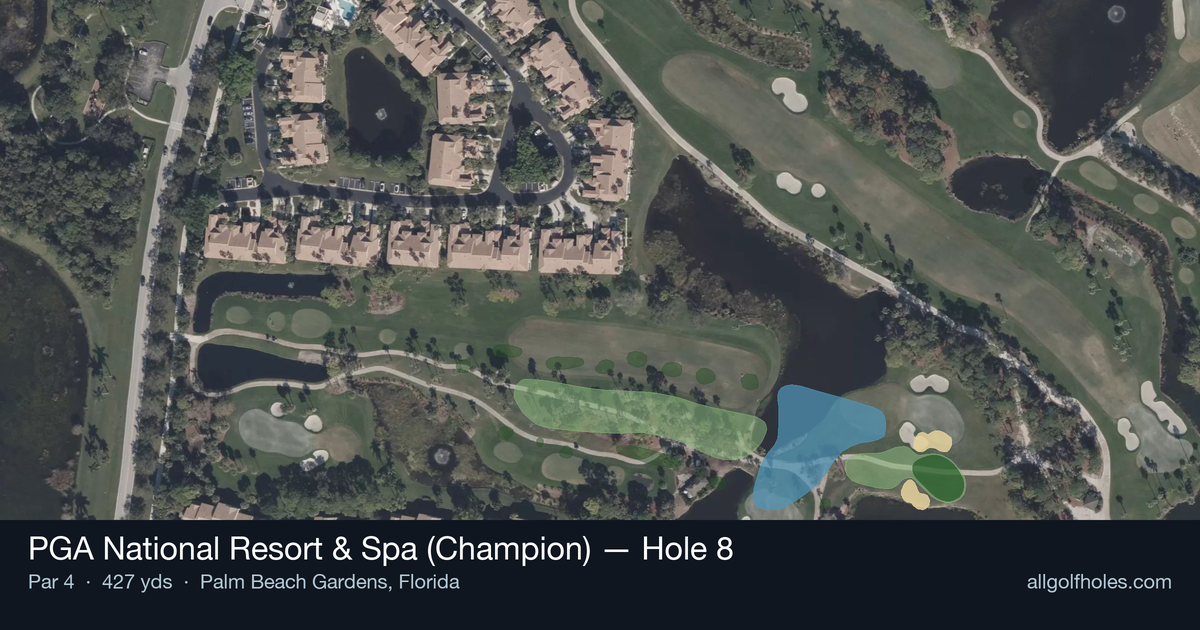
Aerial source not provided
Green size: 32 yds deep × 26 yds wide
Scorecard yardage is for Championship tees. The aerial shows its labeled reference position; distance rings measure to the green.
Championship tees · Par 4 · 427 yards
The plan for No. 8
The eighth hole at PGA National Resort & Spa (Champion) presents a deceptively challenging par 4 that demands precision over power. This straight 427-yard test features a generous fairway that invites aggressive drives, but the real challenge awaits at the small, well-protected green complex. With minimal hazards framing the hole, golfers might assume this is a straightforward scoring opportunity, yet the compact putting surface requires pinpoint accuracy on approach shots. The green's size creates a premium on distance control and club selection, as missing the target often leaves difficult recovery shots. What makes this hole memorable is its ability to punish overconfidence – while the tee shot appears forgiving, the demanding approach shot separates strategic players from those who simply grip it and rip it.
Off the tee
The straight layout allows for an aggressive tee shot strategy, but course management should guide your club selection. A driver can provide the ideal distance to leave a short iron into the green, but consider the conditions and your comfort level. The target line should favor the center of the fairway, giving you the best angle and distance for your approach. For most players, a well-struck 3-wood or hybrid can provide excellent positioning while keeping the ball in play. Focus on finding the fairway rather than maximizing distance - a shorter approach from the fairway is far preferable to a longer shot from the rough. ## APPROACH The small green is the defining feature of this hole and demands precision club selection. With no significant hazards to navigate, you can be aggressive with your target, but the compact putting surface requires you to dial in your distance control perfectly. Choose one extra club and swing smoothly rather than forcing a shorter iron. The small green means there's limited room for error, so prioritize hitting the center of the green over attacking pin positions. Pay attention to wind conditions, as they'll have a greater impact on a smaller target. ## ON THE GREEN The small green creates interesting putting dynamics where lag putting becomes crucial. Even from relatively short distances, the limited surface area means speed control is paramount. Focus on getting your first putt close rather than being overly aggressive with longer putts. Short putts become more pressure-packed on smaller greens, so take extra time with your pre-shot routine. The compact surface also means that subtle breaks can be more pronounced, so read your putts carefully from multiple angles. ## RISK VS REWARD While the lack of major hazards might suggest an aggressive approach, the small green creates its own risk/reward scenario. The reward for precise shots is significant - well-struck approaches can leave short birdie putts. However, the risk of missing the small target and facing challenging up-and-downs makes conservative play often the smarter choice. The main risk/reward decision comes with tee shot club selection. Driver provides the shortest approach but requires confident execution, while laying back with a fairway wood or long iron provides better positioning with a slightly longer approach shot. ## DIFFERENT SKILL LEVELS **High-Handicap Players:** Focus entirely on finding the fairway with your tee shot, even if it means using a 5-wood or hybrid. From there, aim for the center of the green regardless of pin position. The small target makes precision more important than aggression, so take one extra club and make a smooth swing on your approach. **Low-Handicap Players:** You can be more aggressive with driver off the tee, but still prioritize fairway position. On approach shots, you have the skill to attack certain pin positions, but respect the small green si
Approach & recovery
The small green is the defining feature of this hole and demands precision club selection. With no significant hazards to navigate, you can be aggressive with your target, but the compact putting surface requires you to dial in your distance control perfectly. Choose one extra club and swing smoothly rather than forcing a shorter iron. The small green means there's limited room for error, so prioritize hitting the center of the green over attacking pin positions. Pay attention to wind conditions, as they'll have a greater impact on a smaller target. ## ON THE GREEN The small green creates interesting putting dynamics where lag putting becomes crucial. Even from relatively short distances, the limited surface area means speed control is paramount. Focus on getting your first putt close rather than being overly aggressive with longer putts. Short putts become more pressure-packed on smaller greens, so take extra time with your pre-shot routine. The compact surface also means that subtle breaks can be more pronounced, so read your putts carefully from multiple angles. ## RISK VS REWARD While the lack of major hazards might suggest an aggressive approach, the small green creates its own risk/reward scenario. The reward for precise shots is significant - well-struck approaches can leave short birdie putts. However, the risk of missing the small target and facing challenging up-and-downs makes conservative play often the smarter choice. The main risk/reward decision comes with tee shot club selection. Driver provides the shortest approach but requires confident execution, while laying back with a fairway wood or long iron provides better positioning with a slightly longer approach shot. ## DIFFERENT SKILL LEVELS **High-Handicap Players:** Focus entirely on finding the fairway with your tee shot, even if it means using a 5-wood or hybrid. From there, aim for the center of the green regardless of pin position. The small target makes precision more important than aggression, so take one extra club and make a smooth swing on your approach. **Low-Handicap Players:** You can be more aggressive with driver off the tee, but still prioritize fairway position. On approach shots, you have the skill to attack certain pin positions, but respect the small green si
On the green
The small green creates interesting putting dynamics where lag putting becomes crucial. Even from relatively short distances, the limited surface area means speed control is paramount. Focus on getting your first putt close rather than being overly aggressive with longer putts. Short putts become more pressure-packed on smaller greens, so take extra time with your pre-shot routine. The compact surface also means that subtle breaks can be more pronounced, so read your putts carefully from multiple angles. ## RISK VS REWARD While the lack of major hazards might suggest an aggressive approach, the small green creates its own risk/reward scenario. The reward for precise shots is significant - well-struck approaches can leave short birdie putts. However, the risk of missing the small target and facing challenging up-and-downs makes conservative play often the smarter choice. The main risk/reward decision comes with tee shot club selection. Driver provides the shortest approach but requires confident execution, while laying back with a fairway wood or long iron provides better positioning with a slightly longer approach shot. ## DIFFERENT SKILL LEVELS **High-Handicap Players:** Focus entirely on finding the fairway with your tee shot, even if it means using a 5-wood or hybrid. From there, aim for the center of the green regardless of pin position. The small target makes precision more important than aggression, so take one extra club and make a smooth swing on your approach. **Low-Handicap Players:** You can be more aggressive with driver off the tee, but still prioritize fairway position. On approach shots, you have the skill to attack certain pin positions, but respect the small green si
Watch for
- Use mapped hazard edges and the hole 8 aerial for the selected tee before committing to a line.
Hole 8 Green Complex
Mapped green boundary
Green size: 3,981 sq ft
Course coverage
Tournament and creator videos about PGA National Resort & Spa (Champion) — shared course coverage, not hole-specific clips.
Tournament coverage
Cognizant Classic highlights
Cognizant Classic | Final Round Highlights
2025
Featured by these creators
Creator videos about this course
YouTube creators who filmed or featured PGA National Resort & Spa (Champion). · Stats as of Oct 12, 2026 · 6d ago
Has the PGA Tour wrecked PGA National? & FBF to Steve Pate's win in Palm Beach | The Shotgun Start
TGL's future & Todd Watch returns at PGA National for Cognizant Classic | The Shotgun Start
PGA National - Hole 5 - 238 yard par 3
How did Hole 8 play?
How did this hole play today?
Frequently asked questions
Yardage reference: Championship tees · 427 yards.
What's the best strategy off the tee?
↓
For this 427-yard par 4, most players will hit driver to set up a comfortable approach.
How difficult is hole 8?
↓
This hole is one of the tougher holes on the course for most golfers. Key challenges include: water in play, small green.
What hazards should I watch out for on hole 8?
↓
Key hazards include: water at 342.5 yards. Plan your shots to avoid these trouble spots.
How big is the green on hole 8?
↓
The green is small and requires precision. Expect challenging pin positions with limited room for error.