Hole 11 at PGA National Resort & Spa (Champion)
- Par
- 4
- Yardage
- 450 yds
- Stroke index
- 4
- Hazards
- 2 bunkers · Water
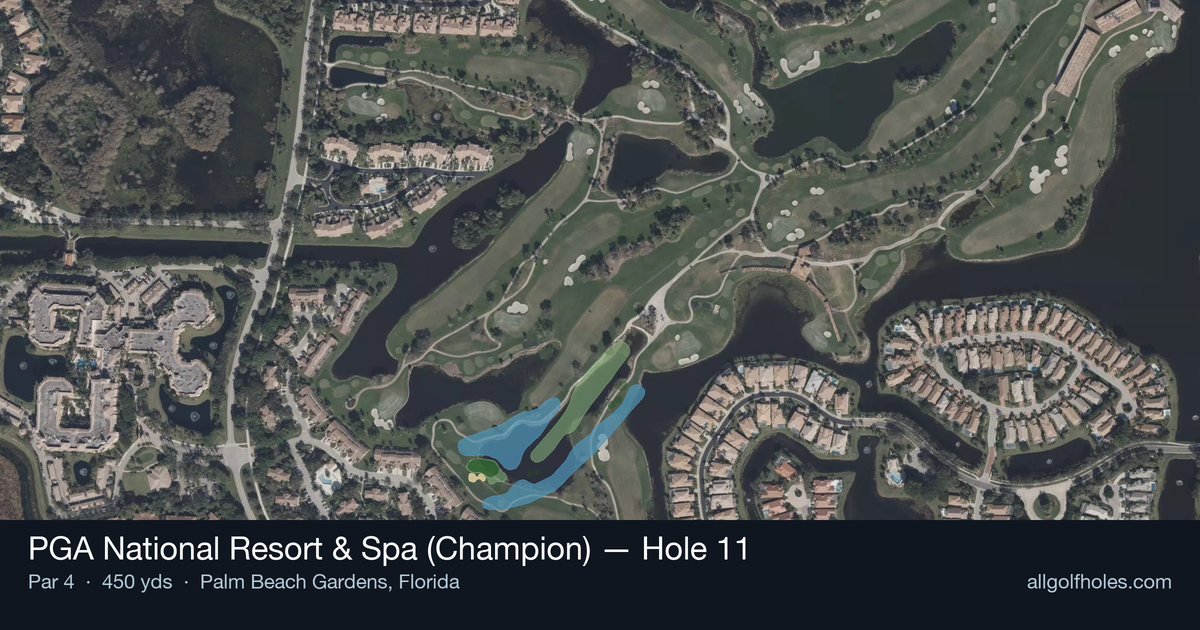
Aerial source not provided
Green size: 34 yds deep × 36 yds wide
Scorecard yardage is for Championship tees. The aerial shows its labeled reference position; distance rings measure to the green.
Championship tees · Par 4 · 450 yards
The plan for No. 11
The 11th hole at PGA National Resort & Spa (Champion) presents a deceptively challenging par 4 that demands both precision and power from the championship tees at 450 yards. This straight-away hole may appear straightforward, but its true test lies in the approach shot to a small, well-guarded green complex that punishes anything less than surgical accuracy. The generous fairway invites an aggressive tee shot, rewarding long hitters who can shorten the demanding approach. However, the real challenge emerges on the second shot, where players must navigate to a compact green that offers little margin for error. The small putting surface requires precise distance control and proper club selection, as anything short or long leaves difficult recovery shots. What makes this hole particularly memorable is how it exemplifies championship golf design – appearing benign from the tee yet revealing its teeth as players get closer to the flag. The combination of length and the premium placed on approach shot accuracy makes this a true test of complete golf skills.
Off the tee
The key off the tee is finding the optimal position for your approach shot rather than simply bombing driver. Most players should focus on the center of the fairway, using a club that ensures you stay in play while leaving a manageable distance to the pin. Depending on your distance, this might mean driver for shorter hitters or a controlled 3-wood for longer players who want to avoid running through the landing zone. The straight layout rewards those who can hit their target line consistently, so pick a specific target and commit to it. ## APPROACH With a small green as your target, precision becomes paramount on the approach shot. The key is selecting enough club to comfortably reach the green while maintaining control. A smooth swing with a mid-iron to long-iron (depending on your tee shot position) often works better than forcing a shorter club. Focus on the center of the green unless the pin position clearly favors one side. The small target means there's little room for error, so err on the side of taking more club rather than coming up short. ## ON THE GREEN The small green size means most putts will be relatively straightforward in terms of distance, but reading the subtle breaks becomes critical. Pay attention to the overall slope and drainage patterns around the green. With limited real estate, lag putting to ensure two-putts becomes more important than aggressive birdie attempts from longer distances. Focus on getting your first putt to the correct level and leaving yourself an uphill putt when possible. ## RISK VS REWARD This hole offers limited risk/reward opportunities, which is actually part of its strategic challenge. The reward comes from playing smart, conservative golf rather than taking aggressive lines. The main decision point is club selection off the tee - longer hitters might be tempted to take driver for a shorter approach, but the small green means the advantage of a shorter club into the green might not outweigh the risk of missing the fairway entirely. ## DIFFERENT SKILL LEVELS **High-handicap players** should prioriti
Approach & recovery
With a small green as your target, precision becomes paramount on the approach shot. The key is selecting enough club to comfortably reach the green while maintaining control. A smooth swing with a mid-iron to long-iron (depending on your tee shot position) often works better than forcing a shorter club. Focus on the center of the green unless the pin position clearly favors one side. The small target means there's little room for error, so err on the side of taking more club rather than coming up short. ## ON THE GREEN The small green size means most putts will be relatively straightforward in terms of distance, but reading the subtle breaks becomes critical. Pay attention to the overall slope and drainage patterns around the green. With limited real estate, lag putting to ensure two-putts becomes more important than aggressive birdie attempts from longer distances. Focus on getting your first putt to the correct level and leaving yourself an uphill putt when possible. ## RISK VS REWARD This hole offers limited risk/reward opportunities, which is actually part of its strategic challenge. The reward comes from playing smart, conservative golf rather than taking aggressive lines. The main decision point is club selection off the tee - longer hitters might be tempted to take driver for a shorter approach, but the small green means the advantage of a shorter club into the green might not outweigh the risk of missing the fairway entirely. ## DIFFERENT SKILL LEVELS **High-handicap players** should prioriti
On the green
The small green size means most putts will be relatively straightforward in terms of distance, but reading the subtle breaks becomes critical. Pay attention to the overall slope and drainage patterns around the green. With limited real estate, lag putting to ensure two-putts becomes more important than aggressive birdie attempts from longer distances. Focus on getting your first putt to the correct level and leaving yourself an uphill putt when possible. ## RISK VS REWARD This hole offers limited risk/reward opportunities, which is actually part of its strategic challenge. The reward comes from playing smart, conservative golf rather than taking aggressive lines. The main decision point is club selection off the tee - longer hitters might be tempted to take driver for a shorter approach, but the small green means the advantage of a shorter club into the green might not outweigh the risk of missing the fairway entirely. ## DIFFERENT SKILL LEVELS **High-handicap players** should prioriti
Watch for
- Use mapped hazard edges and the hole 11 aerial for the selected tee before committing to a line.
Hole 11 Green Complex
Mapped green boundary
Green size: 4,692 sq ft
Course coverage
Tournament and creator videos about PGA National Resort & Spa (Champion) — shared course coverage, not hole-specific clips.
Tournament coverage
Cognizant Classic highlights
Cognizant Classic | Final Round Highlights
2025
Featured by these creators
Creator videos about this course
YouTube creators who filmed or featured PGA National Resort & Spa (Champion). · Stats as of Oct 12, 2026 · 6d ago
Has the PGA Tour wrecked PGA National? & FBF to Steve Pate's win in Palm Beach | The Shotgun Start
TGL's future & Todd Watch returns at PGA National for Cognizant Classic | The Shotgun Start
PGA National - Hole 5 - 238 yard par 3
How did Hole 11 play?
How did this hole play today?
Frequently asked questions
Yardage reference: Championship tees · 450 yards.
What's the best strategy off the tee?
↓
For this 450-yard par 4, most players will hit driver to set up a comfortable approach.
How difficult is hole 11?
↓
This hole is a moderate challenge for most golfers. Key challenges include: water in play.
What hazards should I watch out for on hole 11?
↓
Key hazards include: water at 352.2 yards. Plan your shots to avoid these trouble spots.
How big is the green on hole 11?
↓
The green is medium-sized with moderate targets. The green is wider than it is deep, rewarding shots that find the correct tier. Pay attention to pin placement when selecting your approach club.
What's a good score on hole 11?
↓
This hole is one of the tougher holes where par feels like birdie. A challenging par 4. Accept that bogey happens and avoid big numbers.