Hole 7 at PGA National Resort & Spa (Champion)
- Par
- 3
- Yardage
- 226 yds
- Stroke index
- 15
- Hazards
- 5 bunkers · Water
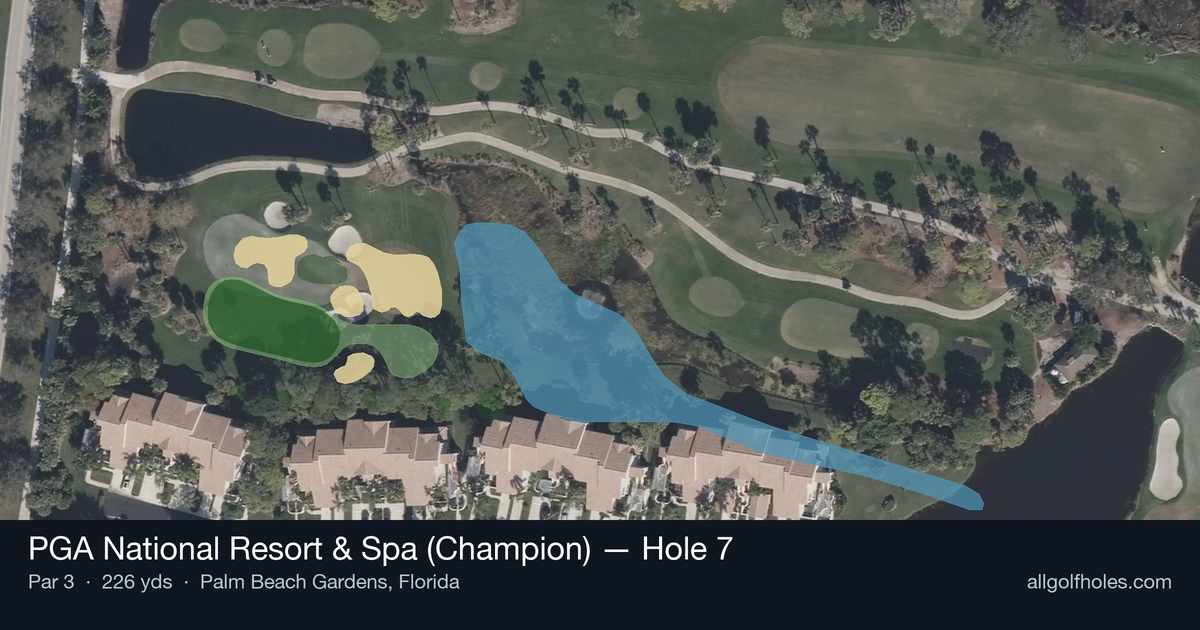
Aerial source not provided
Green size: 42 yds deep × 22 yds wide
Scorecard yardage is for Championship tees. The aerial shows its labeled reference position; distance rings measure to the green.
Championship tees · Par 3 · 226 yards
The plan for No. 7
The seventh hole at PGA National Resort & Spa (Champion) presents a deceptively challenging par 3 that demands precision over power. At 226 yards, this straight shot requires golfers to commit fully to their club selection, as the small green offers little margin for error. Despite the absence of water or bunkers, the hole's difficulty lies in its length and the premium it places on accuracy. The compact putting surface punishes wayward approaches, making distance control crucial for scoring opportunities. What appears straightforward from the tee quickly reveals itself as a true test of iron play, where even slight misses can lead to difficult recovery shots and challenging up-and-downs.
Off the tee
Your primary focus should be club selection that ensures you can reach the green with authority. For most golfers, this means choosing between a 4-iron, 5-iron, or hybrid depending on conditions and personal distances. Aim for the center of the green regardless of pin position - the small target makes going flag-hunting a risky proposition. Take one extra club if there's any doubt, as coming up short on a long par 3 often leads to difficult up-and-down situations. Pay attention to wind conditions, as the longer carry distance amplifies any breeze effects. ## APPROACH Since this is a par 3, your tee shot IS your approach. The key is committing fully to your club selection and making solid contact. With a small green as your target, focus on a smooth, controlled swing rather than trying to muscle the ball. The lack of significant hazards means you can be aggressive in attacking the green, but remember that missing the putting surface entirely creates challenging recovery shots. Trust your yardage and swing with confidence. ## ON THE GREEN The small green size means you're likely facing longer putts than you might expect, even with good approach shots. Take time to read the subtle breaks carefully, as shorter putts can be deceptive on smaller surfaces. Focus on lag putting to ensure you don't leave yourself with difficult comeback putts. The green's compact nature means speed control is crucial - running putts past the hole can leave you in trouble quickly. ## RISK VS REWARD The risk/reward calculation here is relatively straightforward. The reward for aggressive play is a potential birdie opportunity, while the risk is missing the small green entirely. With no major hazards to avoid, you can afford to be assertive with your club selection and target. The main risk comes from being indecisive or under-clubbing, which often results in short approaches that make par more difficult to achieve. ## DIFFERENT SKILL LEVELS **Higher Handicap Players:** Focus on getting the ball anywhere on the green rather than attacking specific pin positions. Consider taking an extra club to ensure you reach the putting surface, and aim for the center of the green regardless of flag location. A bogey here isn't disastrous given the hole's length and difficulty. **Lower Handicap Players:** You can be more aggressive in your target selection while still respecting the small green size. Consider pin position in your club selection - back pins might require an extra club, while front pins allow for more aggressive play. Look to capitali
Approach & recovery
Since this is a par 3, your tee shot IS your approach. The key is committing fully to your club selection and making solid contact. With a small green as your target, focus on a smooth, controlled swing rather than trying to muscle the ball. The lack of significant hazards means you can be aggressive in attacking the green, but remember that missing the putting surface entirely creates challenging recovery shots. Trust your yardage and swing with confidence. ## ON THE GREEN The small green size means you're likely facing longer putts than you might expect, even with good approach shots. Take time to read the subtle breaks carefully, as shorter putts can be deceptive on smaller surfaces. Focus on lag putting to ensure you don't leave yourself with difficult comeback putts. The green's compact nature means speed control is crucial - running putts past the hole can leave you in trouble quickly. ## RISK VS REWARD The risk/reward calculation here is relatively straightforward. The reward for aggressive play is a potential birdie opportunity, while the risk is missing the small green entirely. With no major hazards to avoid, you can afford to be assertive with your club selection and target. The main risk comes from being indecisive or under-clubbing, which often results in short approaches that make par more difficult to achieve. ## DIFFERENT SKILL LEVELS **Higher Handicap Players:** Focus on getting the ball anywhere on the green rather than attacking specific pin positions. Consider taking an extra club to ensure you reach the putting surface, and aim for the center of the green regardless of flag location. A bogey here isn't disastrous given the hole's length and difficulty. **Lower Handicap Players:** You can be more aggressive in your target selection while still respecting the small green size. Consider pin position in your club selection - back pins might require an extra club, while front pins allow for more aggressive play. Look to capitali
On the green
The small green size means you're likely facing longer putts than you might expect, even with good approach shots. Take time to read the subtle breaks carefully, as shorter putts can be deceptive on smaller surfaces. Focus on lag putting to ensure you don't leave yourself with difficult comeback putts. The green's compact nature means speed control is crucial - running putts past the hole can leave you in trouble quickly. ## RISK VS REWARD The risk/reward calculation here is relatively straightforward. The reward for aggressive play is a potential birdie opportunity, while the risk is missing the small green entirely. With no major hazards to avoid, you can afford to be assertive with your club selection and target. The main risk comes from being indecisive or under-clubbing, which often results in short approaches that make par more difficult to achieve. ## DIFFERENT SKILL LEVELS **Higher Handicap Players:** Focus on getting the ball anywhere on the green rather than attacking specific pin positions. Consider taking an extra club to ensure you reach the putting surface, and aim for the center of the green regardless of flag location. A bogey here isn't disastrous given the hole's length and difficulty. **Lower Handicap Players:** You can be more aggressive in your target selection while still respecting the small green size. Consider pin position in your club selection - back pins might require an extra club, while front pins allow for more aggressive play. Look to capitali
Watch for
- Use mapped hazard edges and the hole 7 aerial for the selected tee before committing to a line.
Hole 7 Green Complex
Mapped green boundary
Green size: 4,780 sq ft
Course coverage
Tournament and creator videos about PGA National Resort & Spa (Champion) — shared course coverage, not hole-specific clips.
Tournament coverage
Cognizant Classic highlights
Cognizant Classic | Final Round Highlights
2025
Featured by these creators
Creator videos about this course
YouTube creators who filmed or featured PGA National Resort & Spa (Champion). · Stats as of Oct 12, 2026 · 5d ago
Has the PGA Tour wrecked PGA National? & FBF to Steve Pate's win in Palm Beach | The Shotgun Start
TGL's future & Todd Watch returns at PGA National for Cognizant Classic | The Shotgun Start
PGA National - Hole 5 - 238 yard par 3
How did Hole 7 play?
How did this hole play today?
Frequently asked questions
Yardage reference: Championship tees · 226 yards.
What club should I use on this par 3?
↓
At 226 yards, most golfers will need a fairway wood or hybrid to reach this green. Adjust for elevation, wind, and pin position.
How difficult is hole 7?
↓
This hole is one of the tougher holes on the course for most golfers. Key challenges include: long par 3, water in play.
What hazards should I watch out for on hole 7?
↓
Key hazards include: water at 114.1 yards. Plan your shots to avoid these trouble spots.
How big is the green on hole 7?
↓
The green is medium-sized with moderate targets. The green is wider than it is deep, rewarding shots that find the correct tier. Pay attention to pin placement when selecting your approach club.
What's a good score on hole 7?
↓
This hole is a challenging par where bogey is acceptable. This longer par 3 will test your long iron or hybrid game. Par is a good score.