Hole 10 at PGA National Resort & Spa (Champion)
- Par
- 5
- Yardage
- 545 yds
- Stroke index
- 8
- Hazards
- 7 bunkers
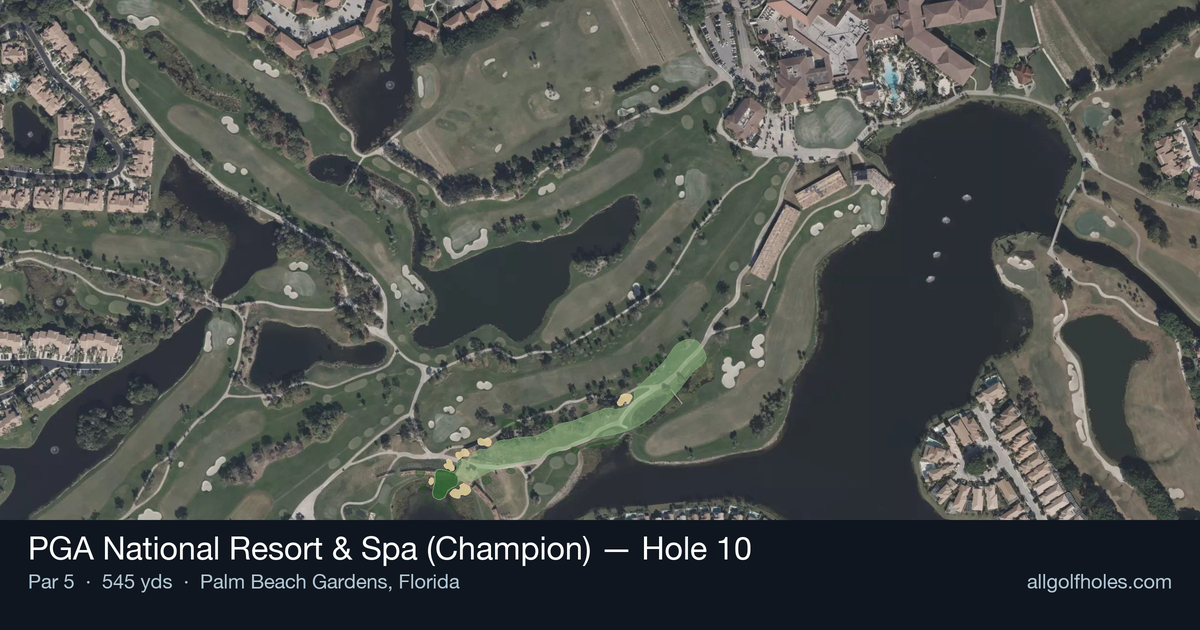
Aerial source not provided
Green size: 37 yds deep × 30 yds wide
Scorecard yardage is for Championship tees. The aerial shows its labeled reference position; distance rings measure to the green.
Championship tees · Par 5 · 545 yards
The plan for No. 10
The 10th hole at PGA National Resort & Spa (Champion) presents a deceptively challenging par 5 that demands both power and precision across its 545 yards. This straight-away layout appears inviting from the tee, offering a generous fairway that encourages aggressive play, but the absence of significant hazards doesn't diminish its strategic complexity. The key lies in positioning for the approach to the small, subtly contoured green that punishes wayward shots with difficult recovery options. Smart players will favor accuracy over distance on their second shot, setting up a manageable short iron into the compact green complex. Despite its straightforward appearance, this hole rewards course management and punishes overly aggressive play, making it a true test of strategic thinking on PGA National's championship layout.
Off the tee
The opening shot sets the tone for the entire hole, with distance and accuracy both playing crucial roles. Driver is the preferred club for most players, as maximizing distance off the tee opens up more strategic options for the second shot. Focus on finding the center of the fairway with a smooth, controlled swing rather than trying to overpower the shot. The straight layout means you can be aggressive with your target line, aiming directly at the flagstick in the distance. Players who struggle with driver accuracy should consider 3-wood or hybrid to ensure they stay in play while still advancing the ball a reasonable distance down the fairway. ## APPROACH The approach strategy varies significantly based on your tee shot result and personal distance capabilities. Longer hitters who found the fairway may have an opportunity to reach the green in two with a mid-iron to long-iron, depending on conditions. However, the small green size makes this a high-risk proposition that requires exceptional accuracy. Most players will benefit from laying up to their preferred wedge distance, typically leaving 100-120 yards to the pin. When laying up, favor the right side of the fairway if possible, as this often provides the best angle into the small green. Avoid getting too aggressive with distance on your layup – it's better to have a full wedge shot than an awkward half-swing from closer range. ## ON THE GREEN The small green demands precise distance control on your approach, as there's little room for error with pin placement. Focus on getting the ball to the correct level of the green, as subtle breaks can be deceiving on smaller putting surfaces. Lag putting becomes critical here – two-putting from long range is always a victory on a green this size. Pay attention to the grain direction, which can significantly affect ball speed on Florida courses. When facing challenging pin positions near the edges, aim for the center of the green and take your chances with a longer putt rather than risking a miss that leaves a difficult recovery. ## RISK VS REWARD The primary risk-reward decision comes on the second shot for players within range of the green. Going for the green in two offers excellent birdie and even eagle potential, but the small target means mishits often result in difficult recovery shots. The reward is significant – getting home in two almost guarantees at least a birdie opportunity. However, the conservative play of laying up to wedge distance still provides excellent scoring chances while virtually eliminating big numbers. Consider factors like pin position, wind conditions, and your current round momentum when making this decision. ## DIFFERENT SKILL LEVELS **Low Handicappers:** Should seriously consider going for the green in two when conditions allow, as their precision with longer irons makes the small target more manageable. Focus on aggressive tee shots with driver to maximize second-shot opportunities, and don't be afraid to attack pins when laying up. **High Handicappers:** Should prioritize keeping the ball in play and advancing it steadily down the fairway. Use the club that gives you the most confidence off the tee, even if it means sacrificing some distance. Plan for three shots to reach the green, focusing on leaving comfortable distances for each subsequent shot. The small green means even modest approach shots can yield birdie opportunities with good putting. This hole rewards smart course management and precise execution while offering legitimate scoring opportunities for players at every skill level. The key is matching your strategy to your abilities while taking advantage of the relatively ha
Approach & recovery
The approach strategy varies significantly based on your tee shot result and personal distance capabilities. Longer hitters who found the fairway may have an opportunity to reach the green in two with a mid-iron to long-iron, depending on conditions. However, the small green size makes this a high-risk proposition that requires exceptional accuracy. Most players will benefit from laying up to their preferred wedge distance, typically leaving 100-120 yards to the pin. When laying up, favor the right side of the fairway if possible, as this often provides the best angle into the small green. Avoid getting too aggressive with distance on your layup – it's better to have a full wedge shot than an awkward half-swing from closer range. ## ON THE GREEN The small green demands precise distance control on your approach, as there's little room for error with pin placement. Focus on getting the ball to the correct level of the green, as subtle breaks can be deceiving on smaller putting surfaces. Lag putting becomes critical here – two-putting from long range is always a victory on a green this size. Pay attention to the grain direction, which can significantly affect ball speed on Florida courses. When facing challenging pin positions near the edges, aim for the center of the green and take your chances with a longer putt rather than risking a miss that leaves a difficult recovery. ## RISK VS REWARD The primary risk-reward decision comes on the second shot for players within range of the green. Going for the green in two offers excellent birdie and even eagle potential, but the small target means mishits often result in difficult recovery shots. The reward is significant – getting home in two almost guarantees at least a birdie opportunity. However, the conservative play of laying up to wedge distance still provides excellent scoring chances while virtually eliminating big numbers. Consider factors like pin position, wind conditions, and your current round momentum when making this decision. ## DIFFERENT SKILL LEVELS **Low Handicappers:** Should seriously consider going for the green in two when conditions allow, as their precision with longer irons makes the small target more manageable. Focus on aggressive tee shots with driver to maximize second-shot opportunities, and don't be afraid to attack pins when laying up. **High Handicappers:** Should prioritize keeping the ball in play and advancing it steadily down the fairway. Use the club that gives you the most confidence off the tee, even if it means sacrificing some distance. Plan for three shots to reach the green, focusing on leaving comfortable distances for each subsequent shot. The small green means even modest approach shots can yield birdie opportunities with good putting. This hole rewards smart course management and precise execution while offering legitimate scoring opportunities for players at every skill level. The key is matching your strategy to your abilities while taking advantage of the relatively ha
On the green
The small green demands precise distance control on your approach, as there's little room for error with pin placement. Focus on getting the ball to the correct level of the green, as subtle breaks can be deceiving on smaller putting surfaces. Lag putting becomes critical here – two-putting from long range is always a victory on a green this size. Pay attention to the grain direction, which can significantly affect ball speed on Florida courses. When facing challenging pin positions near the edges, aim for the center of the green and take your chances with a longer putt rather than risking a miss that leaves a difficult recovery. ## RISK VS REWARD The primary risk-reward decision comes on the second shot for players within range of the green. Going for the green in two offers excellent birdie and even eagle potential, but the small target means mishits often result in difficult recovery shots. The reward is significant – getting home in two almost guarantees at least a birdie opportunity. However, the conservative play of laying up to wedge distance still provides excellent scoring chances while virtually eliminating big numbers. Consider factors like pin position, wind conditions, and your current round momentum when making this decision. ## DIFFERENT SKILL LEVELS **Low Handicappers:** Should seriously consider going for the green in two when conditions allow, as their precision with longer irons makes the small target more manageable. Focus on aggressive tee shots with driver to maximize second-shot opportunities, and don't be afraid to attack pins when laying up. **High Handicappers:** Should prioritize keeping the ball in play and advancing it steadily down the fairway. Use the club that gives you the most confidence off the tee, even if it means sacrificing some distance. Plan for three shots to reach the green, focusing on leaving comfortable distances for each subsequent shot. The small green means even modest approach shots can yield birdie opportunities with good putting. This hole rewards smart course management and precise execution while offering legitimate scoring opportunities for players at every skill level. The key is matching your strategy to your abilities while taking advantage of the relatively ha
Watch for
- Use mapped hazard edges and the hole 10 aerial for the selected tee before committing to a line.
Hole 10 Green Complex
Mapped green boundary
Green size: 4,661 sq ft
Course coverage
Tournament and creator videos about PGA National Resort & Spa (Champion) — shared course coverage, not hole-specific clips.
Tournament coverage
Cognizant Classic highlights
Cognizant Classic | Final Round Highlights
2025
Featured by these creators
Creator videos about this course
YouTube creators who filmed or featured PGA National Resort & Spa (Champion). · Stats as of Oct 12, 2026 · 5d ago
Has the PGA Tour wrecked PGA National? & FBF to Steve Pate's win in Palm Beach | The Shotgun Start
TGL's future & Todd Watch returns at PGA National for Cognizant Classic | The Shotgun Start
PGA National - Hole 5 - 238 yard par 3
How did Hole 10 play?
How did this hole play today?
Frequently asked questions
Yardage reference: Championship tees · 545 yards.
Can this par 5 be reached in two?
↓
At 545 yards, A true three-shot hole for most players. Position your layup to leave a comfortable wedge distance.
How difficult is hole 10?
↓
This hole is a good scoring opportunity for most golfers.
How big is the green on hole 10?
↓
The green is medium-sized with moderate targets. Pay attention to pin placement when selecting your approach club.