Hole 12 at PGA National Resort & Spa (Champion)
- Par
- 4
- Yardage
- 427 yds
- Stroke index
- 14
- Hazards
- 4 bunkers · Water
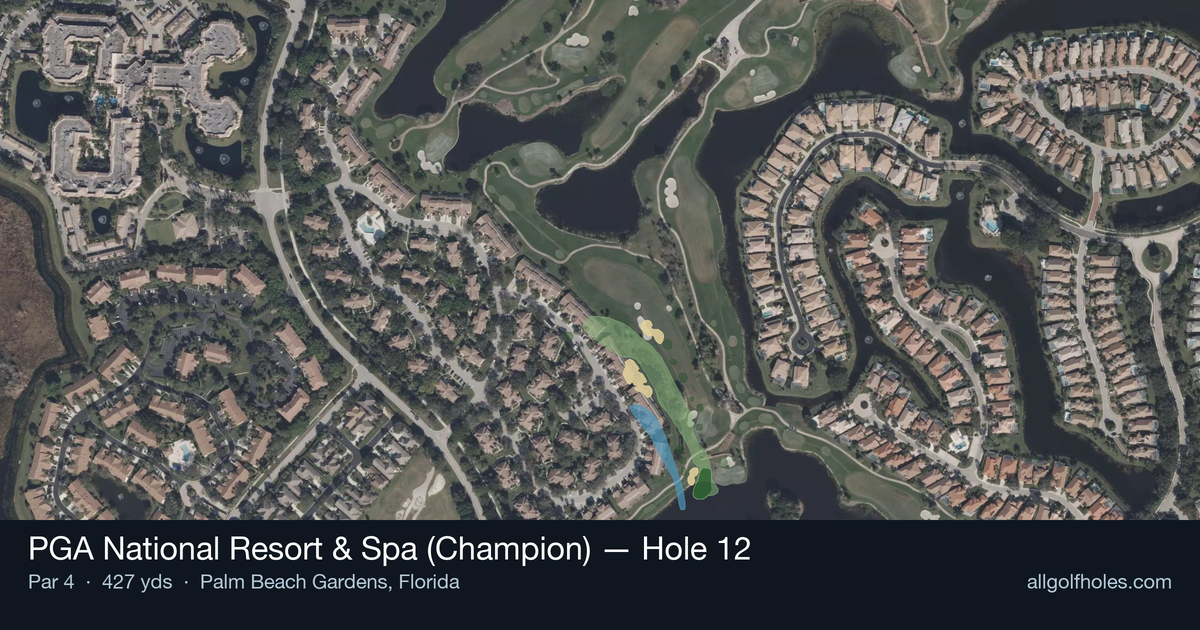
Aerial source not provided
Green size: 28 yds deep × 36 yds wide
Scorecard yardage is for Championship tees. The aerial shows its labeled reference position; distance rings measure to the green.
Championship tees · Par 4 · 427 yards
The plan for No. 12
The 12th hole at PGA National Resort & Spa (Champion) presents a deceptively straightforward par 4 that demands precision over power. This 427-yard straight-away hole may appear uncomplicated on the scorecard, but its small green complex creates the primary challenge that defines the playing experience. From the tee, golfers face a generous fairway that invites an aggressive tee shot, allowing players to position themselves for an optimal approach angle. The absence of significant hazards means course management focuses entirely on distance control and accuracy into the compact putting surface. The small green rewards precise iron play and punishes wayward approaches with challenging recovery shots from the surrounding areas. What makes this hole memorable is its emphasis on fundamental golf skills – a well-struck drive followed by a demanding approach shot that tests every golfer's ability to hit their target under pressure.
Off the tee
The absence of significant hazards allows for an aggressive mindset off the tee, but smart players will prioritize position over pure distance. A well-struck driver or strong 3-wood should leave you in prime position, but the key is finding the optimal distance for your preferred approach yardage. Many players benefit from working backward from their comfort zone - if you're most confident with a 7 or 8-iron approach, club accordingly off the tee. The straight layout rewards commitment to your target line, so pick your spot and execute with confidence. ## APPROACH The small green is the hole's primary defense and demands pinpoint accuracy with your approach shot. Club selection becomes critical here - it's better to be slightly long with a controlled swing than to force a shot you're not comfortable with. The compact target means there's little margin for error, so prioritize hitting the center of the green over attacking pins. Consider the firmness of the green and factor in any wind conditions, as a small target amplifies the impact of these variables. ## ON THE GREEN With a small putting surface, you'll likely face shorter putts than on many holes, but don't let that create false confidence. The reduced real estate means subtle breaks can be more pronounced, and speed control becomes even more critical. Focus on getting your first putt close rather than being overly aggressive, as three-putts from short range can be especially damaging to your scorecard. Pay attention to the grain and any slope, as these factors are magnified on a smaller surface. ## RISK VS REWARD This hole offers a classic risk/reward scenario disguised as a straightforward par 4. The temptation is to attack with driver and go for a short iron approach, but the small green punishes overly aggressive play. The smarter play often involves taking a more conservative tee shot that leaves your favorite approach distance, even if it means hitting a longer iron into the green. The scoring opportunity is real, but it rewards patience and precision over power. ## DIFFERENT SKILL LEVELS **Higher handicappers** should focus on course management above all else. Consider hitting 3-wood or hybrid off the tee to ensure you're in play, then prioritize hitting the green with your approach rather than attacking specific pin positions. Aim for the center of the green regardless of pin placement, and you'll give yourself legitimate birdie chances while protecting against big numbers. **Lower handicappers** can be more aggressive with their strategy, using driver to set up shorter approach shots. However, the small green still demands respect - even skilled players should think twice before attacking tight pins. This is an excellent hole to work on precision iron play and commitment to your target line, as the fundamentals of good golf are rewarded here. The key for all skill levels is recogni
Approach & recovery
The small green is the hole's primary defense and demands pinpoint accuracy with your approach shot. Club selection becomes critical here - it's better to be slightly long with a controlled swing than to force a shot you're not comfortable with. The compact target means there's little margin for error, so prioritize hitting the center of the green over attacking pins. Consider the firmness of the green and factor in any wind conditions, as a small target amplifies the impact of these variables. ## ON THE GREEN With a small putting surface, you'll likely face shorter putts than on many holes, but don't let that create false confidence. The reduced real estate means subtle breaks can be more pronounced, and speed control becomes even more critical. Focus on getting your first putt close rather than being overly aggressive, as three-putts from short range can be especially damaging to your scorecard. Pay attention to the grain and any slope, as these factors are magnified on a smaller surface. ## RISK VS REWARD This hole offers a classic risk/reward scenario disguised as a straightforward par 4. The temptation is to attack with driver and go for a short iron approach, but the small green punishes overly aggressive play. The smarter play often involves taking a more conservative tee shot that leaves your favorite approach distance, even if it means hitting a longer iron into the green. The scoring opportunity is real, but it rewards patience and precision over power. ## DIFFERENT SKILL LEVELS **Higher handicappers** should focus on course management above all else. Consider hitting 3-wood or hybrid off the tee to ensure you're in play, then prioritize hitting the green with your approach rather than attacking specific pin positions. Aim for the center of the green regardless of pin placement, and you'll give yourself legitimate birdie chances while protecting against big numbers. **Lower handicappers** can be more aggressive with their strategy, using driver to set up shorter approach shots. However, the small green still demands respect - even skilled players should think twice before attacking tight pins. This is an excellent hole to work on precision iron play and commitment to your target line, as the fundamentals of good golf are rewarded here. The key for all skill levels is recogni
On the green
With a small putting surface, you'll likely face shorter putts than on many holes, but don't let that create false confidence. The reduced real estate means subtle breaks can be more pronounced, and speed control becomes even more critical. Focus on getting your first putt close rather than being overly aggressive, as three-putts from short range can be especially damaging to your scorecard. Pay attention to the grain and any slope, as these factors are magnified on a smaller surface. ## RISK VS REWARD This hole offers a classic risk/reward scenario disguised as a straightforward par 4. The temptation is to attack with driver and go for a short iron approach, but the small green punishes overly aggressive play. The smarter play often involves taking a more conservative tee shot that leaves your favorite approach distance, even if it means hitting a longer iron into the green. The scoring opportunity is real, but it rewards patience and precision over power. ## DIFFERENT SKILL LEVELS **Higher handicappers** should focus on course management above all else. Consider hitting 3-wood or hybrid off the tee to ensure you're in play, then prioritize hitting the green with your approach rather than attacking specific pin positions. Aim for the center of the green regardless of pin placement, and you'll give yourself legitimate birdie chances while protecting against big numbers. **Lower handicappers** can be more aggressive with their strategy, using driver to set up shorter approach shots. However, the small green still demands respect - even skilled players should think twice before attacking tight pins. This is an excellent hole to work on precision iron play and commitment to your target line, as the fundamentals of good golf are rewarded here. The key for all skill levels is recogni
Watch for
- Use mapped hazard edges and the hole 12 aerial for the selected tee before committing to a line.
Hole 12 Green Complex
Mapped green boundary
Green size: 3,951 sq ft
Course coverage
Tournament and creator videos about PGA National Resort & Spa (Champion) — shared course coverage, not hole-specific clips.
Tournament coverage
Cognizant Classic highlights
Cognizant Classic | Final Round Highlights
2025
Featured by these creators
Creator videos about this course
YouTube creators who filmed or featured PGA National Resort & Spa (Champion). · Stats as of Oct 12, 2026 · 5d ago
Has the PGA Tour wrecked PGA National? & FBF to Steve Pate's win in Palm Beach | The Shotgun Start
TGL's future & Todd Watch returns at PGA National for Cognizant Classic | The Shotgun Start
PGA National - Hole 5 - 238 yard par 3
How did Hole 12 play?
How did this hole play today?
Frequently asked questions
Yardage reference: Championship tees · 427 yards.
What's the best strategy off the tee?
↓
For this 427-yard par 4, most players will hit driver to set up a comfortable approach.
How difficult is hole 12?
↓
This hole is one of the tougher holes on the course for most golfers. Key challenges include: water in play, small green.
What hazards should I watch out for on hole 12?
↓
Key hazards include: water at 350.7 yards. Plan your shots to avoid these trouble spots.
How big is the green on hole 12?
↓
The green is small and requires precision. The green is deeper than wide, so club selection is crucial. Expect challenging pin positions with limited room for error.