Hole 11 at Sedgefield Country Club
- Par
- 4
- Yardage
- 488 yds
- Stroke index
- 6
- Hazards
- 2 bunkers
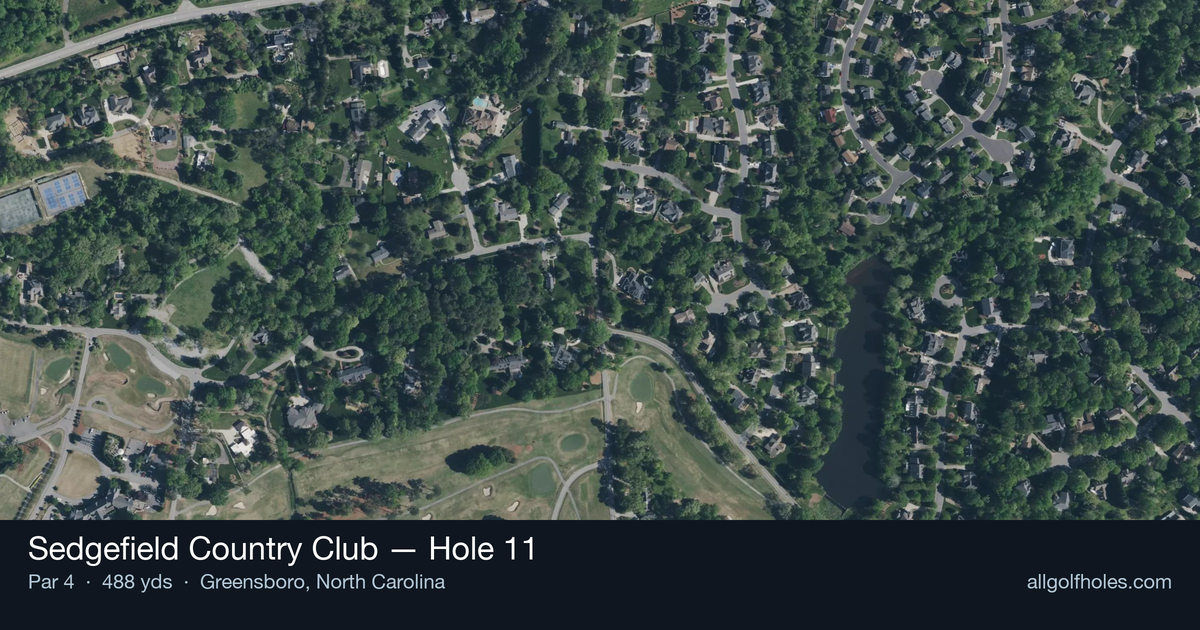
Aerial source not provided
Green size: 32 yds deep × 27 yds wide
Scorecard yardage is for Championship tees. The aerial shows its labeled reference position; distance rings measure to the green.
Championship tees · Par 4 · 488 yards
The plan for No. 11
Sedgefield Country Club hole 11 presents a demanding par 4 at 488 yards that tests both power and precision on this storied Wyndham Championship venue. The straight layout offers no hiding spots, requiring a confident tee shot down a generous fairway to set up the crucial approach. What makes this hole particularly challenging is the small, undulating green complex that embodies the course's reputation for tricky putting surfaces. The green's forward-sloping character and subtle breaks demand precise distance control on the approach shot, as anything long or short leaves difficult recovery options. This Pete Dye design showcases the architect's philosophy of rewarding accurate play while punishing wayward shots, making it a true test of golf strategy and execution in the heart of the round.
Off the tee
The tee shot strategy revolves around positioning for the best possible approach angle while maximizing distance. With 488 yards to cover, most players will need their longest accurate club off the tee. Driver is the obvious choice for players who can control it, but the key is finding the center of the fairway rather than chasing maximum distance into trouble. Target the middle of the fairway and focus on a smooth, controlled swing that prioritizes accuracy. The straight layout means there's room to work with, but Pete Dye designs often feature subtle slopes and contours that can kick balls into less favorable positions. A well-struck 3-wood might be the smarter play for golfers who struggle with driver consistency, as leaving yourself 180-190 yards in is far better than being in recovery mode after a wayward drive.
Approach & recovery
The approach shot is where this hole's true character emerges. From the likely distances of 150-200 yards remaining, club selection becomes crucial given Sedgefield's characteristically small, undulating greens that "tend to slope forward" and can "fall off the edges." Focus on hitting the center of the green rather than chasing pins, especially when they're tucked near the edges. The forward-sloping nature of these greens means shots that come up short often feed toward the hole, while anything long can quickly find trouble. A mid-iron to long-iron approach should emphasize a controlled trajectory that lands softly on the putting surface. Pay attention to pin position - when the flag is near the front, don't be afraid to take one less club and let the slope work in your favor. Back pins require more aggressive play but still demand precision over power.
On the green
Sedgefield's small, undulating greens require careful reading and conservative putting strategy. The forward slopes mentioned in course descriptions mean many putts will break more than they appear, particularly on longer attempts. Focus on lag putting to get within easy two-putt range rather than being aggressive with longer birdie attempts. The "interesting hole locations" created by the green's contours can make certain pins nearly impossible to attack directly, so sometimes putting to the fat part of the green and accepting a longer second putt is the wise play. Uphill putts will typically be more forgiving than downhill attempts, given the forward-sloping tendency. When reading breaks, remember that Pete Dye greens often have subtle undulations that can catch players off guard. ## RISK VS REWARD The primary risk/reward decision comes on the tee shot: how aggressive to be with driver versus playing more conservatively with 3-wood or hybrid. The reward for a well-struck driver is a shorter iron into the green, but the risk of finding trouble and facing a difficult recovery can quickly turn this into a bogey or worse. The approach shot offers another risk/reward scenario when attacking tucked pins versus playing to the center of the green. Given the small target and forward slopes, the conservative play often yields better results than aggressive pin-hunting. ## DIFFERENT SKILL LEVELS **High-Handicap Players:** Focus on two good shots rather than trying to reach in regulation at all costs. A 3-wood or hybrid off the tee followed by a mid-iron layup to about 100 yards can set up an easier wedge approach. Don't be afraid to play this as a three-shot hole - bogey beats double bogey every time. **Mid-Handicap Players:** Driver off the tee is likely necessary, but prioritize the fairway over maximum distance. Plan your approach to the center of the green and focus on solid contact. This hole rewards patience and course management over heroics. **Low-Handicap Players:** This becomes a legitimate birdie opportunity with proper execution. Driver to the optimal position, then an aggressive but controlled approach to create realistic birdie chances. However, respect the small green and don't force shots that aren't there - par is never a bad score on a 488-yard par 4. The key to success on this Pete Dye design is recognizing that length alone won't conquer it - strategic thinking and precise execution are what separate good scores from struggles on this demanding par 4.
Watch for
- Course conditioning and mapped hazards may affect line selection; confirm from the aerial.
Hole 11 Green Complex
Mapped green boundary
Green size: 5,768 sq ft
Course coverage
Tournament and creator videos about Sedgefield Country Club — shared course coverage, not hole-specific clips.
Tournament coverage
Wyndham Championship highlights
Wyndham Championship | Final Round Highlights
2025
How did Hole 11 play?
How did this hole play today?
Frequently asked questions
Yardage reference: Championship tees · 488 yards.
What's the best strategy off the tee?
↓
For this 488-yard par 4, most players will hit driver to set up a comfortable approach.
How difficult is hole 11?
↓
This hole is a moderate challenge for most golfers. Key challenges include: long par 4.
How big is the green on hole 11?
↓
The green is medium-sized with moderate targets. Pay attention to pin placement when selecting your approach club.
What's a good score on hole 11?
↓
This hole is one of the tougher holes where par feels like birdie. A challenging par 4. Accept that bogey happens and avoid big numbers.