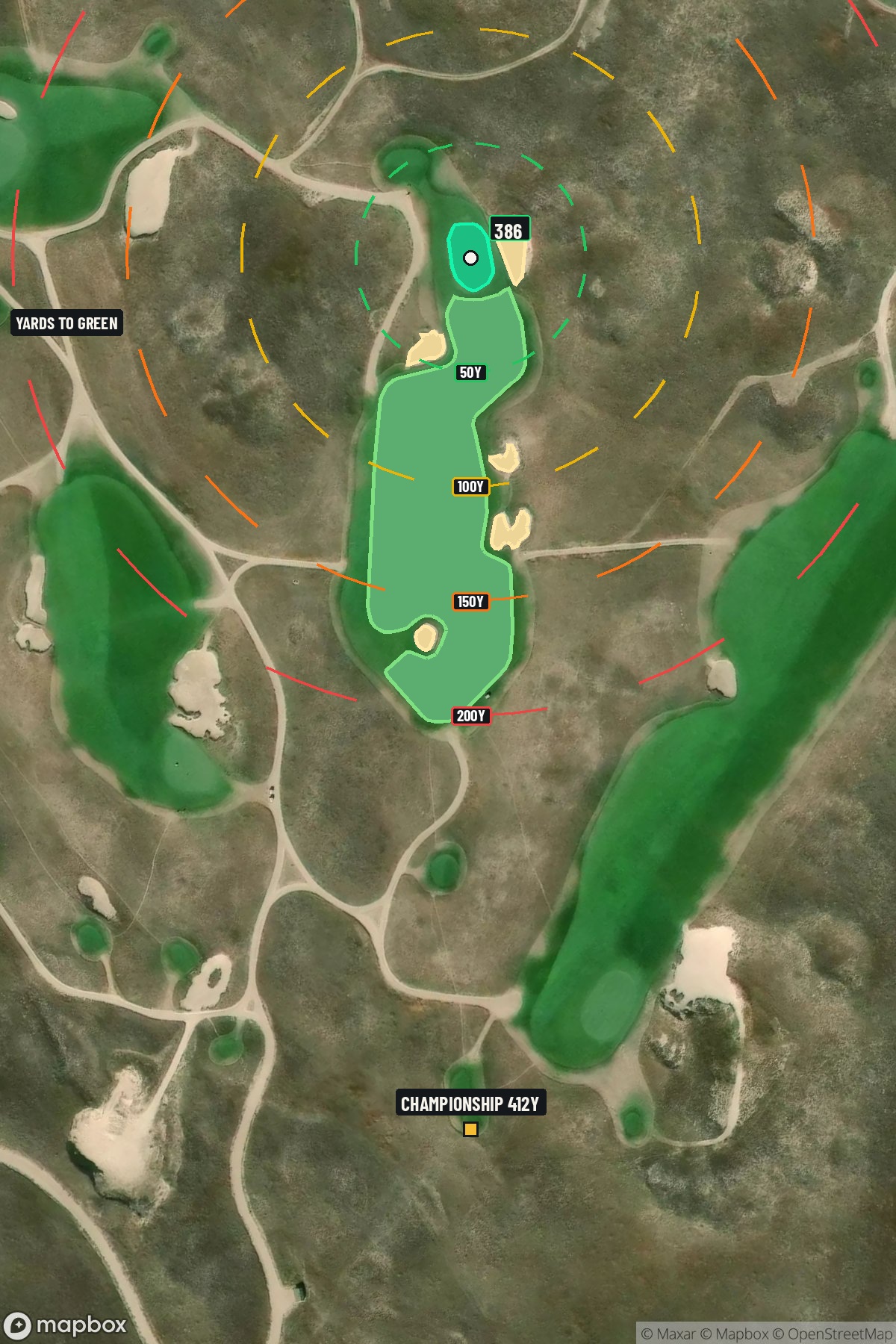
Hole 5 of 18 · Mullen, Nebraska

Hole 5 at Sand Hills Golf Club

Par
4
Yards
412
Handicap
16
Bunkers
6
Hole 5 aerial at Sand Hills Golf Club
Map distances from Championship tee · 412 yds

The map's printed distances are measured from the Championship tee to the green; they do not move when you change tees.

Green size: 31 yds deep × 21 yds wide

Mapbox Satellite composite · capture date not provided. Green at the top.

Where this map comes from

Satellite photo
Date not published
Mapbox satellite
Green contours
2023–2024 survey
USGS lidar survey
Report a map problem
100%
Hole 5 aerial at Sand Hills Golf Club

The plan for No. 5

The play: The fifth hole at Sand Hills Golf Club exemplifies the course's reputation for strategic simplicity amid Nebraska's stunning sandhills landscape. This 412-yard par 4 presents a deceptively straightforward challenge that rewards precision over power. The generous fairway invites confident tee shots, but the approach demands careful consideration as players face a small, subtly contoured green that punishes wayward iron play. Without bunkers or water to complicate matters, success hinges entirely on course management and execution. The hole's elevated position showcases the rolling prairie terrain that makes Sand Hills Golf Club one of America's most celebrated modern links-style courses, where natural beauty meets thoughtful design.

Shot by shot

  1. Off the tee

    The straight layout allows for aggressive targeting down the center line without concern for doglegs or severe trouble. Driver remains a viable option for longer hitters seeking to shorten the approach, but a controlled 3-wood or hybrid leaves a comfortable mid-iron into the green while maintaining accuracy. The key is finding the optimal distance that matches your most reliable approach club - typically leaving yourself with a 7-iron through pitching wedge for the second shot. Position slightly left of center if possible, as this angle often provides the best view and approach to small greens. Avoid the temptation to overcook the tee shot; with no major hazards lurking, the penalty for missing the fairway is primarily rough conditions rather than penalty strokes.

  2. Approach & recovery

    The small green size makes this the hole's defining shot. Club selection must account for limited margin for error - when in doubt, take one more club and swing smoothly rather than forcing a shorter iron. The green's compact dimensions reward approaches that land softly and check up quickly. Target the center of the green regardless of pin position, as the small surface area makes pin-hunting unnecessarily risky. Focus on solid contact and proper trajectory rather than trying to work the ball to specific quadrants. A controlled fade or draw is less important here than simply finding the putting surface.

  3. On the green

    Small greens typically feature subtle but influential slopes that can be difficult to read from approach distance. Spend extra time reading the putt from multiple angles, as the compact surface means every break is magnified. Lag putting becomes crucial - leaving yourself outside comfortable two-putt range on a small green often leads to three-putts. Pin positions in the corners or edges of small greens create particularly challenging approaches, making center-green strategy even more valuable. When the pin is tucked, resist the urge to attack it directly. ## RISK VS REWARD This hole offers excellent birdie opportunities for players who execute solid approach shots. The risk/reward calculation favors conservative play - the potential penalty for missing the small green outweighs any advantage gained from aggressive pin-seeking. Smart players will gladly accept a 15-20 foot birdie putt from the center of the green rather than risk short-siding themselves. The straight, hazard-free layout means the primary risk comes from overaggression on approach shots rather than tee shot placement. ## DIFFERENT SKILL LEVELS **High Handicappers:** Focus entirely on finding the green with your approach shot. Use one extra club and aim for the fattest part of the green, regardless of pin position. A bogey here represents a good score if approach shots consistently miss the target. **Low Handicappers:** This hole should yield several birdies per round. The key is avoiding the temptation to be too precise with approach shots. Accept center-green positions and rely on putting skills to convert scoring opportunities. Consider course conditions and wind when selecting approach clubs, as small greens offer little room for distance miscalculations. The absence of major hazards makes this an ideal hole for building confidence and momentum, provided you respect the small green's demand for precision over power.

  4. Watch for

    • Course conditioning and mapped hazards may affect line selection; confirm from the aerial.

The green on No. 5

Mapped boundary
Wide × deepyards
21×31
Areasq ft
3,994

Gear for Hole 5

We may earn a commission when you buy through these links.

Course coverage

Tournament and creator videos about Sand Hills Golf Club — shared course coverage, not hole-specific clips.

Featured by these creators

Creator videos about this course

YouTube creators who filmed or featured Sand Hills Golf Club. · Stats as of Nov 16, 2026 · 6d ago

Explore golf creators →

The Story of Sand Hills | Designing Golf

Kapalua, Sand Hills, & 35 Years at Skokie Country Club | The Fried Egg Golf Podcast

Golfer feedback

How did Hole 5 play?

⚡ Quick Golfer Pulse

How did this hole play today?

1-tap anonymous vote

Frequently asked questions

Yardage reference: Championship tees · 412 yards.

What's the best strategy off the tee?

↓

For this 412-yard par 4, most players will hit driver to set up a comfortable approach.

How difficult is hole 5?

↓

This hole is a moderate challenge for most golfers. Key challenges include: small green.

How big is the green on hole 5?

↓

The green is small and requires precision. The green is wider than it is deep, rewarding shots that find the correct tier. Expect challenging pin positions with limited room for error.