Hole 8 at Olympia Fields Country Club (North Course)
- Par
- 3
- Yardage
- 226 yds
- Stroke index
- 9
- Hazards
- 5 bunkers
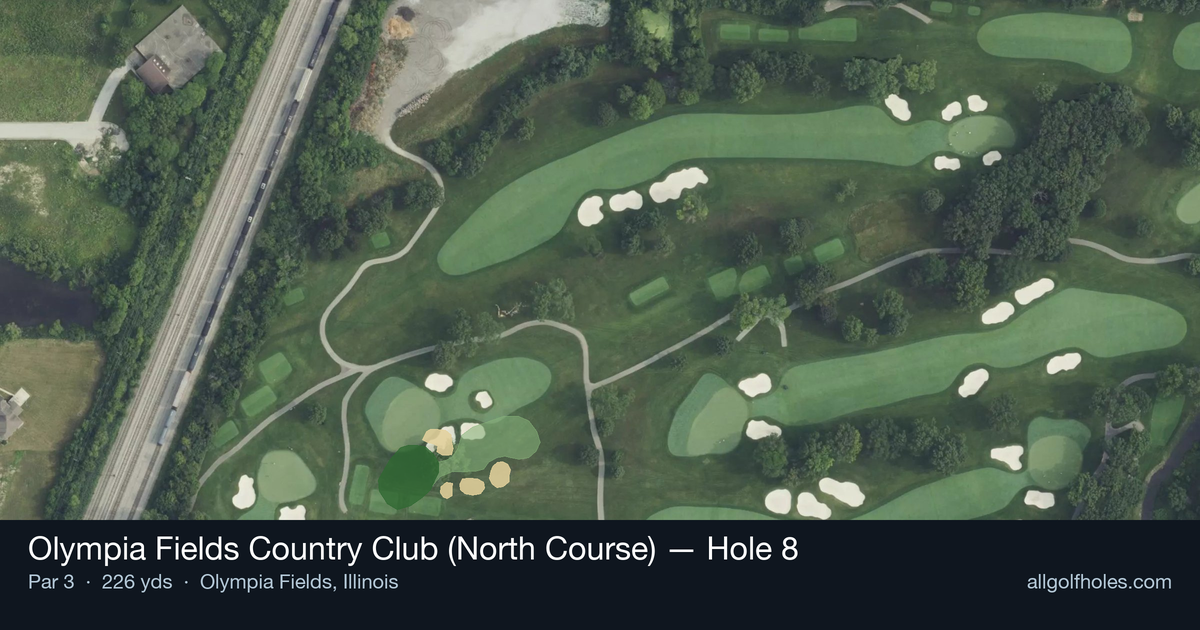
Aerial source not provided
Green size: 36 yds deep × 31 yds wide
Scorecard yardage is for Championship tees. The aerial shows its labeled reference position; distance rings measure to the green.
Championship tees · Par 3 · 226 yards
The plan for No. 8
The eighth hole at Olympia Fields Country Club (North Course) presents a deceptively challenging par 3 that demands precision over power. At 226 yards, this straight-forward test requires golfers to carry their tee shot to a small, well-protected green that offers little margin for error. The absence of major hazards might suggest an easier approach, but the compact target and length create their own intimidation factor. Mid to long irons become crucial club selections depending on wind conditions, while the small green complex rewards accurate distance control above aggressive pin-hunting. This hole epitomizes Olympia Fields' reputation for demanding precision, where par feels like a victory and strategic course management trumps brute force every time.
Off the tee
Club selection is absolutely critical on this lengthy par 3. Most golfers will need anything from a 4-iron to a fairway wood depending on conditions and personal distance capabilities. The key is choosing enough club to comfortably reach the green rather than trying to muscle a shorter iron. Aim for the center of the green regardless of pin position - the small target demands a conservative approach. Pay close attention to wind conditions, as they can significantly impact club selection on a hole of this length. Take one extra club if there's any doubt, as being long is generally preferable to coming up short.
Approach & recovery
Since this is a par 3, your tee shot IS your approach shot. Focus on making solid contact rather than trying to attack specific pin positions on such a small green. The straight layout means you can commit fully to your target line without worrying about doglegs or hidden trouble. Maintain good tempo and balance throughout your swing - the length requirement can tempt golfers to swing too hard, leading to poor contact and missed greens.
On the green
With a small green, any putt you face should be relatively manageable in terms of distance. Focus on reading the subtle breaks carefully, as shorter putts can be deceptive. The compact putting surface means precision is rewarded - take time to study your line and commit to your read. Two-putting should always be the goal, as three-putts on a small green are particularly costly to your scorecard. ## RISK VS REWARD The absence of major hazards actually creates a different type of risk/reward scenario. The reward for aggressive play is minimal since there's no significant trouble to carry or avoid. The risk comes from trying to be too precise with pin hunting on such a small target. The smart play is always to aim for the center of the green and accept whatever putt you're left with. This conservative approach maximizes your chances of hitting the green in regulation. ## DIFFERENT SKILL LEVELS **High Handicappers:** Focus entirely on reaching the green rather than worrying about pin position. Take plenty of club and swing smoothly - a long putt on the green beats a perfect wedge from short of the target. Consider the middle of the green your only target and commit fully to that strategy. **Low Handicappers:** While you have the skills to attack pins, the small green size suggests a more measured approach. You can be slightly more aggressive with pin positions in the center portions of the green, but still respect the challenge that length combined with a small target presents. This hole rewards patience and solid execution over heroic shotmaking. The 9th handicap ranking indicates this hole plays more difficult than its position might suggest - treat it with appropriate respect and focus on avoiding the big number that can come from missing such a small target.
Watch for
- Course conditioning and mapped hazards may affect line selection; confirm from the aerial.
Hole 8 Green Complex
Mapped green boundary
Green size: 6,784 sq ft
How did Hole 8 play?
How did this hole play today?
Frequently asked questions
Yardage reference: Championship tees · 226 yards.
What club should I use on this par 3?
↓
At 226 yards, most golfers will need a fairway wood or hybrid to reach this green. Adjust for elevation, wind, and pin position.
How difficult is hole 8?
↓
This hole is a moderate challenge for most golfers. Key challenges include: long par 3.
How big is the green on hole 8?
↓
The green is fairly large with multiple pin positions. Lag putting becomes important on longer putts.
What's a good score on hole 8?
↓
This hole is a challenging par where bogey is acceptable. This longer par 3 will test your long iron or hybrid game. Par is a good score.