Hole 13 at PGA National Resort & Spa (Champion)
- Par
- 4
- Yardage
- 388 yds
- Stroke index
- 10
- Hazards
- 6 bunkers · Water
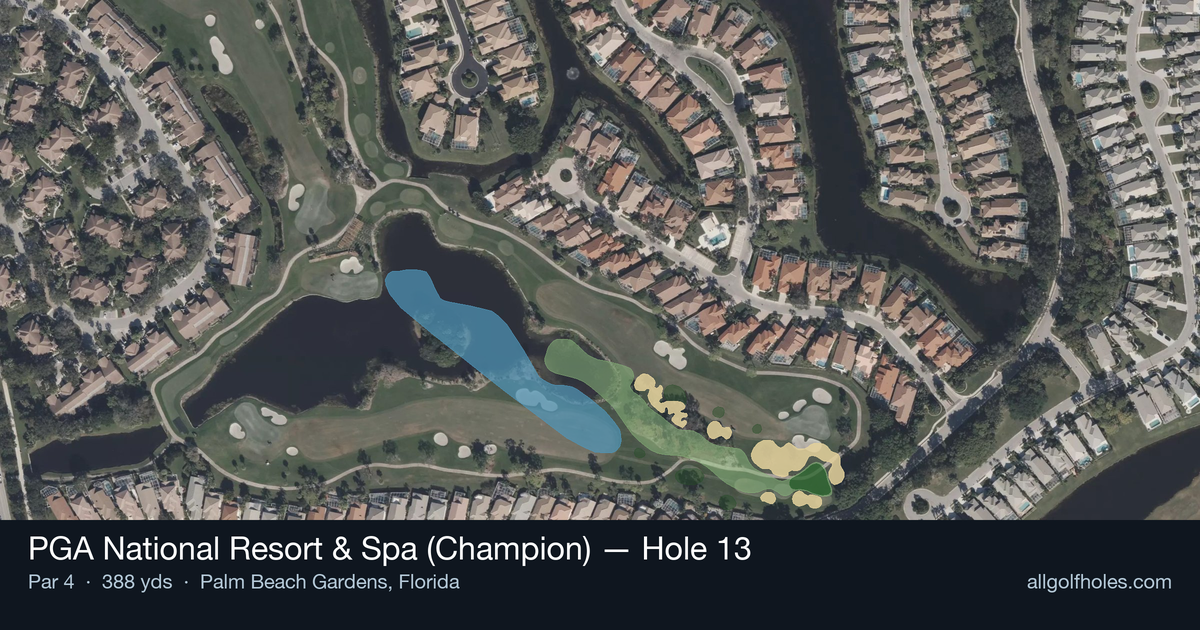
Aerial source not provided
Green size: 33 yds deep × 26 yds wide
Scorecard yardage is for Championship tees. The aerial shows its labeled reference position; distance rings measure to the green.
Championship tees · Par 4 · 388 yards
The plan for No. 13
The 13th hole at PGA National Resort & Spa (Champion) presents a deceptively challenging par 4 that demands precision over power. At 388 yards, this straight-away hole may appear straightforward, but its small green creates the primary strategic challenge. The generous fairway invites an aggressive tee shot, allowing players to position themselves for the crucial approach shot. However, the compact green complex requires pinpoint accuracy with mid-to-short irons, as missing the putting surface leaves difficult recovery shots. Without significant hazards to navigate, success hinges entirely on course management and execution. This hole rewards players who prioritize accuracy over distance, making it a true test of iron play and green-reading skills that exemplifies the strategic design philosophy of this renowned Florida championship venue.
Off the tee
The tee shot strategy centers on finding the optimal approach angle to the small green. With no significant hazards threatening the drive, golfers can be more aggressive with their target line down the center of the fairway. A well-struck driver or 3-wood should leave an ideal approach distance - typically a short to mid-iron for most players. The key is avoiding the temptation to overswing; a controlled swing that finds the fairway center line sets up the entire hole. Consider the pin position when selecting your target, as approach angle becomes critical with such a small green. ## APPROACH The approach shot is where this hole shows its teeth. The small green requires precise distance control and careful club selection. Favor the center of the green regardless of pin position, as short-siding yourself on such a compact target can lead to difficult up-and-downs. Take one extra club and swing smoothly rather than forcing a shorter iron. Pay attention to wind conditions, as they'll have an amplified effect on approach shots to smaller greens. If the pin is tucked, resist the urge to get too aggressive - the middle of the green is always a good miss on holes like this. ## ON THE GREEN The small green size means putting strategy focuses on lag putting and avoiding three-putts rather than aggressive birdie attempts. Read putts carefully, as subtle breaks can be magnified on compact surfaces. Uphill putts are generally safer than downhill, so factor slope into your approach shot planning. When the pin is near an edge, focus on getting your first putt to the safe side of the hole. The key to good scoring here is eliminating big numbers through conservative putting strategy. ## RISK VS REWARD This hole offers a classic risk/reward scenario disguised as a straightforward par 4. The reward is clear - a well-positioned drive and accurate approach can yield birdie opportunities. The risk lies in the small green's unforgiving nature; missed approach shots can lead to difficult chips and potential bogeys. The smart play is to treat this as a two-shot hole where par is always acceptable, with birdie as a bonus for excellent execution.
Approach & recovery
The approach shot is where this hole shows its teeth. The small green requires precise distance control and careful club selection. Favor the center of the green regardless of pin position, as short-siding yourself on such a compact target can lead to difficult up-and-downs. Take one extra club and swing smoothly rather than forcing a shorter iron. Pay attention to wind conditions, as they'll have an amplified effect on approach shots to smaller greens. If the pin is tucked, resist the urge to get too aggressive - the middle of the green is always a good miss on holes like this. ## ON THE GREEN The small green size means putting strategy focuses on lag putting and avoiding three-putts rather than aggressive birdie attempts. Read putts carefully, as subtle breaks can be magnified on compact surfaces. Uphill putts are generally safer than downhill, so factor slope into your approach shot planning. When the pin is near an edge, focus on getting your first putt to the safe side of the hole. The key to good scoring here is eliminating big numbers through conservative putting strategy. ## RISK VS REWARD This hole offers a classic risk/reward scenario disguised as a straightforward par 4. The reward is clear - a well-positioned drive and accurate approach can yield birdie opportunities. The risk lies in the small green's unforgiving nature; missed approach shots can lead to difficult chips and potential bogeys. The smart play is to treat this as a two-shot hole where par is always acceptable, with birdie as a bonus for excellent execution.
On the green
The small green size means putting strategy focuses on lag putting and avoiding three-putts rather than aggressive birdie attempts. Read putts carefully, as subtle breaks can be magnified on compact surfaces. Uphill putts are generally safer than downhill, so factor slope into your approach shot planning. When the pin is near an edge, focus on getting your first putt to the safe side of the hole. The key to good scoring here is eliminating big numbers through conservative putting strategy. ## RISK VS REWARD This hole offers a classic risk/reward scenario disguised as a straightforward par 4. The reward is clear - a well-positioned drive and accurate approach can yield birdie opportunities. The risk lies in the small green's unforgiving nature; missed approach shots can lead to difficult chips and potential bogeys. The smart play is to treat this as a two-shot hole where par is always acceptable, with birdie as a bonus for excellent execution.
Watch for
- Use mapped hazard edges and the hole 13 aerial for the selected tee before committing to a line.
Hole 13 Green Complex
Mapped green boundary
Green size: 3,458 sq ft
Course coverage
Tournament and creator videos about PGA National Resort & Spa (Champion) — shared course coverage, not hole-specific clips.
Tournament coverage
Cognizant Classic highlights
Cognizant Classic | Final Round Highlights
2025
Featured by these creators
Creator videos about this course
YouTube creators who filmed or featured PGA National Resort & Spa (Champion). · Stats as of Oct 12, 2026 · 5d ago
Has the PGA Tour wrecked PGA National? & FBF to Steve Pate's win in Palm Beach | The Shotgun Start
TGL's future & Todd Watch returns at PGA National for Cognizant Classic | The Shotgun Start
PGA National - Hole 5 - 238 yard par 3
How did Hole 13 play?
How did this hole play today?
Frequently asked questions
Yardage reference: Championship tees · 388 yards.
What's the best strategy off the tee?
↓
For this 388-yard par 4, most players will hit driver to set up a comfortable approach.
How difficult is hole 13?
↓
This hole is a moderate challenge for most golfers. Key challenges include: water in play, small green.
What hazards should I watch out for on hole 13?
↓
Key hazards include: water at 121.2 yards. Plan your shots to avoid these trouble spots.
How big is the green on hole 13?
↓
The green is small and requires precision. Expect challenging pin positions with limited room for error.
What's a good score on hole 13?
↓
This hole is a medium-length test where par is a solid result. A straightforward par 4 where course management pays off.