Hole 17 at Whistling Straits
- Par
- 4
- Yardage
- 375 yds
- Stroke index
- 7
- Hazards
- 6 bunkers · Water
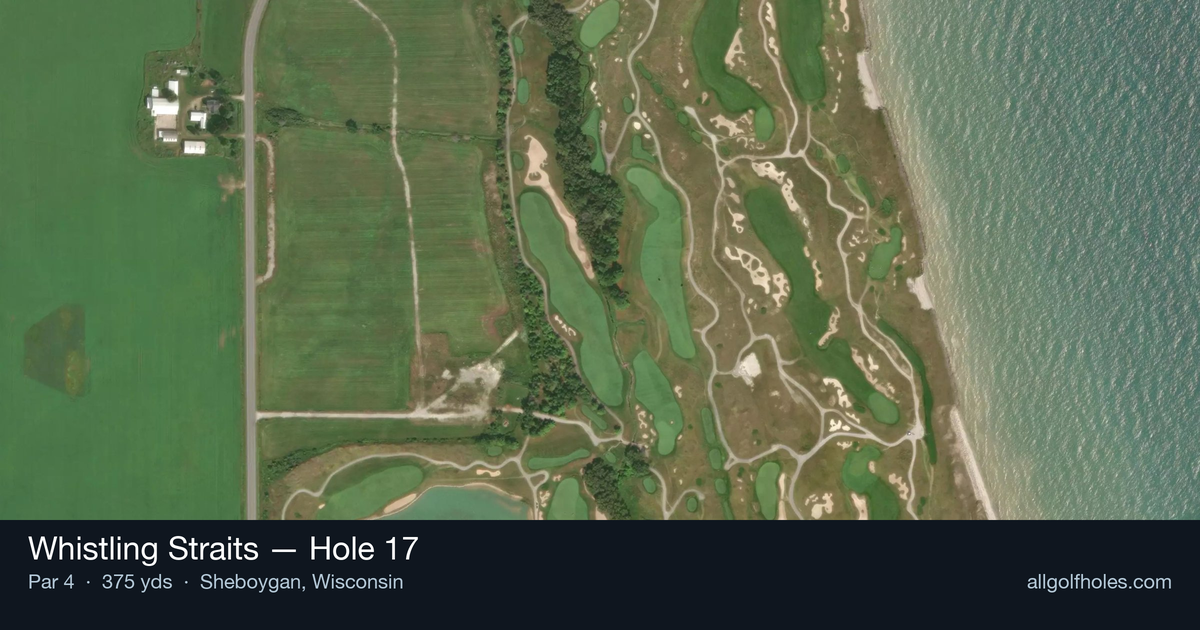
Aerial source not provided
Green size: 27 yds deep × 33 yds wide
Scorecard yardage is for Championship tees. The aerial shows its labeled reference position; distance rings measure to the green.
Championship tees · Par 4 · 375 yards
The plan for No. 17
Known as "Pinched Nerve," the 17th hole at Whistling Straits stands as one of Pete Dye's most diabolical creations, featuring his signature railroad tie bulkheads that frame unforgiving bunkers. This brutal par 3 leaves absolutely no room for error, demanding precision from one of golf's most challenging tee shots.
Off the tee
The tee shot strategy centers on positioning for the optimal approach angle to the small green. From the elevated tee, target the center-left portion of the fairway to avoid the thick fescue that lines both sides. A controlled driver or strong 3-wood works well here, as distance isn't as critical as accuracy. The key is staying in the short grass while leaving yourself a comfortable approach distance. Avoid the temptation to attack the pin from the tee - the real scoring opportunity comes from a well-positioned second shot. Wind direction will heavily influence club selection, so factor in the prevailing conditions off Lake Michigan.
Approach & recovery
The approach shot to this small green demands pinpoint accuracy and proper club selection. With limited green surface to work with, focus on hitting to the center of the putting surface rather than chasing pin positions. The green's compact size means even a well-struck shot can easily run off into trouble if you're too aggressive. A mid-iron to long-iron, depending on your tee shot position and wind conditions, should provide the control needed. Take one extra club and swing smoothly rather than forcing a shorter iron. The key is commiting to your target line and trusting your distance control.
On the green
The small green creates challenging putting scenarios where lag putting becomes crucial. With limited space, even moderate approach shots can leave lengthy putts with significant break. Focus on getting your first putt close rather than being aggressive toward the hole. The green's contours can be subtle but influential, so take time to read the slopes carefully. Two-putting should be your primary goal, as the tight confines make three-putts a real possibility if you're not careful with speed control.
Watch for
- Water along the hole
- Fairway bunker crossing the landing zone
- Greenside bunker (greenside)
Hole 17 Green Complex
Mapped green boundary
Green size: 5,816 sq ft
Course coverage
Tournament and creator videos about Whistling Straits — shared course coverage, not hole-specific clips.
Featured by these creators
Creator videos about this course
YouTube creators who filmed or featured Whistling Straits. · Stats as of Oct 12, 2026 · 6d ago
Our $50,000 BUCKET LIST Golf Trip With LUKE KWON & TOOMS.... (Whistling Straits)
I recreated Jordan Spieth's Whistling Straits shot 👀⛳️
I play one of the BEST Golf Courses in America 🇺🇸 (Whistling Straits)
The Good Good Whistling Straits Major
How did Hole 17 play?
How did this hole play today?
Frequently asked questions
Yardage reference: Championship tees · 375 yards.
What's the best strategy off the tee?
↓
For this 375-yard par 4, most players will hit 3-wood or driver to set up a comfortable approach.
How difficult is hole 17?
↓
This hole is a moderate challenge for most golfers. Key challenges include: water in play, heavily bunkered.
How big is the green on hole 17?
↓
The green is medium-sized with moderate targets. Pay attention to pin placement when selecting your approach club.
What's a good score on hole 17?
↓
This hole is a medium-length test where par is a solid result. A straightforward par 4 where course management pays off.