Hole 2 at Erin Hills Golf Course
- Par
- 4
- Yardage
- 358 yds
- Stroke index
- 13
- Hazards
- 7 bunkers · Water
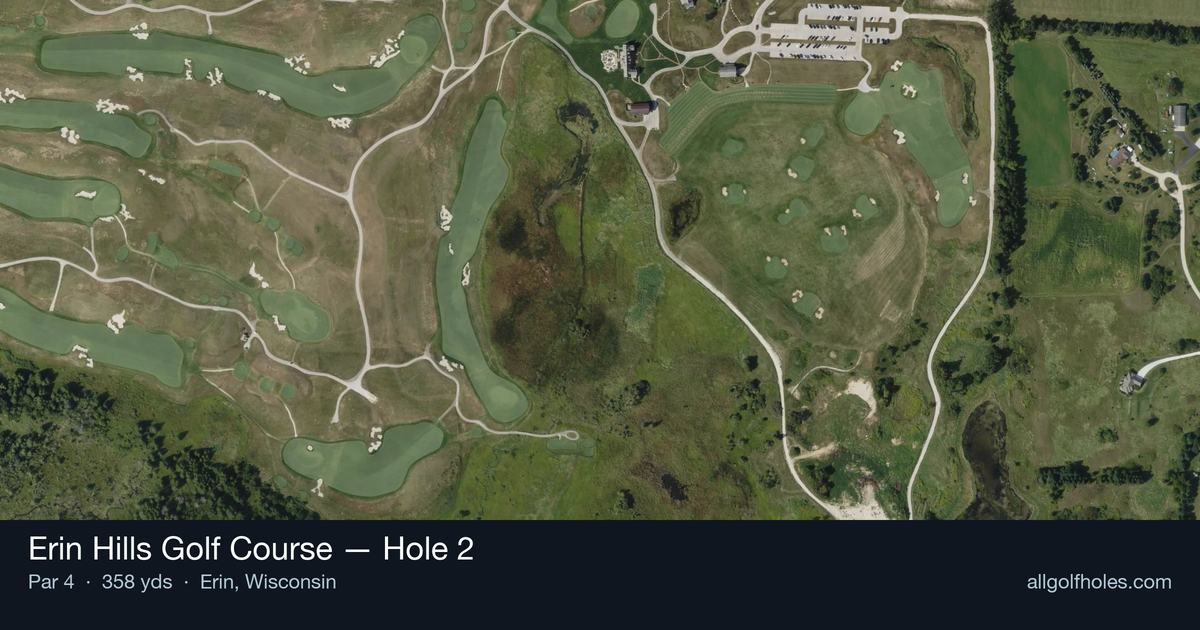
Aerial source not provided
Green size: 32 yds deep × 21 yds wide
Scorecard yardage is for Championship tees. The aerial shows its labeled reference position; distance rings measure to the green.
Championship tees · Par 4 · 358 yards
The plan for No. 2
The second hole at Erin Hills Golf Course presents a deceptively strategic par 4 that embodies the championship pedigree of this renowned Wisconsin links. At 358 yards, this straight hole appears straightforward from the tee, but the elevated green complex demands precision and course management. The fairway offers a generous landing area for the tee shot, allowing players to focus on positioning for the critical approach. What makes this hole memorable is the dramatically elevated green that favors a high, soft approach shot, with natural backstops providing both challenge and forgiveness. The small green requires accurate iron play, rewarding those who can control trajectory and spin. This early test sets the tone for Erin Hills' demanding yet fair examination of golf skills.
Off the tee
The key to success starts with an intelligent tee shot that prioritizes position over distance. With the hole's straight layout, focus on finding the center of the fairway rather than trying to bomb it close to the green. A controlled drive with a fairway wood or hybrid can often be the smarter play, leaving a comfortable approach distance while ensuring you stay in the short grass. The target line should favor the center-left portion of the fairway, giving you the best angle into the elevated green. Avoid the temptation to get too aggressive off the tee - this hole rewards precision and sets up better when you're hitting your approach from an optimal position in the fairway.
Approach & recovery
The approach shot is where this hole shows its teeth. With the green sitting well above the fairway level, you'll need to account for the elevation change and plan for a high-trajectory shot. The small green size demands accuracy, making club selection critical. Take one or two clubs more than the yardage would normally suggest to account for the elevation. A high-arcing mid-iron to short-iron approach gives you the best chance to hold the putting surface. The elevated nature of the green means shots that come in too low will likely roll off the back or sides. Position your approach to the center of the green whenever possible, as the small target area leaves little room for error. The backstop behind the green can help with slightly long shots, but don't rely on it as your primary strategy.
On the green
The small, elevated green typically features subtle breaks that can be tricky to read. Pay close attention to the overall slope of the green during your approach, as this will influence most putts. The elevation change from fairway to green often creates optical illusions that can affect distance control. Focus on lag putting to the center of the green when facing longer putts, as the small surface area makes three-putts a real threat. Pin positions on the edges of this green can be particularly challenging, so don't be afraid to aim for the fat part of the green regardless of flag location. ## RISK VS REWARD This hole offers a subtle risk/reward proposition. The shorter length might tempt players to get aggressive off the tee, but the elevated green actually rewards a more conservative approach. The real reward comes from precise positioning rather than bold shot-making. Players who try to drive it too close to the green often find themselves with awkward approach angles or in trouble. The safer play of positioning your drive in the ideal landing zone sets up a more manageable approach to the elevated target. ## DIFFERENT SKILL LEVELS **High-handicap players** should focus on keeping the ball in play off the tee and not trying to overpower the hole. Use a club you're confident with from the tee, even if it's a hybrid or fairway wood. On the approach, take plenty of club to account for the elevation and aim for the center of the green. **Low-handicap players** can be more aggressive with their target lines and pin hunting, but should still respect the elevated green's demands. Consider the wind conditions more carefully, as the elevated green can be significantly affected by breezes. These players can also use the hole's shorter length as a scoring opportunity by being precise with their approach shots. The key for all skill levels is recognizing that this hole rewards smart course management over aggressive play. Position yourself well off the tee, respect the elevation on your approach, and you'll find yourself with excellent birdie opportunities on this strategic par 4.
Watch for
- Sand_1 — Greenside center
- Sand_2 — Crossing center
- Sand_3 — Crossing center
- Sand_4 — Crossing center
- Sand_5 — Greenside center
- Sand_6 — Greenside center
- Sand_7 — Greenside center
- Water — Crossing behind_tee
Hole 2 Green Complex
Mapped green boundary
Green size: 4,318 sq ft
Course coverage
Tournament and creator videos about Erin Hills Golf Course — shared course coverage, not hole-specific clips.
Featured by these creators
Creator videos about this course
YouTube creators who filmed or featured Erin Hills Golf Course. · Stats as of Oct 12, 2026 · 6d ago
The Major Cut @ Erin Hills
Can We Make Cut @ Erin Hills?! (Major Cut Ep. 5)
The back nine at Erin Hills with Riggs. Presented by @EveryManJack
World #2 Jeeno Thitikul at the U.S. Women's Open at Erin Hills 🍀
Scottie Scheffler's peak, Erin Hills pops back, & Sponsor Exemption windfalls | The Shotgun Start
How did Hole 2 play?
How did this hole play today?
Frequently asked questions
Yardage reference: Championship tees · 358 yards.
What's the best strategy off the tee?
↓
For this 358-yard par 4, most players will hit 3-wood or driver to set up a comfortable approach.
How difficult is hole 2?
↓
This hole is one of the tougher holes on the course for most golfers. Key challenges include: water in play, heavily bunkered, small green.
How big is the green on hole 2?
↓
The green is small and requires precision. The green is wider than it is deep, rewarding shots that find the correct tier. Expect challenging pin positions with limited room for error.
What's a good score on hole 2?
↓
This hole is a medium-length test where par is a solid result. A straightforward par 4 where course management pays off.