Hole 16 at Erin Hills Golf Course
- Par
- 3
- Yardage
- 200 yds
- Stroke index
- 16
- Hazards
- 10 bunkers
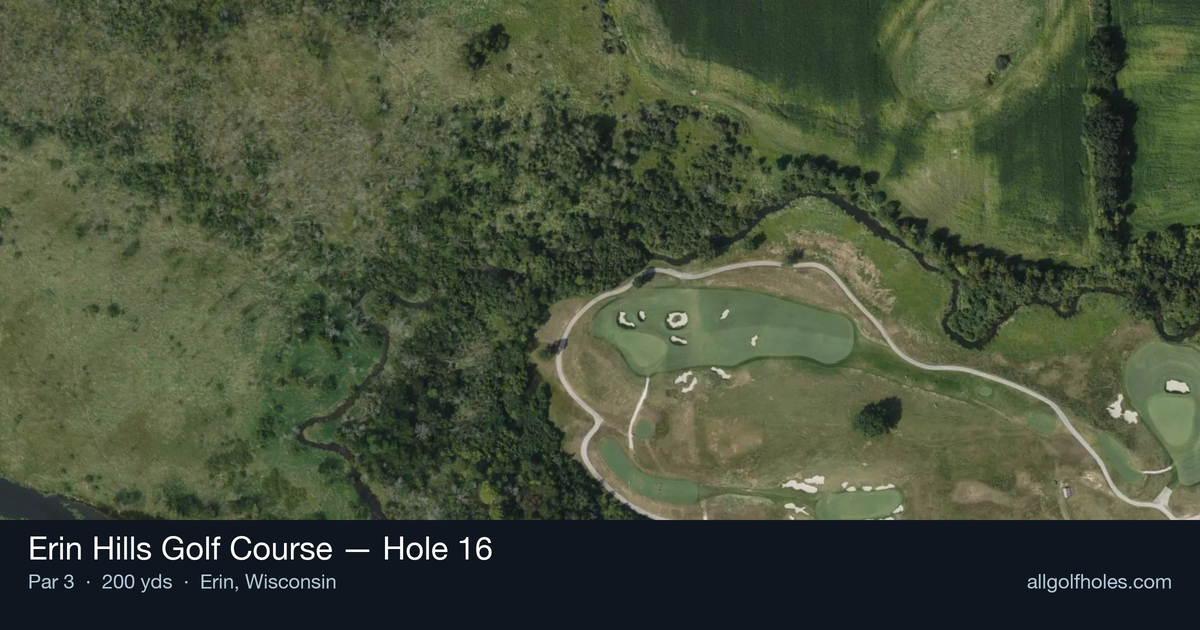
Aerial source not provided
Green size: 38 yds deep × 22 yds wide
Scorecard yardage is for Championship tees. The aerial shows its labeled reference position; distance rings measure to the green.
Championship tees · Par 3 · 200 yards
The plan for No. 16
The 16th hole at Erin Hills Golf Course presents a deceptively challenging par 3 that epitomizes the course's strategic design philosophy. At 200 yards, this tee shot demands precision to an elevated green complex that favors a high, soft approach shot. The hole's unique character emerges from conflicting geometry - while the hole bends subtly right to left, the natural ground slope runs left to right, creating an optical illusion that can confound club selection and aim. The elevated green sits prominently against the Wisconsin landscape, requiring golfers to account for both distance and trajectory to hold the putting surface. With a natural backstop behind the green providing some forgiveness, this par 3 rewards aggressive play while punishing anything short or offline, making it a memorable test late in the round.
Off the tee
Club selection is paramount on this elevated par-3, with most players needing one to two clubs more than the yardage suggests due to the uphill nature of the shot. The elevated green strongly favors a high ball flight, making this an ideal hole for hitting a smooth swing with a longer iron rather than forcing a shorter club. Target the center of the green regardless of pin position, as the small green size makes precision more important than aggressive pin-seeking. Wind conditions can play havoc with ball flight on this exposed hole, so factor in any breeze when making your club selection.
Approach & recovery
Since this is a par-3, your tee shot is your approach shot. The key insight here is understanding how the ground slopes affect your ball's behavior - while the hole bends right to left, the ground slopes left to right, creating a natural counter-balance that can work in your favor. Aim slightly right of your intended target to account for the ground slope, allowing the terrain to funnel your ball toward the pin. The elevated nature of the green means shots that come up short will likely roll back significantly, making it better to err on the long side than come up short.
On the green
The small green size means putting becomes a premium skill on this hole. The elevated nature creates subtle breaks that can be deceiving from ground level. Pay close attention to the overall slope of the green during your approach, as putts will generally break with the natural left-to-right ground slope. The backstop behind the green provides some safety for aggressive approaches, but don't rely on it - focus on landing your ball on the putting surface with the proper trajectory. ## RISK VS REWARD This hole offers a classic risk/reward scenario in club selection. The conservative play is taking an extra club and swinging smoothly to ensure you reach the elevated green, accepting a longer putt for a guaranteed par opportunity. The aggressive approach involves taking less club and hitting it harder to get closer to the pin, but this increases the risk of coming up short and facing a difficult recovery shot from below the green. ## DIFFERENT SKILL LEVELS **High-Handicap Players:** Focus entirely on reaching the green with your tee shot. Take an extra club and make a smooth, controlled swing aimed at the center of the green. Don't worry about pin position - getting on the putting surface is your primary goal. The elevated green will reject short shots, so err on the side of taking too much club rather than too little. **Low-Handicap Players:** You can be more aggressive with pin position while still respecting the hole's challenges. Use the right-to-left ground slope to your advantage by playing for a slight draw that works with the terrain. Consider the wind carefully and don't be afraid to take one more club for a smooth swing rather than forcing a shorter iron. Your superior ball-striking ability allows you to attack pins, but the small green still demands respect. The 16th at Erin Hills rewards golfers who can read the terrain and make smart decisions under pressure, making it a true test of course management skills in the championship stretch.
Watch for
- Sand_1 — Greenside center
- Sand_10 — Greenside center
- Sand_2 — Greenside center
- Sand_3 — Crossing center
- Sand_4 — Crossing center
- Sand_5 — Greenside center
- Sand_6 — Greenside center
- Sand_7 — Greenside center
Hole 16 Green Complex
Mapped green boundary
Green size: 4,443 sq ft
Course coverage
Tournament and creator videos about Erin Hills Golf Course — shared course coverage, not hole-specific clips.
Featured by these creators
Creator videos about this course
YouTube creators who filmed or featured Erin Hills Golf Course. · Stats as of Oct 12, 2026 · 6d ago
The Major Cut @ Erin Hills
Can We Make Cut @ Erin Hills?! (Major Cut Ep. 5)
The back nine at Erin Hills with Riggs. Presented by @EveryManJack
World #2 Jeeno Thitikul at the U.S. Women's Open at Erin Hills 🍀
Scottie Scheffler's peak, Erin Hills pops back, & Sponsor Exemption windfalls | The Shotgun Start
How did Hole 16 play?
How did this hole play today?
Frequently asked questions
Yardage reference: Championship tees · 200 yards.
What club should I use on this par 3?
↓
At 200 yards, most golfers will need a long iron or hybrid (5-iron to 6-iron) to reach this green. Adjust for elevation, wind, and pin position.
How difficult is hole 16?
↓
This hole is a moderate challenge for most golfers. Key challenges include: heavily bunkered, small green.
How big is the green on hole 16?
↓
The green is small and requires precision. The green is wider than it is deep, rewarding shots that find the correct tier. Expect challenging pin positions with limited room for error.